
Google Search Results Vs. Donald Trump’s Reputation
How Donald Trump's mastery of controversy and publicity ultimately collided with Google's reflection of what millions of people actually want to find.

Donald Trump's negative Google search results are not the product of bias or rigging — they reflect what millions of people are actively searching for. Google surfaces content based on relevance and mass demand, not individual preference. Trump's own publicity tactics, built on emotional provocation and controversy, helped create the very reputation crisis he complains about. This article examines how those tactics work, why they backfired at scale, and what it means for anyone managing an online reputation.
Ex-President Trump thinks Google is rigged against him. It’s probably not, but that doesn’t stop the scrutiny. Google’s portrayal of Trump is a reflection of people’s desires – all the people, not a group or an individual. A pandemic, economic disaster, insurrection at the Capitol, and Black Lives Matter marches don’t help.
While Donald Trump had mastered the art of publicity prior to becoming President, it’s a genie let out of its bottle. Once escaped, it can have unforeseen consequences like those we are seeing today. His carefully cultivated reputation clearly got out of hand when other people were added to the mix.
For example, President Trump once wrote that “Google search results for ‘Trump News’ shows only the viewing/reporting of Fake News Media. In other words, they have it RIGGED…” But it isn’t really rigged when tens of millions of people Google his name to find out what has been done in his name. So much of it was negative that one of the most human of emotions – negativity bias – crushed any carefully cultivated online persona that may have been left.
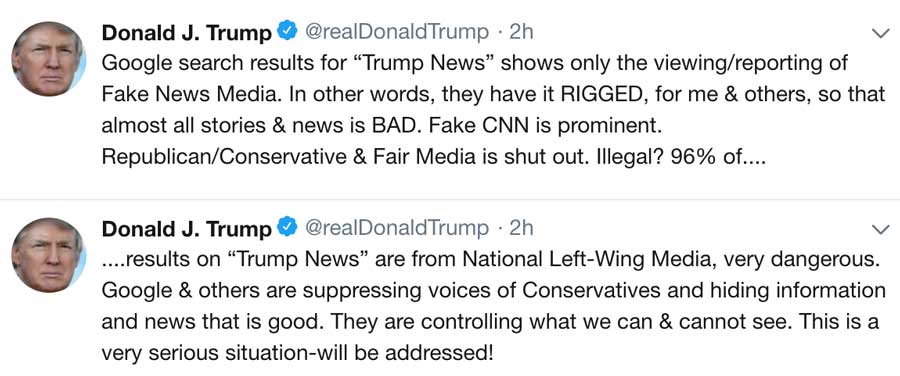
Are Google results rigged? The answer is no. Google simply reflects what it believes people want – they call it relevance. Google does not discern well between truth or lies (see “knowledge-based trust“), but it does a very good job of returning results the masses want – just not necessarily what any individual wants.
In his 1987 book “The Art of the Deal”, ghost writer Tony Schwartz wrote that “good publicity is preferable to bad, but from a bottom-line perspective, bad publicity is sometimes better than no publicity at all. Controversy, in short, sells.” Trump is getting some pretty bad publicity these days, but Google is only the messenger.
In this article, we’ll take a closer look at Donald Trump’s approach to marketing and publicity, how it has affected his reputation, and the ultimate result of his choices.
Emotions Drive Search Results
Psychology studies show that emotions are a critical factor in how we make decisions and even purchases. Pushing emotional hot buttons can cause content to get shared and even go viral.
Trump is a master at tapping into emotions to spur controversy and generate publicity. People view and share things that make them angry or generate other strong emotions. Google reflects this.
For example, when Holly Holm beat Ronda Rousey in the UFC championship fight, Trump posted on X (formerly Twitter) that he was glad to see her lose and that Rousey was “not a nice person”. By commenting on trending news, the post received over 12,000 retweets and over 2,000 comments. Trump was banned from the platform in January 2021 following the Capitol riots, reinstated by Elon Musk in November 2022, and has since primarily used his own platform, Truth Social.
Get a Free Reputation Assessment
Find out what people see when they search for you online. No obligation — results in 24 hours.
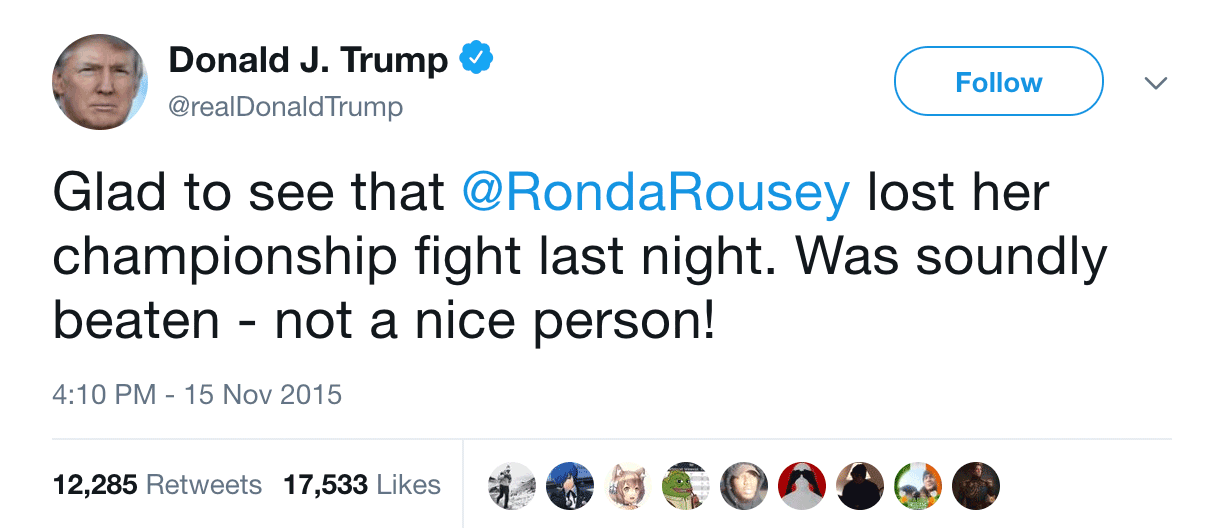
Rousey also built her personal brand on a strong personality. Trump’s comments offended diehard Rousey supporters but drew support from people who didn’t like her.
Note that this post had nothing to do with the 2016 election – it was simply an opportunity to tap into people’s emotions and generate publicity. Google reflects what people appear to want, and those desires are often fueled by emotion. This is a key reason why search results can appear so different depending on who is searching and where.
Trump has repeatedly tapped into similar opportunities by insulting and criticizing celebrities, famous personalities, and organizations that opposed him. Whether or not you like him, he knows how to get the media to do his bidding.
Purple Cows Get More Attention

President Trump is a huge purple cow. In a field of white cows, the purple one stands out. “Purple Cow” is the name of a book by Seth Godin arguing that the only way to gain attention in a market is to be remarkable. Trump has done exactly that. Among a field of white cows, he stands out because he is purple.
Before the 2016 presidential election, Trump had built a reputation as a successful billionaire business owner and real estate developer. Constant mainstream media exposure, books, and his role as host of “The Apprentice” grew his name recognition for years.
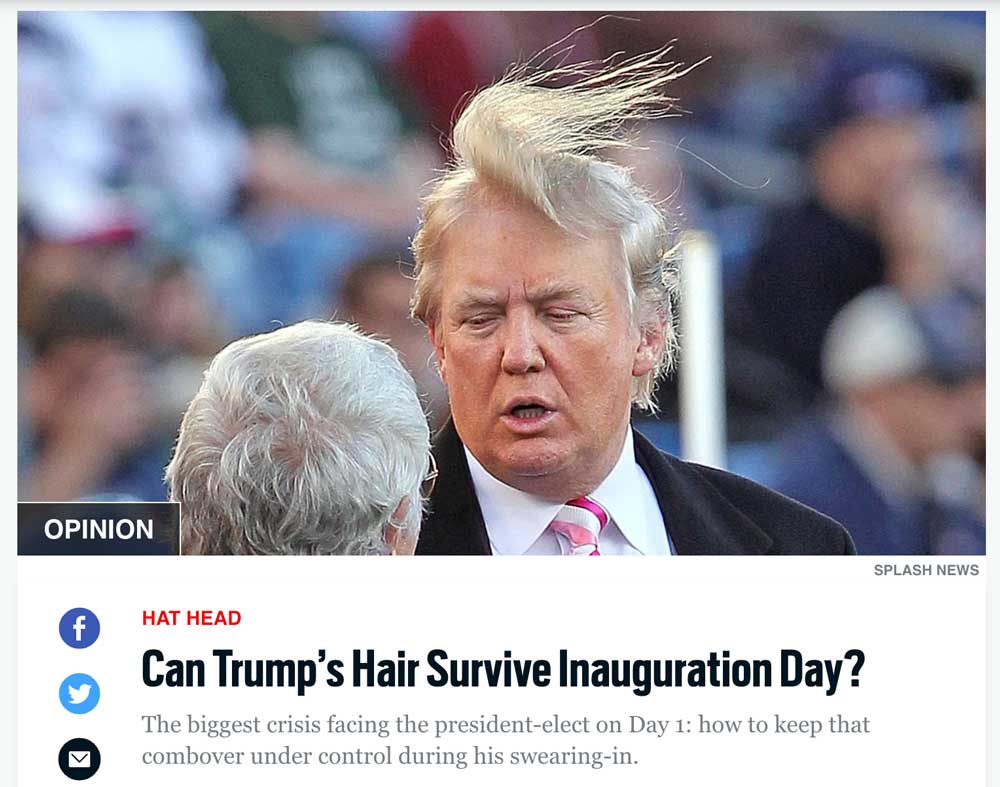
His distinctive appearance – including his well-known hair – has proven remarkably effective at keeping him visually recognizable in a crowded political landscape.
While sharing his political views caused many people to view him unfavorably, Trump’s reputation and fame from previous years undoubtedly helped him secure the presidential nomination and win the 2016 election. After losing the 2020 election to Joe Biden, Trump ran again in 2024, defeated Kamala Harris, and returned to the White House in January 2025 for a second term.
Is Your Online Reputation Working For You?
Whether you're a public figure, executive, or brand, your search results tell a story. Let's make sure it's the right one.
Historically, Most High-Volume Trump Content Is Negative
President Trump’s approach worked well to get him elected – twice. But his methodology has remained largely unchanged throughout. His method has resulted in so many negative articles being written about him that his reputation in search results has remained persistently complicated, even as his political fortunes have rebounded.
Google looks for overall trends in reputation and applies historic data to new search results. It isn’t as if Google wakes up with no memory every morning – it uses mountains of existing data to influence today’s results.
There was so much coverage of accusations of a rigged election, the Capitol riots, multiple criminal indictments, and two impeachments that Trump’s search results carry a heavy historical footprint – even as his 2024 election victory added a significant new chapter to that story.
Google and X Are Double-Edged Swords
A large following on X (formerly Twitter) can be an enormous content amplifier. Trump built much of his social media brand on that platform before being banned in January 2021 and later reinstated in November 2022. He now primarily uses Truth Social to voice his opinions and generate ongoing controversy. Controversy drives search results in Google and Bing. It’s not that things are rigged – they’re just dramatic.
The people of a divided United States are venting on social media and in search results – the results are often ugly and rarely controllable.
Trump has developed a reputation for lashing out against well-known politicians and celebrities who don’t support him. His negative energy bounces back. Most politicians are careful about personally attacking others because they want as many people as possible to like them.
Trump isn’t afraid to offend people supporting his opponents. In his view, many of those people will never be his supporters anyway – and insulting opponents on social media generates controversy that disseminates his name and galvanizes his base.
Here’s a list of Trump posts directed at his opponents and critics during his 2016 election campaign.
Trump didn’t seem concerned about maintaining a “presidential” image. As a result, his posts get lots of reactions and media coverage – promoted by both sides of the political spectrum. According to Gallup’s most recent data (2024), approximately 36% of Americans identify as conservative, 35% as moderate, and 25% as liberal. The rest are in the middle or lean liberal. Google tends to reflect the majority opinion. That’s why search results often appear more centrist or liberal.
Is Negative Publicity Trump’s Most Powerful Tool?
According to Gallup, Trump left office in January 2021 with a 34% approval rating – among the lowest recorded for a departing president at the end of his first term. The average approval rating for presidents is typically around 58% during their first year in office. Yet despite those numbers, he remained deeply popular with his base, won the Republican nomination again in 2024, and won the presidency a second time.
Negative publicity keeps his name in the headlines and on social media, which increases public familiarity with his personal brand. Stephen Colbert stopped using his name on his show, instead displaying “T***p” – a practice known as “Voldemorting” (he who shall not be named).
A study conducted by Jonah Berger and associates at Stanford University showed that negative publicity can deliver positive results if a person or company is relatively unknown.
The song “Friday” by Rebecca Black is a clear example. Critics dubbed it one of the worst songs ever created, yet it accumulated over 160 million views on YouTube. Black has since grown her audience considerably, released better-performing songs, and reportedly has a net worth of around $1.5 million.
But Trump was already famous before running for president. Did negative publicity and controversy actually help him?
To understand why Trump got elected despite the negative publicity, we need to understand what most voters really care about. Gallup’s ongoing “Most Important Problem” polling consistently shows that voters prioritize the economy, government leadership, immigration, and the budget deficit. As of 2024–2025, inflation has emerged as a particularly prominent concern – but financial security remains the dominant factor on voters’ minds heading into any election.
People also wanted change. The average middle-class citizen was disappointed by rising health care costs and wanted someone who would work for the people rather than for corporations funding their campaigns.
Trump’s posts and negative news coverage led many to view him as unsympathetic or even childish. Some people see Trump as sexist due to comments he made about certain women. Others view him as racist or indifferent based on his comments regarding illegal immigrants.
However, the people who voted for him were far more concerned about his ideas for improving the economy and changing a system they see as rigged against them. They were willing to overlook his personality to vote for someone who might deliver meaningful change. An article by Michael Gerson in The Atlantic – written in April 2018 and now a useful historical reference – describes the phenomenon well.
One Trump supporter at Reputation X described him in the same terms as the biblical figure Samson. Samson was a hero to many, but he had significant flaws. The supporter stated that while “Trump is nothing like Jesus, he doesn’t need to be” – instead, he is their “savior” for today’s times.
People Are Drawn to Negative News
Negative news often gets more reaction than positive news. That’s why the evening news tends to feature local crime, natural disasters, and other negative occurrences. This may be due to an aspect of human psychology called “negativity bias“. Understanding this dynamic is also central to turning negative publicity into a PR opportunity – something few public figures have done as consistently as Trump.
In short, negative publicity kept people aware of Trump’s name and allowed him to spread his message. His campaign slogan was “Make America Great Again” and his core message focused on improving the economy and helping Americans find jobs to support their families. While most people voted for Hillary Clinton in the popular vote in 2016, enough people in the right places embraced his message to give him the Electoral College votes he needed to win – an outcome that had occurred only five times in U.S. history up to that point (1824, 1876, 1888, 2000, and 2016). In 2024, Trump won both the Electoral College and the popular vote outright.
To Sum It Up
Maintaining a positive and squeaky-clean reputation is important to most people, but Donald Trump seems to thrive on controversy – he just doesn’t like it when the winds don’t blow his way. His approach has proven remarkably resilient, keeping him in the spotlight through two impeachments, multiple criminal indictments, a lost election, and a historic political comeback. He beat Hillary Clinton in 2016, lost to Joe Biden in 2020, and then defeated Kamala Harris in 2024 to return to the White House for a second term.
So is negative publicity really a “negative”? In Trump’s case, the evidence suggests it never was. Whether that formula continues to serve him through a second term remains one of the more fascinating questions in modern political reputation management. For most individuals and brands, however, the safer path is a proactive one – understanding how proactive reputation management differs from reactive damage control before a crisis forces your hand.
Frequently Asked Questions








Protect Your Online Reputation
Every day you wait, negative content gets stronger. Talk to our experts about a custom strategy for your situation.
Get Your Free Analysis