
How to Structure an Executive Biography Page That Ranks Well In Google
A well-structured executive biography page can dominate Google search results and shape how decision-makers find and perceive your leadership team.

- Give each executive their own dedicated page with their name in the URL
- Use a single H1 tag containing the executive's full name as the page headline
- Name the headshot image file after the executive and keep it under 120KB
- Write a biography of at least 500 words that includes the executive's full name
- Add Person schema with SameAs links to LinkedIn, Twitter, and Crunchbase profiles
This guide explains how to build an executive biography page that ranks well in Google search results. Key elements include a dedicated URL containing the executive's name, a properly tagged H1 headline, a headshot with a named file, and a biography of at least 200 words. Adding outbound links to the executive's profiles and implementing Person schema further strengthens search visibility and can help populate a Google Knowledge Panel.
How to Structure an Executive Biography Page That Ranks Well in Google
-
1
Create a stand-alone biography page
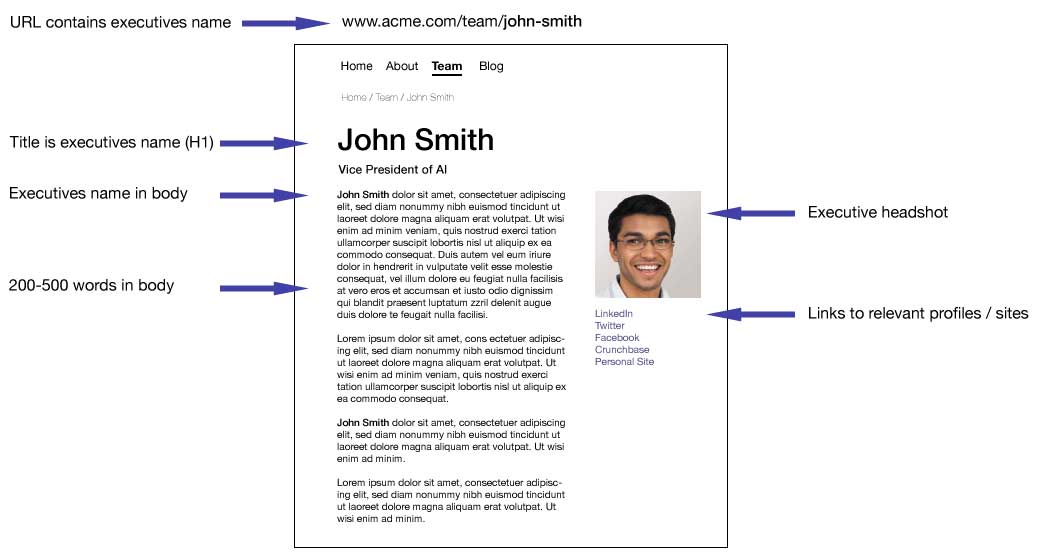
The executive biography should have its own dedicated page rather than being grouped with other executives. You can maintain a team overview page with short snippets, but each executive's name should link to their individual full biography page. For example, a team page at www.acme.com/team/ can list executives, while each full bio lives at a URL like www.acme.com/team/john-smith.
-
2
Include the executive's name in the URL
The URL of the biography page should contain the executive's full name to help search engines understand who the page is about. A format such as www.acme.com/john-smith or www.acme.com/team/john-smith works well. This simple structural choice improves relevance signals for name-based searches.
-
3
Optimize the headshot image
Include a professional headshot on the biography page and name the image file after the executive, such as john-smith.jpg. This helps search engines identify the image and potentially surface it in search results. Keep the file size under 120KB, as larger images load more slowly and can negatively affect search performance.
-
4
Write a sufficiently detailed biography
The biography text should be at least 200 words, with 500 words being the preferred target. Include the executive's full name at least once or twice within the body of the text to reinforce relevance for name-based queries.
-
5
Add outbound links to relevant profiles
Link out from the biography page to the executive's personal profiles, such as LinkedIn, Crunchbase, or a personal website. These links can appear within the body copy, in a sidebar, or below the biography text. Make sure the profiles are specific to the individual executive, not the company's general social accounts.
-
6
Set the executive's name as the H1 headline
Place the executive's name in the page's primary headline using an H1 HTML tag, for example <H1>John Smith</H1>. There should be only one H1 tag per page. Additional subheadings using H2, H3, and other tags can be used throughout the page but should appear below the H1.
-
7
Add Person schema markup to the page
Implement Person schema on the executive's biography page or personal website to help Google understand who the page represents. Within the schema, use the SameAs property to reference the executive's LinkedIn, Twitter, Crunchbase, and other social profiles. This structured data can help populate or enhance the executive's Knowledge Panel in Google search results.
This brief guide illustrates how to develop an executive biography page on a corporate website that ranks well in search engines.
Get a Free Reputation Assessment
Find out what people see when they search for you online. No obligation — results in 24 hours.
Stand-alone page
The executive biography should have its own page, not be grouped with other executives on the same page. For example, you can have a “team” page that might be located at www.acme.com/team/ where snippets about each executive are placed, but the executive’s name should link to a stand-alone page with a full biography. That page might be located at www.acme.com/team/john-smith, where john-smith is the full name of the executive.
URL structure
The URL of the executive biography page should have the name of the executive in it. For example, www.acme.com/john-smith or www.acme.com/team/john-smith .
Headshot image
Ideally, a biography page should include a headshot of the executive. The filename for the headshot image should contain the name of the executive. For example, it might be named “john-smith.jpg”, or similar. This helps search engines identify the image and possibly include it in search results.
The file size of the headshot image should be less than 120k in size. Large files load slower and can negatively affect search performance.
Biography
The biography should be at least 200 words, but 500 words is preferable. The biography should include the full name of the executive at least once or twice.
Outbound links
The executive biography page should have outgoing links to relevant profiles. This may include the LinkedIn profile of the executive, a Crunchbase profile, or a personal website, among others. The links can be included in the body copy of the biography, in a sidebar, or under the body copy. Remember, these are not the company’s LinkedIn or other profiles; they should be specific to the executive.
Title / H1
The name of the executive should be in the headline. In HTML terms, this means that the HTML tag for the headline should be an H1 tag. There should only be one H1 tag per page. Other tags, like H2, H3, etc., can be used as often as necessary, but they should be placed below the title with the H1 tag. Example: <H1>John Smith</H1> .
Schema: Person
Add “Person” schema to the home page of the executives’ website. Within the schema, use “SameAs” to include links to the executives’ LinkedIn profiles, Twitter, Crunchbase, and other social profiles. This helps Google understand that those sites are associated with the executive. It can also help fill out the Knowledge Panel of the executive in Google search results.
This is an example of Person Schema:https://jsonld.com/person/
About the author
Kent Campbell is the chief strategist for Reputation X, an award-winning online reputation management agency. He has over 15 years of experience with SEO, Wikipedia editing, review management, and online reputation strategy. Kent has helped celebrities, leaders, executives, and marketing professionals improve the way they are seen online. Kent writes about reputation, SEO, Wikipedia, and PR-related topics, and is an expert witness for reputation-related legal matters.
–
Frequently Asked Questions







Protect Your Online Reputation
Every day you wait, negative content gets stronger. Talk to our experts about a custom strategy for your situation.
Get Your Free Analysis