
Strategies for Managing Board-Level Reputation
When your board makes headlines for the wrong reasons, these practical governance strategies keep stakeholder trust intact before and after the storm.


- Embed ethical governance into daily operations—audits and codes of conduct prevent crises before they start.
- Communicate proactively with stakeholders; silence invites misinformation and erodes trust.
- Diverse boards make better decisions—different perspectives lead to stronger, more informed outcomes.
- How your board responds to a crisis matters more than the crisis itself—prioritize accountability and authenticity.
- Align your board's tone and decisions with your company's broader values to avoid costly credibility gaps.
Board-level reputation has become a public-facing asset that directly affects investor confidence, employee morale, and brand credibility. This article outlines practical governance strategies—from ethical practices and proactive communication to crisis response and board diversity—that help leadership teams build and protect their standing. Strong board reputation is built through consistent daily habits, not just crisis management.
We’ve all been there—your board just made a big decision. Maybe it’s appointing a new CEO or announcing a major business shift. Suddenly, investors are second-guessing the details, your employees are debating it over Slack, and the media is dissecting every line in the announcement. The conversation rapidly moves beyond what your board decided to how your board operates—its integrity, transparency, and leadership.
Board-level reputation has moved beyond internal chatter to become front-page news. Any misstep can quickly cascade into a full-blown reputational hit, impacting how your company is viewed externally. While we often think about corporate reputation as a holistic concept, people notice the actions—and missteps—of specific leadership teams more than ever. Keeping your board’s credibility strong isn’t just good practice; it’s mission-critical.

This article covers practical, workable strategies that keep your board viewed as trustworthy, transparent, and capable—drawn from real-world governance challenges. Before diving into the how, here’s a quick summary of why it matters.
Key Takeaways
- Board credibility shapes how your company is perceived: Your board’s decisions ripple outward, affecting everything from investor confidence to employee morale. When stakeholders trust your board’s intentions and clarity, you create stable relationships that survive the bumps down the road.
- Ethical governance as prevention, not damage control: Robust governance practices—regular audits, clear codes of conduct, ethical transparency—are the preventative medicine for reputation damage. Trust-building isn’t something you deploy only in a crisis; solid governance means fewer crises altogether.
- Clear and proactive communication isn’t optional: Stakeholders shouldn’t have to read tea leaves—they expect clarity and transparency, especially during uncertainty. Good communication can’t solve all issues, but it goes a long way toward defusing misinformation and concerns.
- Board diversity brings genuine value: Diverse boards aren’t just socially responsible; they genuinely make better, more informed decisions. Different backgrounds and perspectives around the table lead to healthier discussions and stronger outcomes.
- How you respond to a crisis matters more than the crisis itself: People will forgive mistakes. They won’t forgive half-hearted apologies or a lack of accountability. Have a clear response plan and commit to authenticity when trouble comes knocking.
- Your board’s reputation is part of your broader brand: Your board isn’t an island. Their tone, decisions, and transparency need to align with the values your wider company communicates daily. Otherwise, the mismatch creates confusion and can cost your brand credibility.
- The goalposts for reputation management are always moving: Emerging trends like digital accountability and ESG expectations mean successful boards have to adapt continuously. Your policies and responses have to evolve, just like your stakeholders’ expectations.
Strategies for Managing Board-Level Reputation
Managing a board’s reputation isn’t an abstract exercise. It’s about being mindful, transparent, and honest about the realities of leadership. You have to consider not just the big dramatic moments, but also your day-to-day habits and behaviors.
Build Ethical Practices into Daily Operations
Ethical governance isn’t a checklist item—it’s the foundation of trust. Establishing clear standards for ethical conduct and accountability across your board, and regularly demonstrating adherence, is the essential first step. Even respected companies fall quickly when they ignore this—Wirecard’s sudden collapse due to financial misconduct is a cautionary example.
Get a Free Reputation Assessment
Find out what people see when they search for you online. No obligation — results in 24 hours.

Go beyond mere compliance by conducting regular audits, openly reviewing practices, and welcoming external oversight. Encouraging whistleblower mechanisms and demonstrating zero tolerance for ethical compromises sends a clear message. For a broader look at how governance connects to public perception, see our Ultimate Guide to Corporate and Executive Reputation.
Communicate Clearly and Regularly
When your board makes consequential decisions, good communication ensures stakeholders don’t feel blindsided. Direct channels like regular investor calls, clear employee updates, or focused stakeholder briefings go a long way toward fostering confidence.
Digital tools like sustainability dashboards or transparent ESG metrics provide stakeholders with real-time insight. Showing you’re willing to be open and proactive cements trust—even when decisions don’t land perfectly, your audience recognizes intention and openness far better than silence or vague corporate messaging.
Diversity Isn’t Just Good PR—It Delivers Better Outcomes
Today’s stakeholders will not only notice but actively advocate for diverse boards. The data backs up why this matters—not just ethically but profitably too.
more likely to outperform peers on profitability — companies in the top quartile for ethnic diversity
McKinsey Diversity Matters Even More

Practically speaking, this means actively seeking voices you might not have considered before, investing in mentorship or partnerships with organizations promoting representation, and committing to measurable diversity goals. It’s about genuinely tapping broad perspectives rather than tokenism. Stakeholders are savvy enough to know the difference.
Is Your Board’s Reputation Working For You?
RepX helps leadership teams build and protect the credibility that stakeholders, investors, and employees expect. Let’s talk about your situation.
Align Board Reputation with Overall Company Identity
Your board’s decisions and communication should align naturally with your company’s brand and stated values. If the board publicly emphasizes sustainability, your decisions and actions should transparently reflect that priority rather than contradict it.
Coordinating board activities with the larger corporate reputation strategy creates cohesive credibility. This alignment is also central to effective online reputation management—what the board does offline shapes what appears online.
Keep Looking Ahead
Just as you adapt business strategies to shifting markets, your board’s approach to reputation management must evolve with changing expectations. Issues like ESG transparency, digital data ethics, and AI oversight are only going to grow more prominent. Have a plan to address how your board tackles them sooner rather than later.
Emerging Concepts in Board-Level Reputation
Board reputation management is evolving quickly. Beyond traditional governance and financial oversight, directors today are judged on how well they adapt to new digital, social, and cross-industry expectations. Three emerging concepts are reshaping how boards should think about reputation.
Cross-Platform Reputation Portability
Board members often serve on multiple boards across various companies, industries, and nonprofit organizations. Research shows that leaders can import credibility from one context to another, but only if there’s a strong fit between the reputation source and the new role.
Example: A CEO praised for digital innovation at a tech firm may carry that credibility into a retail boardroom. But if they join a healthcare board, the same reputation might not transfer unless adapted to that industry’s trust requirements—compliance, safety, and ethics. Boards should highlight directors’ relevant achievements contextually, not assume reputation automatically translates across domains.
Digital Transformation as a Reputation Metric
According to McKinsey’s Rewired report, digital leadership is now a key dimension of board reputation. Stakeholders—especially investors—increasingly evaluate boards on their ability to:
- Oversee AI adoption and governance
- Drive organizational agility through digital initiatives
- Ensure cybersecurity resilience
A board seen as digitally illiterate risks eroding investor confidence, damaging recruitment, and appearing out of step with competitors. Board members should continuously develop digital fluency, not leave it solely to management.
The Reputation Funnel
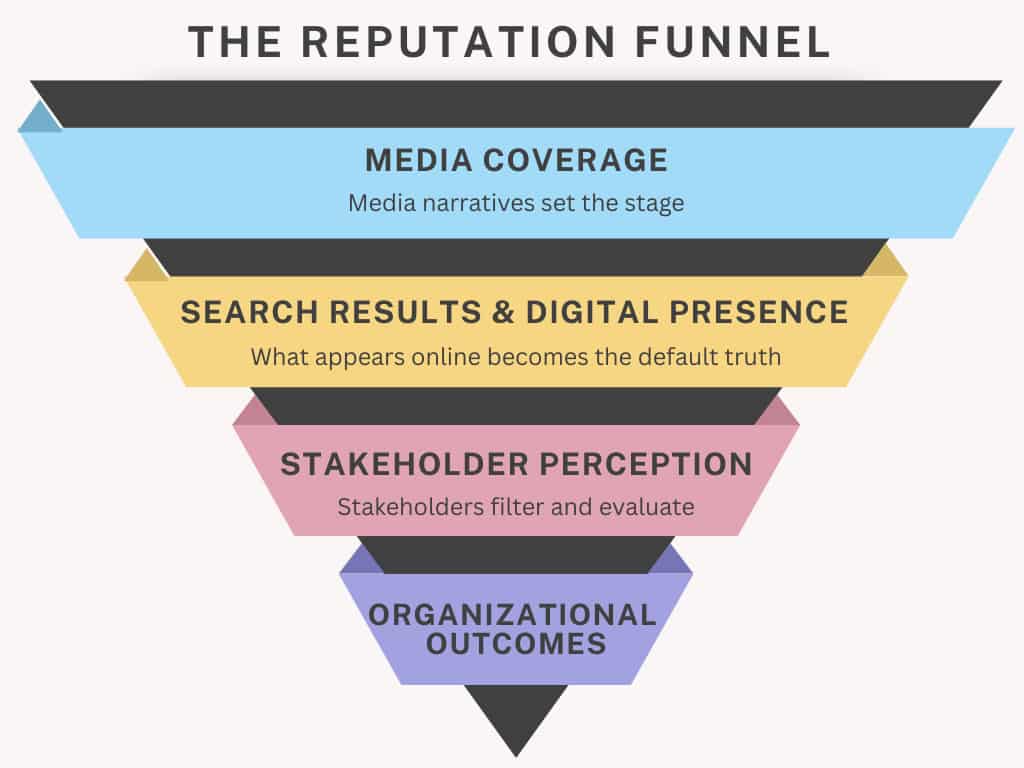
A useful way to understand board-level reputation is through a funnel model that tracks how perception forms and flows:
- Media Coverage: Traditional and digital media still set the tone for how boards are perceived.
- Search Results & Digital Presence: Fewer than 1% of searchers click through to page two of Google results, making search visibility a critical factor in how your board is perceived online.
- Stakeholder Perception: Employees, regulators, and investors interpret these signals; reputation is their evaluation, not the board’s self-image.
- Organizational Outcomes: Poor board reputation can increase turnover risk, suppress stock performance, and repel top candidates.
Understanding reputational risk management at every stage of this funnel is essential for boards that want to stay ahead of problems.
Conclusion
Board-level reputation isn’t a luxury or occasional feel-good initiative—it’s your daily currency of trust and credibility with stakeholders. Each step your board takes, big or small, signals your company’s values and leadership quality. In a hyper-transparent environment, mistakes quickly come under public scrutiny—not just among investors but also among employees, customers, and the broader public.
The good news is that reputation isn’t just about crisis avoidance. It’s about actively building trust every day through consistency—in ethics, in communication, in diversity, and in aligning actions with words. These aren’t abstract ideals; they’re practical means of navigating today’s business world.
Boards that succeed in safeguarding their credibility share a key trait: they’re adaptive, thoughtful, and authentic. They don’t shy away from tough conversations, they listen when they need to listen, and they admit missteps openly. More than ever, stakeholders expect clarity, not perfection.
Ask yourself the hard questions:
- Is your governance framework clear and actively used?
- Do you genuinely prioritize openness with key groups?
- Does your board diversity provide real perspective, not just optics?
- Do your board actions reflect what you say matters?
The answers can be your roadmap. Cultivating the right reputation is less about managing your image and more about fulfilling the promises you make daily—to your stakeholders and to yourselves.
Frequently Asked Questions








Protect Your Online Reputation
Every day you wait, negative content gets stronger. Talk to our experts about a custom strategy for your situation.
Get Your Free Analysis