
How to Structure an Article for Brand Visibility Online
Follow these structured content principles to give your branded articles the strongest possible chance of appearing at the top of Google search results.

This article explains how to structure branded content so it ranks well in search results and supports online reputation management. It covers the key on-page elements that signal relevance to search engines, including title structure, meta descriptions, keyword placement, and internal linking. Following these principles helps ensure that the content Google associates with your brand is content you have shaped and optimized.
How to Structure an Article for Brand Visibility Online
-
1
Write a strong, brand-focused title
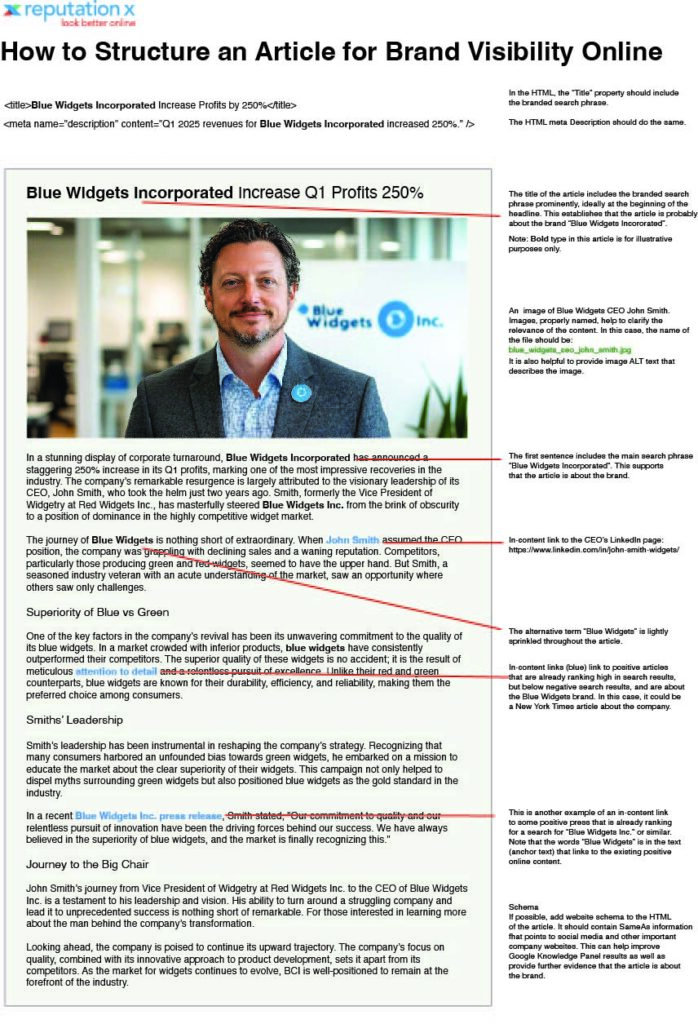
Place your primary branded search phrase as close to the beginning of the headline as possible. Search engines weight the first words of a title more heavily, and readers scanning results are more likely to click when they see the brand name immediately. For example, a title like 'Blue Widgets Incorporated Increases Q1 Profits by 250%' signals relevance to both search engines and readers right away.
-
2
Optimize your meta description
Write a concise meta description that includes your branded search phrase in the first sentence. While meta descriptions are not a direct ranking factor, a well-crafted one can meaningfully improve click-through rates from search results. For example, leading with the brand name and a compelling data point makes the result more appealing to anyone searching for that brand.
-
3
Use the branded phrase naturally throughout the content
Incorporate the branded search phrase in the introduction, conclusion, and a few strategically placed spots in the body without keyword stuffing. This reinforces the article's relevance to the brand and supports SEO reputation management goals. The goal is for Google to associate your optimized, brand-positive content with the search phrase organically.
-
4
Embed in-content links to positive existing content
Link from your new article to existing positive content about your brand using the branded search phrase as anchor text. This passes PageRank to established pieces, helping to boost their authority in search results and pushing negative results down. Prioritize linking to high-quality sources, since Google's emphasis on E-E-A-T means the quality of what you link to matters as much as the link itself.
-
5
Optimize image file names and ALT text
Name your image files descriptively and include the branded search phrase where it fits naturally, such as 'blue_widgets_ceo_john_smith.jpg.' Write ALT text that describes the image accurately while incorporating the brand name, for example, 'John Smith, CEO of Blue Widgets Incorporated, leading the company to success.' Well-optimized images can surface across multiple search experiences, including Google Lens and AI-powered visual search.
-
6
Add structured data schema to your article
Incorporate website schema or other relevant structured data into the HTML of your article to improve how your content appears in search results. Structured data provides search engines with clearer context about your content, which can enhance how it is displayed and understood. This is particularly effective for branded content when combined with the other optimization strategies in this guide.
This article explains how to structure an article for brand visibility online, covering the key elements that give branded content the best chance of ranking well in search results.
When structuring an article for better online visibility, particularly for enhancing brand recognition, it’s important to focus on several key elements. These include optimizing the article for relevant branded search phrases, embedding strategic links and anchors, and ensuring the content supports positive existing online content. Below is a comprehensive guide on how to structure an article effectively for online visibility using the principles highlighted in the higher-resolution PDF you can view here.
Contents of this article
1. Start with a Strong, Relevant Title and Headline
The title of your article is one of the major components of highly visible branded online content. It should prominently include the main branded search phrase, ideally at the beginning of the headline. This helps establish the article’s relevance to the brand right from the outset.
Example:
- If the brand is “Blue Widgets Incorporated,” the title might be: “Blue Widgets Incorporated Increases Q1 Profits by 250%”.
This title immediately signals to search engines and readers that the content is directly related to the brand, improving its chances of appearing in relevant search results.
2. Optimize the Meta Description
The meta description is a brief summary of your article that appears in search engine results. It should include the branded search phrase and provide a concise overview of the article’s content. While Google has confirmed that meta descriptions are not a direct ranking factor, a well-crafted description can meaningfully improve click-through rates — which matters just as much.
Note how, in the example below, the words “Blue Widgets” appear in the first sentence, making the result more compelling to anyone searching for the brand.
Example:
- “Q1 2025 revenues for Blue Widgets Incorporated increased by 250%, marking a significant turnaround for the company.”
This description reinforces the article’s focus on the brand and can encourage clicks from search engine results pages (SERPs). For a deeper look at how branded search results work, see our guide on using web schema to improve branded search results.
3. Use the Branded Phrase Throughout the Content
The branded search phrase should appear naturally throughout the article. This reinforces the article’s relevance to the brand without overstuffing keywords. Include the phrase in key areas like the introduction and conclusion, as well as a few strategically placed spots in the body.
Example:
- “Blue Widgets Incorporated has consistently outperformed its competitors due to the superior quality of its products.”
This approach is a core component of SEO reputation management — ensuring that the content Google associates with your brand is content you’ve shaped and optimized.
Want Your Brand Content to Rank Higher?
Our team builds and optimizes branded content strategies that improve visibility and shape what people find when they search for you.
4. Include In-Content Links to Positive Existing Content
One of the most powerful reputation management tactics is embedding in-content links that direct readers to existing positive content about your brand. This passes PageRank — the SEO value Google formally attributes to links — from your new article to established pieces, helping to boost their authority in search results.
Google’s ongoing algorithm updates have placed increasing emphasis on content quality and E-E-A-T (Experience, Expertise, Authoritativeness, Trustworthiness) signals alongside link authority, so the quality of what you’re linking to matters as much as the link itself.
- Anchor Text: Use the branded search phrase as the anchor text. For example, if there is a well-ranking article about “Blue Widgets” in a relevant online publication, the link in your article should look like this (using New York Times as an example): “As mentioned in this New York Times article about Blue Widgets, the company has made significant strides in innovation.”
This strategy ensures that the link is relevant and helps promote positive content related to your brand. It also plays a meaningful role in pushing negative search results down in SERPs by elevating authoritative positive content in their place.
5. Use Proper Image Naming and ALT Text
Images are another SEO element worth optimizing. The image file name and its ALT text should be descriptive, with the branded search phrase included where it fits naturally. ALT text primarily serves an accessibility function, but it also provides useful contextual signals to search engines.
The rise of AI-powered visual search — including Google Lens and Google’s AI Overviews — has made image optimization more valuable than ever. A well-optimized image may surface across multiple types of search experiences.
Example:
- If your article includes an image of the CEO, the file should be named “blue_widgets_ceo_john_smith.jpg”. The ALT text might read: “John Smith, CEO of Blue Widgets Incorporated, leading the company to success.”
6. Incorporate Website Schema
Adding structured data, such as website schema, to the HTML of your article can significantly improve how your content appears in search results. While Google has clarified that structured data doesn’t directly boost rankings, it does influence how content is displayed — including rich results and Google’s Knowledge Panel.
Knowledge Panels are increasingly shaped by entity-based understanding and your brand’s overall footprint across the web, and schema plays a meaningful role in that. Structured data is also becoming more relevant for AI-driven search, as Google’s AI Overviews may draw on schema signals when generating answers.
- SameAs Property: The schema should include “SameAs” information, which points to your brand’s social media profiles and other authoritative websites. This further strengthens the association of your content with your brand.
Example of embedded schema
Here is an example of the “person” schema that might be embedded in the HTML of the example article above if you wanted the article to focus on not only the company but also the prominently mentioned CEO. Adding schema like this does not change the article, but it does send a strong signal to search engines that the article is about the company and the CEO. This type of schema could even be combined with article schema, or many other types. For more on this topic, see our guide to adding schema to corporate biography pages.
{
  "@context": "https://schema.org",
  "@type": "Person",
  "name": "John Smith",
  "jobTitle": "Chief Executive Officer",
  "worksFor": {
    "@type": "Organization",
    "name": "Blue Widgets Inc.",
    "url": "https://www.bluewidgets.com"
  },
  "image": "https://www.bluewidgets.com/images/john-smith.jpg",
  "url": "https://www.bluewidgets.com/about-us/john-smith",
  "sameAs": [
    "https://www.linkedin.com/in/john-smith-widgets/",
    "https://www.x.com/bluewidgetsinc",
    "https://www.awesomebluewidgets.net"
  ],
  "description": "John Smith is the Chief Executive Officer of Blue Widgets Inc., a leading innovator in the widget industry. He began his role as CEO two years ago, after serving as Vice President of Widgetry at Red Widgets Inc. John was awarded 'Widgeteer of the Month' in 2021 for his exceptional contributions to the field.",
  "birthPlace": {
    "@type": "Place",
    "name": "Springfield, Illinois"
  },
  "alumniOf": {
    "@type": "CollegeOrUniversity",
    "name": "University of Widgetry",
    "url": "https://www.universityofwidgetry.edu"
  },
  "award": "Widgeteer of the Month, 2021",
  "gender": "Male",
  "nationality": "American",
  "email": "mailto:john.smith@bluewidgets.com",
  "telephone": "+1-800-555-1234"
}
7. Links and Sharing Amplify Your Article
Once your article is published, the next critical step is to amplify its reach by strategically linking to it from your company website and other relevant websites. Links remain one of the primary factors search engines use to assess the relevance and authority of online content.
Link quality matters significantly more than link quantity. A handful of editorially earned links from topically relevant, authoritative sources will outperform a large volume of low-quality ones.
Linking from the Company Website
Your company website should serve as the central hub for all your online content. Create a prominent link to the newly published article from a relevant section of your website, such as your blog, news section, or a dedicated resource page. This drives direct traffic to the article and signals to search engines that this content is valuable and directly connected to your brand.
- Internal Linking: Ensure that the article is linked from other relevant pages within your website. If the article is about “Blue Widgets,” link to it from pages that discuss products, innovations, or case studies related to Blue Widgets. This internal linking strategy strengthens the SEO of both the article and the linked pages by distributing PageRank across your site. To understand how this fits into a broader strategy, see our overview of link building for SEO reputation campaigns.
Linking from Other Relevant Websites
Encourage partners, industry blogs, and other authoritative websites to link to your article organically. Guest posts and collaborations can be excellent opportunities to earn these external links — but it’s important to do this the right way.
Google’s guidelines are clear that links in press releases or large-scale guest posting campaigns intended primarily for link building should use rel="nofollow" or rel="sponsored" attributes. Manipulative link schemes can result in manual penalties. Focus on earning editorial links through genuinely useful content, and the SEO benefits will follow.
- Anchor Text: When getting external links, ensure that the anchor text includes your branded search phrases when possible, such as “Blue Widgets Inc.” This helps reinforce the association of your article with your brand.
Social Media Promotion
Social media platforms like Facebook, X (formerly Twitter), LinkedIn, and others are powerful tools for promoting your article to a broader audience. Sharing your article across these platforms drives traffic and increases content visibility. While Google has confirmed that social signals like likes and shares are not direct ranking factors, greater visibility means more people encounter your content — which can lead to organic backlinks and increased brand authority over time.
- Multiple Postings: Post the article more than once across your social media channels. Each post can target different aspects of the article, such as highlighting a key insight or using different media like images or videos. Posting more than once ensures your content reaches different segments of your audience who might not see it the first time.
- Brand-Related Hashtags: Incorporating brand-related hashtags can help extend your content’s reach, though effectiveness varies by platform. On X (formerly Twitter), hashtags remain useful for topic discovery. On LinkedIn, their algorithmic weight has diminished, so use them sparingly. On Instagram and Facebook, hashtag reach has generally declined, making strong captions and community engagement more important. Hashtags like #BlueWidgets or #WidgetInnovation can still surface your content to interested audiences — tailor your approach to each platform.
Encourage Sharing
Encourage your followers and employees to share the article on their own social media profiles. The more the article is shared, the more visibility it gains, which can lead to higher engagement and more backlinks. Consider using social media advertising to boost the reach of your posts to targeted audiences.
Wrapping Up
Structuring an article for better online visibility involves a mix of technical SEO practices and content strategies that ensure your article is relevant, authoritative, and valuable. By following these guidelines — crafting strong titles and meta descriptions, strategically embedding in-content links, using well-named images, and incorporating schema — you can significantly enhance your brand’s online presence.
This approach not only boosts visibility but also helps steer the narrative around your brand by promoting positive content and authority in search results. For a broader look at how these tactics fit together, explore our complete guide to online reputation management.
Frequently Asked Questions







Protect Your Online Reputation
Every day you wait, negative content gets stronger. Talk to our experts about a custom strategy for your situation.
Get Your Free Analysis