
How to Push Negative Search Results Down in SERPs
Whether you're dealing with false reviews or damaging press, these suppression tactics can help you control what people find when they search your name.


- EU residents can use the Right To Be Forgotten to remove specific Google results within about a month.
- Google accepts removal requests for sensitive PII, explicit images, and content violating its Terms of Service.
- Content can sometimes be removed by contacting the original publisher directly with a formal request.
- De-indexing via DMCA or a NoIndex tag can eliminate content from search results without deleting it entirely.
- When removal is possible, it should always be pursued before resorting to suppression strategies.
Negative search results can be addressed through removal, de-indexing, or suppression in SERPs. This article outlines the most effective methods including the Right To Be Forgotten (available in the EU), DMCA-based de-indexing, removal at the content's origin, and pushing results down through proactive content creation. Acting quickly is critical to prevent reputational damage from becoming entrenched.
How to Push Negative Search Results Down in SERPs
-
1
Identify your removal or suppression approach
Before taking action, determine whether your situation calls for removing content entirely, de-indexing it from search engines, or suppressing it by pushing it down in rankings. Common options include Right To Be Forgotten requests, removal at the source, DMCA-based de-indexing, and digital suppression strategies. Choosing the right approach early saves time and prevents making the situation worse.
-
2
Submit a Right To Be Forgotten request if eligible
If you are a citizen of the European Union or another qualifying country such as Argentina, you can submit a Right To Be Forgotten (RTBF) request to obligate Google to remove specific search results. Google is required to act on valid requests without undue delay, typically within one month. Note that this legal provision is not recognized in the United States or countries like China.
-
3
Request de-indexing directly from Google
Submit a removal request to Google if the content includes sensitive Personally Identifiable Information (PII) such as bank account credentials, tax ID numbers, credit card details, handwritten signatures, or non-consensual explicit photos. Google has streamlined this process to prioritize PII removal, particularly in cases involving doxing. You can also report content that breaches Google's Terms of Service, such as hate speech or content promoting violence.
-
4
Contact the web host to remove the content
If direct removal from Google is not possible, approach the hosting service provider to request deletion of the content, subject to the host's terms of service. This is a viable alternative when the original publisher is unresponsive or unwilling to act. A DMCA takedown request can also be submitted if the content violates copyright law under the 1998 Digital Millennium Copyright Act.
-
5
Reach out to the original publisher for removal
Contact the author or publisher directly and request that they delete or update the negative content at its source. A formal letter or email appeal often suffices, especially with news outlets that prioritize accuracy. Proceed carefully, however, as depending on the author's intent, this approach can sometimes draw more attention to the content rather than less.
-
6
Build high-quality content to suppress negative results
When removal is not possible, create high-quality, relevant content that outranks the negative results over time. Use the E-A-T (Expertise, Authoritativeness, Trustworthiness) method to develop content that genuinely represents you or your brand and resonates with what searchers are looking for. Focus on quality over quantity, as Google's algorithms favor original, useful, and authoritative content.
-
7
Maintain consistent SEO and content creation efforts
Suppressing negative search results is not a one-time effort — it requires ongoing content creation, regular updates, and sustained search engine optimization. Consistently publishing well-optimized positive content pushes unfavorable results further down in rankings until they become less visible or disappear from the first page entirely. Treat this as a long-term strategy rather than expecting immediate results.
In reputation management, you can repair an online reputation by deleting online content, de-indexing it from search engines, or pushing it down in search results where it is seldom seen. The second approach is called “suppression”. This article details how to push down negative search results.
Removing, Deindexing, or Burying Negative Search Results
If online content is negative, untrue, or unflattering, the problem becomes a potentially reputationally damaging issue. These negative results can lead to a reduction of opportunities for both businesses and individuals. This article will outline the basics of pushing down negative search results fast so you can look better when someone Googles you.
It is critical that these damaging or even embarrassing negative search results are removed, de-indexed, or buried as soon as possible to avoid further damage or entrenchment.
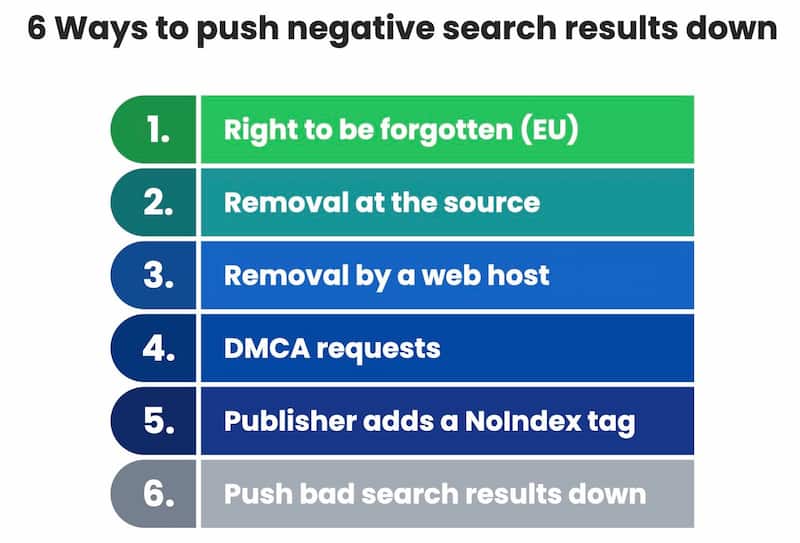
Here are some of the most common ways to push down negative search results.
How to Push Negative Search Results Down
- Right To Be Forgotten (Not available in the United States)
- Removal at the source
- Removal by a web host
- De-index from search results with DMCA or similar
- Publisher adds a NoIndex tag to the page header
- Push bad search results down
Get a Free Reputation Assessment
Find out what people see when they search for you online. No obligation — results in 24 hours.
Understanding “Right To Be Forgotten”
Since 2006, citizens of the European Union, along with a select few other countries like Argentina, have been safeguarded by the legal provision known as the Right To Be Forgotten (RTBF). This law obligates Google to omit specific search results under designated circumstances. Within the EU, an individual applying for RTBF can expect the targeted results to be removed “without undue delay”, typically within a month’s time.
However, in the United States, the “Right To Be Forgotten” isn’t recognized as a means to expunge search results. While there have been legal endeavors to introduce a similar law in the U.S. (some even preceding the advent of the Internet), it remains unestablished due to concerns regarding potential infringement on constitutional free speech rights and issues surrounding censorship. Conversely, countries like China have explicitly stated that a Right To Be Forgotten is non-existent.
De-indexing or Removing Content from Google Search Results
Certain search results can be omitted or entirely erased from Google’s search index if one submits a removal request. Valid grounds for de-indexing might include the elimination of sensitive details like tax ID numbers, bank account credentials, credit card information, handwritten signatures, and explicit photos shared without the individual’s consent.
Google has streamlined its removal request process, prioritizing the deletion of Personally Identifiable Information (PII) more efficiently. This enhancement aligns with Google’s dedicated effort to combat “doxing”—a malicious act of publishing someone’s PII on the internet.
If you encounter misleading information or content that breaches Google’s Terms of Service, it’s possible to report or flag it. This option is viable for genuine breaches, which may encompass hate speech or content promoting violence. Google also acts on legal directives, such as those associated with the 1998 Digital Millennium Copyright Act. Apart from Google, one can also approach the respective hosting service providers to delete specific content, contingent on the host’s terms of service.
Whenever a removal appears feasible, we typically recommend our clients opt for that solution initially.
Removing Content at Its Origin
Eliminating or concealing content is achievable at the initial point of publication, provided the responsible party consents. Although the publisher or author has the ability to delete content from a webpage, the timeframe for this action remains uncertain.
Often, a formal letter or email appeal suffices, particularly with news platforms that prioritize accuracy and factual reporting. To reinforce your request, you can consider sending a letter to the author. Here are some free templates to have the content removed at the source. Nonetheless, such an approach should be undertaken carefully since, depending on the circumstances and the aims of the original author, it can make things worse.
This blog post details how to remove negative online content.
Strategies for Enhancing Digital Reputation
Digital Suppression Strategy
In the realm of online reputation management, a common method is the strategic suppression of undesired content. The basis of this strategy is not always about deleting or hiding unwanted content but rather outperforming it so it becomes less visible or even invisible.
This is achieved by crafting content that is not only relevant but also of superior quality. Over time, well-optimized, high-quality content rises in search engine rankings, effectively pushing down less desirable results.
Principles of Suppression:
-
Relevance: Content created should resonate with what searchers are looking for. It should also genuinely represent the subject or entity in question. We use the E.A.T method of content development to achieve this.
-
Quality over Quantity: It isn’t about producing more, but about producing better. Google’s algorithms favor content that is original, useful, and authoritative (Authority is part of E.A.T).
-
Consistent Effort: Like any good strategy, results aren’t immediate. Regular updates, ongoing content creation, and search engine optimization (SEO) efforts are essential.
Illustrative Suppression Scenarios
-
Elevating Positive Press: Let’s say a major financial firm has unfavorable articles from prominent news sources like the NY Times on the first page of search results. The suppression strategy would involve promoting positive press or content to move those unfavorable links down.
-
Mitigating Regulatory Appearances: For a business, having regulatory sites like SEC.gov appear prominently could be concerning. The goal would be to highlight other relevant and positive content about the company to reduce the prominence of such links.
-
Managing Personal Reputation: If an executive finds herself plagued by negative blog posts on the first page of search results, the strategy would involve pushing up positive and neutral content about her.
Starting a Suppression Campaign
If you’re faced with unfavorable online content, consider partnering with experts like Reputation X. Our approach begins with:
-
Initial Assessment: We delve deep into your specific situation, analyzing the feasibility of a suppression campaign.
-
Strategic Proposal: After our research, we craft a proposal detailing our strategy. This includes goals, timelines, and actionable steps.
-
Collaborative Review: We value your input. After presenting our plan, we’ll collaborate with you to refine it, ensuring your unique needs are met.
-
Campaign Execution: Once approved, our team embarks on the meticulous task of improving your online reputation.
Remember, today, more than ever, your online reputation is often the first impression you make. Ensuring it’s a positive one is crucial for personal and professional success.
Frequently Asked Questions









Protect Your Online Reputation
Every day you wait, negative content gets stronger. Talk to our experts about a custom strategy for your situation.
Get Your Free Analysis