
Personal Reputation Management – How People Craft Google Results
Everyone has a personal reputation — and in the digital age, managing it is no longer optional but a daily responsibility you can't afford to ignore.

- Everyone has a personal reputation that exists and evolves whether they manage it or not.
- Neglecting your online brand can cost you jobs, promotions, relationships, and opportunities.
- Think of reputation management like hygiene — consistent upkeep prevents serious social fallout.
- Proactively defining your personal brand lets you control how others perceive and respond to you.
- Online reputations can spread virally and linger permanently, making early action essential.
Personal reputation management isn't just for celebrities — everyone has a reputation that requires active attention. Like personal hygiene, neglecting your online brand carries real social and professional consequences. Proactively shaping your reputation opens doors to career opportunities, stronger relationships, and lasting success.
There’s a reason why the National Enquirer, The Sun, Daily Star, and US Weekly publish content that is all about scandalous behavior. We all love a good fall from grace story (unless it’s happening to us), a red hot gossip drop, or a celebrity rumor. And when personal reputations start blowing up, we are tapping and swiping our devices to get the latest details.
You may not end up on the cover of US Weekly, but you nonetheless have a reputation. And that reputation needs to be managed.
This article is a field guide for managing personal reputation in today’s reputation-centric culture. Everyone possesses a reputation — and therefore, everyone has the responsibility for managing it.
Why Personal Reputation Matters
Personal reputation management: not just for celebs
When most people hear the term personal reputation management, they might picture a politician embroiled in controversy or a celebrity whose image is being picked apart by tabloid headlines. Celebrity reputations get a lot of press, obviously.

But in truth, everyone has a reputation, be it big or small. Each person’s reputation matters within their sphere of influence, no matter how vast or limited that sphere may be. Our world runs on social interaction and social media networks, which means the image of an individual has reached a scale no previous generation had to grapple with.
Today, reputation issues can linger forever in the electronic ether, explode virally to an audience of millions, and plunge someone from public applause to public approbation within hours.
It’s not just celebrities who need personal reputation management. Everyone needs to pay attention to their online brand. A personal reputation can mean the difference between securing a job or being blacklisted by corporate recruiters. It may put your name at the top of the list for community leadership roles — or cause people to keep their distance.
Personal reputation is like personal hygiene
One helpful way to think about personal reputation management is to consider the parallel of personal hygiene. Most people choose to brush their teeth regularly, shower, tend to their nails and hair, and control body odor. It’s the socially acceptable thing to do.
Personal hygiene is an individual responsibility. Most people with good health and a sound mind take care of these tasks themselves. It takes some time and money, but most of us consider it well spent.
What happens if you stop? The consequences come in the form of social exclusion — ridicule, avoidance, and ostracism.
Get a Free Reputation Assessment
Find out what people see when they search for you online. No obligation — results in 24 hours.
Personal reputation management works the same way. The consequences may not be odoriferous, but they can be just as dire. Once you neglect your reputation, life begins to unravel.
Consequences of neglect
If you neglect your reputation, it is managed by default — by chance, by the nefarious intentions of others, or by a slow slide into obscurity.
Just as no one else is going to brush your teeth for you, few people will shape your identity in a positive way. Those who neglect their reputation wind up being passed over for jobs or promotions, rejected by partners or friends, and plagued by what seems like bad luck.
Socially, there is no excuse for neglecting one’s personal online brand. If those consequences aren’t motivating enough, consider the benefits.
Benefits of personal reputation management
No one becomes successful without personal reputation management. Once you proactively manage your reputation, opportunity follows. Here are some of those benefits.
- You define your life. Personal reputation management is a lot like creating a business brand. What do you want to be recognized for? What kind of people do you want to be surrounded by? Just as you get to define your personal style, you also get to define your personal brand and reputation.
- Success begets success. Once people perceive you in a certain way, reality takes the form of those perceptions. This isn’t voodoo — it’s social science. Walk into a bank looking disheveled and asking for a business loan, and you may be turned down regardless of your application. Walk in confidently, well-dressed, and composed, and you may get the loan even if your application isn’t perfect.
- Security. When you manage your personal reputation, your reputation takes care of you. A strong reputation can deliver a job, a partner, friends, a social safety net, and financial means — virtually everything most people consider marks of success.
- Upward mobility. An outstanding reputation puts you in touch with people and places that are closed off to those with no reputation or a negative one. Through a great reputation, you gain social access to people who have power and influence.
Whatever you want in life, your personal reputation will help deliver it. To go deeper on the foundations, see our overview of what reputation management really means and the ethics behind it.
How to Manage Your Personal Reputation
Some people assume that personal reputation management requires a team of coders, data scientists, and AI programmers monitoring screens around the clock. In reality, the barrier to entry is much lower than that.

Required resources
Here’s everything you need to manage your personal reputation if you don’t already have a problem.
- A way to get online. A personal computer or tablet is ideal, but even a public library terminal will do.
- A phone number. Many social networks require one for two-step verification. It’s not always mandatory, but it’s strongly recommended.
- An email address. Gmail is recommended for reasons explained below.
- Optional: a modest budget for purchasing a domain name. Most standard .com registrations run $10–$20 per year through major registrars, though pricing varies by domain name and provider.
Take Control of Your Personal Reputation
Whether you're starting from scratch or dealing with a reputation problem, our team can help you build and protect your online presence.
Claim your reputation real estate
Your first order of business is to secure social media accounts on each of the major networks. You may already have a presence on some, but make sure you’re not missing any.
What social media sites should you be on?
Claim your username and profile on all the major social media sites.
- LinkedIn — This is your online resume. Recruiters, colleagues, and hiring managers visit regularly to check up on candidates.
- Facebook — With billions of active users worldwide, it remains one of the most important platforms for establishing a basic online presence.
- X (formerly Twitter) — You may not use it actively, but you should claim your name on it.
- Instagram — Secure your username and post a profile photo. That’s all you need for now.
- TikTok — With over a billion active users, TikTok is one of the most visible platforms on the web. Even if you never post a video, claiming your username protects your identity there.
- Snapchat — Its core audience skews toward Gen Z, but it’s worth a few minutes to lock down your username regardless of your age.
- Pinterest — It can be surprisingly useful for establishing a positive presence.
- YouTube — As a Google property, your YouTube channel is tied to your Gmail login and can rank well in search results. If you don’t have a Gmail address, get one.
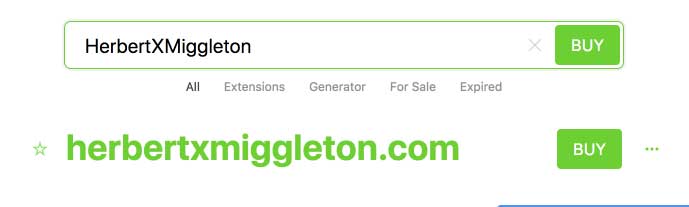
- Your own domain name — Owning a domain with your name may not seem urgent right now, but you never know when it could matter. Use a tool like GoDaddy’s domain search to see if your name is available as a .com. Purchase the domain that matches your name as closely as possible.
What name should you use on your social profiles?
Use the name you think people will most often Google you by. Some people choose a screen name or false name — don’t. If you do, you’ll be relying on Google to connect your real name with your online identity, which is unreliable.
Note: If you are supervising a child’s foray into social media, avoid using their legal name until they become an adult.
Here are some tips for handling name variations across platforms.
- One account per person. Some married couples create joint social media accounts — this is confusing and not recommended.
- If your username is already taken, try these alternatives:
- Add your middle initial — e.g., JohnASmith
- Add your middle name — e.g., JohnAdamSmith
- Use initials for your first and middle name — e.g., JASmith
- Shorten your last name — e.g., JohnAdamSm
- Use dashes between names if allowed — e.g., John-Smith
- Add “TheReal” before your name — e.g., TheRealJohnSmith
- Add “Official” — e.g., JohnSmithOfficial
- Avoid appending numbers — JohnAdam008710 is not memorable and looks unprofessional.
- Keep your name consistent across all accounts. If you’re JohnASmith on Instagram, use the same handle on Pinterest and elsewhere.
- Don’t change your name unless you absolutely have to. Consistency builds recognizability over time.
What about profile photos?
Social media profile photos are critically important. They establish you as a real human being (as opposed to a bot) and signal a great deal about your reputation. Follow these guidelines.
- Use one. Nothing signals “bot” louder than a profile with no photo. Children, pets, cars, and flowers do not qualify as a photo of you.
- Take it seriously. Don’t use a casual selfie. A professional headshot is ideal. Investing $150–$400 in a professional shoot is well worth it — even budget-friendly photographers can deliver a polished result.
- Use a recent photo. Your profile photo should match your current appearance.
- Skip the sunglasses. You may look cooler, but people can’t see your eyes.
- Smile. It makes you approachable.
- Use the same photo across all profiles. Consistency lends an air of uniformity and recognizability to your online presence.
- Avoid blurry, cropped, group, or pixelated photos. Your profile photo should clearly show your face and only your face.
Be aware of doppelgängers
A doppelgänger is a non-biologically related look-alike or double of a living person. In personal reputation management, a doppelgänger can be a serious problem.
Imagine your name is Herbert Miggleton. You’re a mid-level manager at a reputable company and a decent person. Unknown to you, there’s another Herbert Miggleton of similar age — and he has a damaging online presence. This scenario has happened to real people.
Unless you’re actively monitoring your reputation, this kind of name collision can jeopardize job opportunities and personal relationships. If you share a name with someone who has a damaging online presence, our guide on what to do when someone with your same name does bad things is essential reading.
Be present and stay active
The visibility of your personal brand depends on how present you are online and what you’re posting. You’ll need to decide how active you want to be. Some people post publicly every day; others drop a post every week or two.
Here are three recommendations for managing your reputation through presence.
Check your privacy settings
If you’re opting for low visibility, lock down your social media accounts. Monitor incoming friend or follow requests and control who can see your information.
Choose your level of activity
More presence means more management, more risk, and more time. Different goals call for different levels of activity. If you’re in the job market, increasing your LinkedIn activity makes sense. Hiding or deleting old or objectionable posts would also be prudent.
Focus on the platforms that matter most to you
It can be difficult to be highly active on every social media account. Choose the platforms most relevant to your goals and invest your time there.
Know the risks and manage them
Individual reputation monitoring is necessary, but it comes with real risks. The management side of personal reputation can be distilled into two principles: control yourself, and clean up the past.
Related: Removing personal information online
Control yourself
The short history of social media is littered with people who publicly destroyed their reputation online. Whether it was a string of expletives on X, an affair that went public, photos of a drunken escapade, or a public rant directed at a boss — things can go south fast.
Set rules for yourself. Control your privacy settings if you question your ability to stay quiet when appropriate. And commit to not touching your phone after the third glass of wine. Your reputation is worth the discipline.
Clean up the past
In a Wall Street Journal interview, Eric Schmidt predicted that every young person would one day be entitled to change their name upon reaching adulthood — to disown youthful mistakes stored on friends’ social media profiles.
Social media isn’t that forgiving yet. For some of us, regrettable moments live on as Facebook photos. Do what you can to get those photos removed. Plead with friends, untag yourself, or otherwise give revisionist history a try.
Schmidt later admitted the name-change idea was a joke — “just not a very good one.” But he also offered a more serious observation worth heeding: “If you have something that you don’t want anyone to know, maybe you shouldn’t be doing it in the first place.”
If you’re dealing with content that’s already causing damage, our guide on how to remove personal information from search results walks through your practical options. If you’re facing a broader reputation crisis, the quick practical guide to rebuilding reputation after a crisis is a good next step.
Conclusion
Personal reputation is the responsibility of every adult living in a connected society. But it’s also a genuine privilege. Done correctly, personal reputation management gives you power, opportunity, and access.
Managing your reputation doesn’t need to be painful or time-consuming. It’s the simple practice of claiming your space, being present, and staying aware.
Frequently Asked Questions









Protect Your Online Reputation
Every day you wait, negative content gets stronger. Talk to our experts about a custom strategy for your situation.
Get Your Free Analysis