
Seven Free Wikipedia Alternatives
Wikipedia isn't always citable — these seven free encyclopedias give you trustworthy, research-ready alternatives for school, work, and beyond.

- Wikipedia's open editing model makes it unreliable for academic or professional citations
- Many educational institutions explicitly prohibit Wikipedia as a citable source
- Encyclopedia Britannica Online and Scholarpedia offer expert-reviewed, professionally vetted content
- Specialty encyclopedias like Conservapedia and Deletionpedia serve niche research purposes
- Using vetted alternatives strengthens the credibility of your research and sourcing
Wikipedia's open-contribution model makes it unreliable for academic and professional research, yet many people don't know credible free alternatives exist. This article reviews seven vetted online encyclopedias—including Britannica, Scholarpedia, and Encyclopedia.com—that offer expert-reviewed content. Each alternative serves different research needs, giving users more trustworthy options beyond Wikipedia.
Is Wikipedia the Only Wiki?
A wiki is a collaborative website or software that allows users to create and edit pages and content. The word comes from the Hawaiian “wiki-wiki,” meaning “quick.” The first wiki was created in 1994 by Ward Cunningham as a way for software designers to exchange ideas. Since then, countless wikis of all sizes and subjects have emerged across the web. While Wikipedia is by far the best known, many smaller wikis cover highly specific topics — from Star Trek lore to sandwich taxonomy.Why Is Wikipedia So Popular?
Since its launch in 2001, Wikipedia has grown to become the largest online encyclopedia. As of January 2026, Wikipedia ranks 5th among the most-visited websites worldwide. Several factors drive that dominance:- Wikipedia articles appear near the top of almost every Google search result.
- The site is fast, lean, and rarely experiences downtime.
- Content is frequently updated because the open editing model lets anyone revise articles — though questions about who actually edits Wikipedia raise real concerns about accuracy and bias.
Is Wikipedia a Reliable Source?
Co-founder Jimmy Wales set out to give “every single person on the planet…free access to the sum of all human knowledge.” He’s come remarkably close. But the same open contribution model that fuels Wikipedia’s scale also undermines the neutrality and accuracy of its content. Many educational institutions explicitly prohibit citing Wikipedia. At ReputationX, we regularly edit Wikipedia pages to correct inaccurate information for clients as part of our reputation management services — so we see firsthand how reliable Wikipedia really is (or isn’t). Wikipedia may settle a casual bet about whether Abraham Lincoln was the 15th or 16th president (he was the 16th), but serious research requires sources backed by verified professionals and transparent editorial processes.Best Alternatives to Wikipedia for Reliable Research
When you need authoritative information from experts, or when Wikipedia’s editorial biases on certain topics prove frustrating, vetted encyclopedias offer a stronger foundation. The rise of misinformation online has made source credibility more important than ever. Wikipedia is the most popular and largest knowledge source, but it is far from the only one. The alternatives below each offer different strengths — some are free, some are subscription-based, and all provide a level of editorial oversight that Wikipedia cannot match.Quick Comparison: Free Wikipedia Alternatives at a Glance
| Source | Free Access? | Editorial Model | Topic Scope | Citation-Friendly? |
|---|---|---|---|---|
| Encyclopedia Britannica Online | Limited (subscription for full access: $74.95/yr) | Expert-authored and professionally edited | Broad, comprehensive | Yes — widely accepted in academia |
| Scholarpedia | Yes | Peer-reviewed, invited experts only | Sciences (physics, neuroscience, math, CS) | Yes — peer-reviewed articles with named authors |
| Encyclopedia.com | Yes | Aggregated from professional reference works | Broad, multi-source | Yes — entries sourced from Oxford UP, Columbia, etc. |
| Infoplease | Yes | Curated by Sandbox Learning (Pearson Education heritage) | Broad, summary-oriented | Yes — vetted, tamper-proof content |
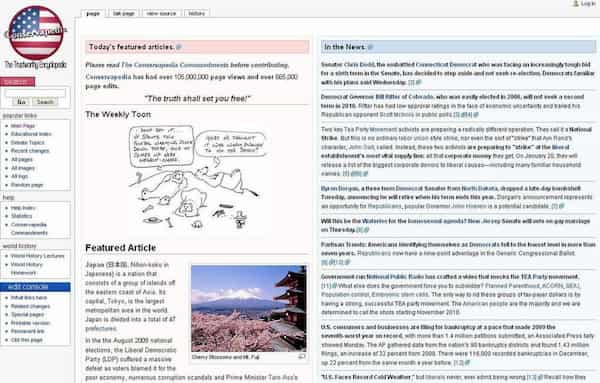
| Conservapedia | Yes | Moderated by editorial staff with a conservative viewpoint | Broad with ideological focus | Limited — not accepted by most academic institutions |
| Deletionpedia | Was free (now offline) | Automated archive of deleted Wikipedia content | Varied (rescued articles) | No — archival, not peer-reviewed |
| World Book Encyclopedia | No (subscription required) | Expert-authored, editor-reviewed | Broad, K-12 through adult | Yes — long-established editorial credibility |
| Grokipedia | Yes | AI-generated by Grok; user corrections reviewed by AI | Broad, comprehensive | No — not peer-reviewed; accuracy concerns noted |
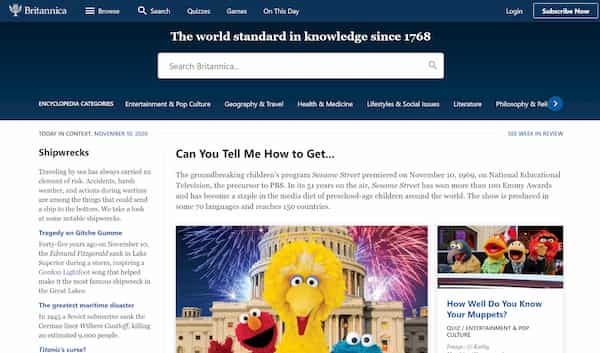
Encyclopedia Britannica Online
Scholarpedia
Wikipedia and Scholarpedia are both powered by MediaWiki software, but the similarities end there. Scholarpedia operates on a fundamentally different editorial model: only invited experts can contribute articles, and every submission goes through a formal peer-review process before publication. Before an article is published, it must be sponsored to verify the identity and authority of the author. At least two independent experts must publicly approve the content. The author’s name is permanently attached to each article, and any subsequent edits require the original author’s approval — eliminating the anonymous vandalism that plagues Wikipedia. Scholarpedia’s coverage is strongest in the sciences, particularly physics, computational neuroscience, mathematics, and computer science. Because each article functions essentially as a peer-reviewed publication with a named expert author, Scholarpedia entries are citable in academic papers in much the same way as review articles in scholarly journals. For researchers in the natural and computational sciences, Scholarpedia is arguably the single most credible Wikipedia alternative available.Oxford Reference
Oxford Reference (Oxford Reference Online) is a large, subscription-based online collection of reference works—dictionaries, encyclopedias, companions, and quotation books—published mainly by Oxford University Press.Encyclopedia.com
Encyclopedia.com lets you search across more than 200 encyclopedias and reference books in a single query. Encyclopedia.com reports that it has over 300,000 citable reference entries and more than 50,000 topic summaries The site aggregates content from professional publishers including Oxford University Press and Columbia Encyclopedia. Because Encyclopedia.com pulls from editorially vetted reference works rather than user-generated content, its entries are suitable for citation. The platform is entirely free, making it one of the strongest options for researchers who need reliable information without a subscription.Infoplease
Infoplease is a publication with roots in Pearson Education, the world’s largest distributor of educational literature. The genre can be traced to 1938, when Information Please debuted on American radio. Content is curated from trusted sources including the Random House Dictionary, U.S. Census Bureau, Library of Congress, and United Nations agencies such as UNESCO and the World Health Organization. Infoplease also offers multimedia features for research assistance. Rather than full-length articles, Infoplease provides brief, factual topic summaries. The information is vetted and tamper-proof — users cannot contribute to or edit the content. For quick reference checks backed by authoritative sources, Infoplease is a strong free option.Conservapedia
Deletionpedia
Deletionpedia was a site that rescued articles deleted from Wikipedia. It used an automated bot to detect Wikipedia pages flagged for deletion, then copied the content to its own archive so a version would persist for researchers. The site is no longer operational. Its shutdown left a gap for anyone interested in recovering deleted Wikipedia content, though the Wayback Machine and other archival tools can sometimes fill that role. Deletionpedia was never a citable academic source — its value was purely archival.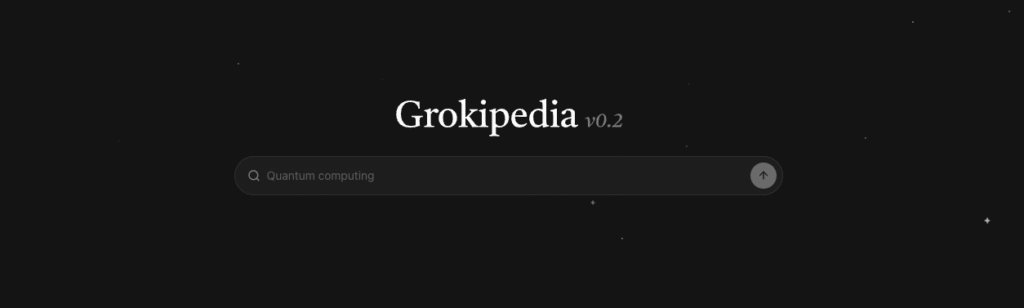
Launched in October 2025 by Elon Musk’s xAI, Grokipedia represents a rather different approach to knowledge aggregation. Unlike Wikipedia, which relies on a huge community of human volunteer editors, Grokipedia is almost entirely AI-generated. The site uses xAI’s large language model, Grok, to create, verify, and update its articles. Musk positioned the project as an ideological alternative to Wikipedia, arguing that the latter suffers from left-wing bias and “propaganda.”
Grokipedia’s editorial model is completely closed to direct human editing. While logged-in users can suggest corrections or new content via a web form, every proposal is evaluated and implemented exclusively by the Grok AI. The platform launched with hundreds of thousands of articles — many forked directly from Wikipedia — and quickly scaled to over 5.6 million entries by early 2026. Instead of traditional revision histories, articles feature recency indicators showing when the AI last refreshed the content.
Does Your Company Qualify for a Wikipedia Page?
Run a free notability check. Our analysis engine reviews real press coverage against Wikipedia's actual notability standards and emails you a detailed report — no sales call required.
Your notability check is running
We're analyzing coverage of right now — it usually takes 10–15 minutes. Your report link will arrive from noreply@reputationx.com; check spam if you don't see it. Keep reading — nothing else to do here.
Despite its rapid growth and free access, Grokipedia’s reliability for serious research is very much up for debate. External analyses have found that the AI-generated content frequently suffers from hallucinations, factual inaccuracies, and a reliance on low-credibility sources like social media conversations. Reviewers have noted that the platform often validates debunked conspiracy theories. Because it lacks human editorial oversight and peer review, Grokipedia is not currently accepted as a citable source in academic or professional contexts.
Wikipedia Alternatives for Specific Topics: Subject-Specific Wikis
Not every researcher needs a traditional encyclopedia. Many users searching for “Wikipedia-like websites” or “sites similar to Wikipedia” actually want wiki-style platforms focused on specific subjects rather than broad reference works. Several communities have built extensive wikis around particular domains:- Fandom (formerly Wikia): Hosts thousands of community-maintained wikis covering entertainment properties — from Star Wars and Marvel to video games and anime. Useful for pop culture research, though not citable in academic work.
- Citizendium: Founded by Wikipedia co-founder Larry Sanger, Citizendium requires real-name contributors and expert oversight. Though smaller and less actively maintained than Wikipedia, its editorial model provides a middle ground between open wikis and fully expert-authored encyclopedias.
- Academic and scientific wikis: Platforms like the SEP (Stanford Encyclopedia of Philosophy) and nLab (mathematics/physics) provide deeply specialized, expert-curated content in narrow academic fields. These are frequently cited in academic papers.
- Industry-specific wikis: Fields like cybersecurity, medicine (WikiDoc), and law maintain specialized wikis with varying levels of editorial oversight. Always verify the editorial model before citing.
How to Cite Wikipedia Alternatives in Academic Work
Identifying a reliable source is only half the job — you also need to cite it correctly. Below are formatting guidelines for citing three of the most commonly used Wikipedia alternatives in APA (7th edition) and MLA (9th edition) formats.Citing Encyclopedia Britannica Online
APA: Author last name, First initial. (Year). Title of article. In Encyclopædia Britannica. Retrieved Month Day, Year, from URL MLA: Author last name, First name. “Title of Article.” Encyclopædia Britannica, Publisher, Day Month Year of last update, URL.Citing Scholarpedia
APA: Author last name, First initial. (Year). Title of article. Scholarpedia, Volume(Issue), Page. https://doi.org/… MLA: Author last name, First name. “Title of Article.” Scholarpedia, vol. #, no. #, Year, doi:… Because Scholarpedia articles have named authors, volume numbers, and often DOIs, they cite almost identically to journal articles — a significant advantage over Wikipedia.Citing Encyclopedia.com
APA: Author or Editor (if listed). (Year). Title of entry. In Source Encyclopedia Title. Encyclopedia.com. Retrieved Month Day, Year, from URL MLA: “Title of Entry.” Source Encyclopedia Title, Encyclopedia.com, Day Month Year, URL. When citing Encyclopedia.com, always identify the underlying source (e.g., Oxford University Press, Columbia Encyclopedia) rather than just listing “Encyclopedia.com” — this strengthens your citation’s credibility.Frequently Asked Questions







Protect Your Online Reputation
Every day you wait, negative content gets stronger. Talk to our experts about a custom strategy for your situation.
Get Your Free Analysis