
Mastering Wikipedia’s Editing Rules: COI Explained
Discover how transparency, smart collaboration, and Wikipedia's own guidelines let you contribute responsibly even when you have a professional stake in the content.

- Always disclose your COI upfront on your Wikipedia user page and Talk pages before contributing.
- Never directly edit articles about your own company, clients, or executives — use edit requests instead.
- Keep all proposed content neutral, factual, and supported by independent third-party sources.
- Avoid removing negative but accurately cited information — it signals bias and triggers community scrutiny.
- Use Wikipedia's Talk pages and experienced editors as allies rather than trying to edit unilaterally.
Editing Wikipedia when you have a professional connection to the subject is risky but manageable if done transparently. This guide explains Wikipedia's conflict of interest rules, outlines common pitfalls, and provides practical strategies for contributing responsibly. By disclosing your COI, using Talk pages, and maintaining neutrality, you can engage with Wikipedia without damaging your credibility or your brand's reputation.
Have you ever spotted an error on your company’s (or client’s) Wikipedia page and wondered if you’re allowed to edit it yourself? If so, you’re not alone. Editing Wikipedia pages when you have a professional connection (a conflict of interest, or COI) is tricky ground. Maybe you work for the company mentioned or represent them in some way. Either scenario means you’ll need to tread carefully to keep your credibility—and Wikipedia’s trustworthy standards—intact.
Wikipedia isn’t your average content platform. It’s a community-driven resource guarded by dedicated editors who take neutrality seriously. A conflict of interest doesn’t disqualify you from contributing altogether, although you should never edit your own Wikipedia page.
Fortunately, navigating these rules doesn’t have to feel overwhelming. With transparency, good communication, and adherence to Wikipedia’s core principles, you can participate effectively without raising community eyebrows or compromising your brand’s reputation.
In this guide, we’ll break down conflict of interest clearly and practically. We’ll look at realistic scenarios, outline common pitfalls, and equip you with the tools and mindset you’ll need to edit responsibly—and confidently—on Wikipedia.
Understanding Conflict of Interest on Wikipedia
Whether you’re a marketing director, company executive, or PR representative, editors will flag your contributions if they’re seen as self-serving or promotional. Wikipedia defines COI broadly, encompassing any edits where your personal or professional ties could compromise neutrality.
For instance, suppose your CEO wants her Wikipedia profile cleaned up, removing less-than-flattering content. Removing negative, cited information without open discussion raises red flags immediately. Wikipedia communities notice—and often swiftly revert—such direct edits. Your intentions could be genuine, but perception matters as much as reality here.
Because Wikipedia’s credibility underpins its value, editors are vigilant against bias creeping into articles. Even if you’re providing solid, factual content, editors might initially question your motives due to your affiliation.
The best practice is simple: disclose your COI openly from the start and proactively engage the editing community.
Does Your Company Qualify for a Wikipedia Page?
Run a free notability check. Our analysis engine reviews real press coverage against Wikipedia's actual notability standards and emails you a detailed report — no sales call required.
Your notability check is running
We're analyzing coverage of right now — it usually takes 10–15 minutes. Your report link will arrive from noreply@reputationx.com; check spam if you don't see it. Keep reading — nothing else to do here.
Here’s an example of how a COI disclosure would look on an article’s talk page:
How Wikipedia Spots COI
Wikipedia editors actively look for patterns pointing toward conflict of interest edits. Telltale signs include:
- Newly created accounts that immediately begin editing articles related to a single organization
- PR-style content additions or removals of negative info without proper discussion or sourcing
- Primary sources
- Clearly promotional language slipping in
For example, if your corporate press release language suddenly appears verbatim in your company’s Wikipedia entry, that’s a quick path toward edits being flagged or reversed. Or, worst, page deletion. Editors frequently cross-check edits against public sources and company websites, making comparisons part of their routine diligence.
If your edits ever trigger a community response, avoid becoming defensive. Instead, return to Wikipedia’s COI guidelines for clarity, respond constructively, and openly discuss your position on the article’s Talk page. Genuine, transparent communication beats defensiveness every time.
Collaborate with the Wikipedia Community
Effectively managing COI hinges on honest collaboration with experienced editors. Wikipedia’s “Talk pages” attached to every article are your primary tool for doing exactly that.
Seeking Guidance from Veteran Editors
Wikipedia editors and admins frequently help contributors willing to engage openly. If you’re uncertain about an edit you’re considering, ask experienced community members directly through their user pages or the article Talk pages, clearly stating your COI along with succinct reasoning behind your proposed changes.
For example, introducing yourself transparently might look like this:
“Hi [Editor’s Username],
I work for [Company] and am aware of Wikipedia’s COI guidelines. I noticed a few inaccurate facts in the [Article] and have some neutral source-based corrections. What’s the best way for me to present these edits transparently and responsibly? Thanks!”
Starting like this signals responsibility and invites positive engagement rather than suspicion.
Handling Community Feedback Successfully
After making inquiries or suggestions, expect feedback—and don’t assume it will all be positive. Experienced editors sometimes reject initial drafts, highlight promotional phrasing, or ask for additional citations. This isn’t rejection; it’s refinement. Your professional tone and genuine openness to revisions usually earn you respect and credibility.
For instance, if an editor responds, “The draft you’ve submitted feels promotional in tone,” resist any defensive response. Reply constructively, something like: “Thanks for highlighting that. I’ll rephrase and provide additional reliable sources. Any specific areas you’d suggest changing?” By engaging respectfully, you build goodwill and reach mutually acceptable content improvement faster.
One NGO we worked with initially ran into trouble for including overtly promotional language. After openly discussing concerns with editors and adopting the advice they shared, revised edits sailed through smoothly. Constructive dialogue contributes significantly toward smoother acceptance.
Effective Engagement Reminders:
- Be patient and polite; volunteers may take some time to respond.
- Focus conversations on Wikipedia’s core standards: neutrality, verifiability, impartial tone.
- Clearly acknowledge feedback and be open to incorporating suggestions.
- Avoid personal theories, unpublished findings, or innovative interpretations that can be considered original research by Wikipedia.
Remember: transparent collaboration earns respect, smoothly shepherding your edits toward acceptance among Wikipedia’s editing community.
Common COI Pitfalls (And How to Avoid Them)
Even seasoned professionals can stumble when tackling Wikipedia. Here are a few common mistakes, and practical ways to avoid each:
Failing to Disclose COI Openly
Delay or concealment quickly turns minor concerns into major issues. Be upfront in clearly disclosing your COI early and visibly on your user page or the relevant article discussion pages.
Let’s say a marketing VP edits company pages periodically without disclosure. Even if each change seems minor, a perceived lack of transparency can raise suspicion and potentially lead to a full investigation by Wikipedia editors—rarely good for brand reputation.
Making Direct Edits Without Community Input
It’s tempting to simply correct simple inaccuracies fast, bypassing the discussion process. Resist that urge. Even minor direct edits can quickly lead to negative scrutiny if individuals suspect your COI wasn’t honestly disclosed first.
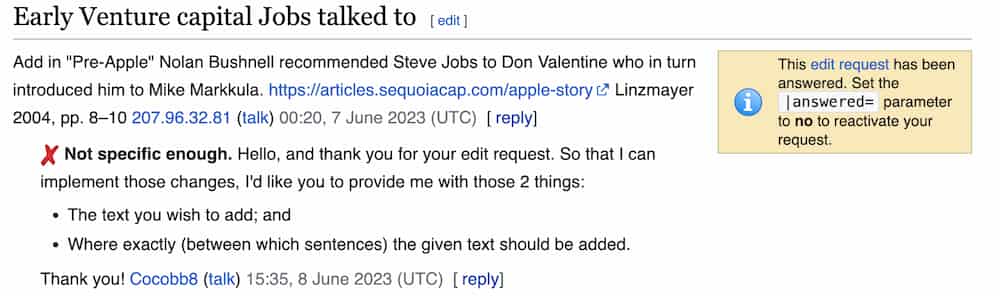
Instead, submit edit requests through Talk pages using neutral language and strong citations. Imagine your company’s financial stats are outdated or incorrect: briefly outline corrections with clear sourcing and invite an uninvolved editor to make the adjustment. You preserve trust, and updates happen smoothly.
Here’s an example of a healthy Talk page conversation requesting edits to the page:
Violations of Content Guidelines
Excessive marketing lingo—words like “leading,” “revolutionary,” or “award-winning”—shifts you quickly into red-flag territory. Keep language simple, factual, well-sourced, and neutral.
For example, instead of saying “Our groundbreaking platform completely changed the market,” cite third-party sources directly: “Independent publication [citation] called the product ‘a major advance in the marketplace.’” Let impartial sources speak for you—it’s stronger ethically and stylistically.
Leveraging the Pillar Article
Your COI strategy gains strength when linked to Wikipedia’s broader community principles outlined in “The Big Fat Guide to Mastering Wikipedia’s Editing Rules.”
This deeper resource helps you grasp underlying expectations clearly—such as aligning your edits with core values like “Neutral Point of View” (NPOV) and “Verifiability” —guiding your decisions ethically. When you’re drafting edits or submitting proposals, regularly referring back to these foundational rules ensures you’re consistently respecting and leveraging Wikipedia’s cultural norms effectively.
Useful Resources and Tools
Editing Wikipedia ethically becomes much simpler when using available internal guidelines like Wikipedia’s main COI policy page, Teahouse forums, Help Desk services, or our exhaustive guide to Wikipedia resources.
Third-party tools like WikiBlame and XTools can support edit tracking, transparency, and are particularly useful if questionable edits arise, allowing quick corrective engagement.
In particularly sensitive or complex cases, genuine Wikipedia specialists or ethical consulting firms (such as our own at Reputation X) advise practically and confidentially, saving potential missteps.
Conclusion
Successfully navigating COI discussions on Wikipedia isn’t simply about rule-following; it’s about transparency, fairness, and responsibility. Editing Wikipedia isn’t an exercise in public relations but rather a demonstration of genuine engagement, openness, and trusted communication.
Take time to build relationships, clarify your intentions, leverage practical resources—and above all, stay transparent. This patient yet purposeful approach safeguards your company’s credibility while respecting Wikipedia’s ethics.
Choosing the responsible path isn’t always simple or immediate, but integrity-led actions reliably lead to the safest—and most valuable—results for all involved.
Frequently Asked Questions







Protect Your Online Reputation
Every day you wait, negative content gets stronger. Talk to our experts about a custom strategy for your situation.
Get Your Free Analysis