
How to Rank In Googles Featured Snippets Results
Discover the exact strategies content marketers use to claim position zero and drive more organic traffic without relying on paid ads.

- Use SEMrush or Ahrefs to find competitor featured snippets and identify keywords worth targeting.
- Search Google directly to find snippet gaps, and mine 'People Also Ask' for additional opportunities.
- Mirror the structure of winning snippets — numbered lists, definition boxes, or tables — based on query type.
- Target long-tail keywords and phrase headings as questions to align with how users search.
- Nearly all featured snippets come from first-page results, so strong rankings are a prerequisite.
Google featured snippets appear at position zero in search results and can significantly boost organic traffic and visibility. To earn a snippet, you need to analyze competitor snippets, identify opportunities through Google search, and format your content to match what Google prefers for a given query. Targeting long-tail keywords, aligning with search intent, and organizing content with clear headings are essential steps in the process.
How to Rank in Google's Featured Snippets Results
-
1
Discover competitors' featured snippets
Use a keyword research tool like SEMrush or Ahrefs to find the featured snippets your competitors are ranking for and the focus keyword phrase behind each one. Pay close attention to the heading structure, paragraph length, and content format Google rewards for a given query. Then create content that mirrors the winning structure — without copying the content itself — to increase your chances of displacing that snippet.
-
2
Find snippet opportunities using Google
Search your target keywords directly in Google to see if featured snippets already exist for those terms. Also check the 'People Also Ask' and 'Related Searches' sections, as these reveal additional queries with high snippet potential. This manual process can surface opportunities you may have missed during competitive analysis.
-
3
Use long-tail keywords and questions in headings
Target longer, more specific keyword phrases in your headings rather than broad terms — for example, 'what is content marketing' instead of 'content marketing.' Including commonly asked questions as headings and providing direct answers signals content value to Google. This approach improves your probability of earning a featured snippet while also driving more qualified traffic.
-
4
Recognize the search intent behind each query
Identify what the user is actually looking for when they type a search query — whether it is informational, transactional, navigational, or something else. Tailor your content format to match that intent; for example, use numbered steps for 'how to' queries and definition boxes for 'what is' queries. Matching intent closely increases the likelihood that Google will pull your content into a featured snippet.
-
5
Organize your content strategically
Structure your content using clear H2 or H3 headings, numbered lists, or bullet points that align with the format Google already rewards for your target query. Well-organized content makes it easier for Google to extract a clean, relevant snippet from your page. Review the existing snippet format for your keyword and replicate that structure in your own content.
-
6
Stay within optimal word count limits
The ideal word count for your snippet-targeted content depends on the type of featured snippet you are pursuing, whether that is a definition box, list, table, or video. Keep answers concise and direct so Google can easily extract the most relevant portion. Overly long or padded responses reduce the likelihood of your content being selected as a snippet.
Google is constantly developing new features that ensure better user experiences. One of these features is the Google featured snippets, which appear first in the search engine results pages (SERPs). The featured snippets’ position is often referred to as position zero.
The Google featured snippets are pulled from website pages on Google and displayed differently depending on the search query. They can either be in the form of a definition box, table, unordered bulleted list, ordered numbered list, or video content.
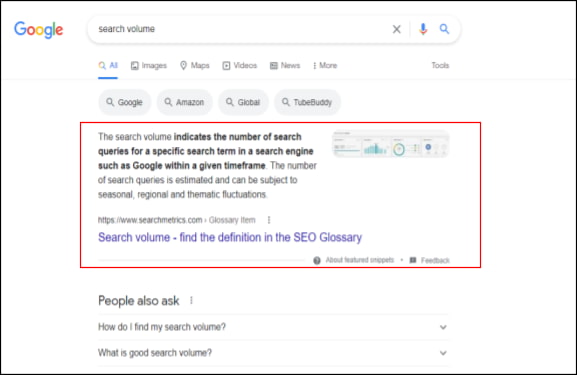
Featured snippets make it easy for users to get answers to their questions without clicking on the link. For instance, if you Google “search volume,” the first search result is a definition box. You can read through and get answers to that query without clicking through to the hosting website.
The feature has proven valuable for content marketers looking to boost conversion rates and drive more organic traffic. Research consistently shows that featured snippets capture a significant share of clicks — underscoring just how much visibility a snippet position can deliver.
If you want your content featured on Google snippets, read on to learn how to achieve it.
- Discover competitors’ featured snippets
- Find snippet opportunities using Google
- Use long-tail keywords and questions in headings
- Recognize the search intent
- Organize your content
- Stay within optimal word count limits
Discover Competitors’ Featured Snippets
Spying on your competitors is one of the easiest ways to identify Google featured snippet opportunities. By finding existing featured snippets, you can identify keywords to target and steal those positions from the competition.
Use a keyword research tool like SEMrush or Ahrefs to find the featured snippets your competitors are ranking for and the focus keyword phrase behind each one.
Discovering competitors’ featured snippets also reveals the content structure Google prefers for a given query. You can then format your content similarly to increase the chances of displacing that snippet.
Get a Free Reputation Assessment
Find out what people see when they search for you online. No obligation — results in 24 hours.
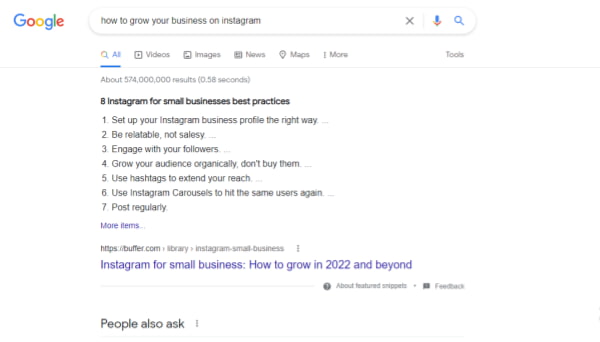
For instance, in the featured snippet below, Google prefers step-by-step content for the search query. With this information, you can create a similar piece of content using a numbered list and H2 or H3 headings for each point.

You can also examine backlinks, readability scores, and word count. Let those insights guide your content creation process. Use a content paraphrasing tool to ensure you don’t plagiarize your competitors’ work.
Find Featured Snippet Opportunities Using Google
You can also find featured snippet opportunities directly from Google. Start by identifying a specific keyword or content topic, then run a search to see if featured snippets already exist for those keywords. It’s a more manual process, but it can surface opportunities you may have missed during competitive analysis.
Check other sections of the Google SERPs as well, including “People Also Ask” and “Related Searches.” These sections reveal the keywords and content ideas most likely to earn a featured snippet. Understanding how People Also Ask works and whether it can be influenced is a valuable complement to your snippet strategy.
For example, in the image below, the search query “seed list” has a featured snippet. Writing a concise seed list definition while utilizing NLP could help you earn it. The “People Also Ask” section also reveals related queries with additional snippet opportunities.

A high ranking increases the chances of your content appearing in snippets. Multiple studies, including ongoing research from Ahrefs, have consistently found that nearly all featured snippets come from pages already ranking on the first page — making strong overall SEO a prerequisite, not an afterthought.
Since engagement may help your SEO ranking, use email marketing to reach more people who might be interested in your content. Build and grow your email list using sign-up forms on your site, and notify subscribers every time you publish a new post.
Want to Dominate Search Results?
Featured snippets are just one piece of a strong SEO reputation strategy. Our team can help you build the content authority and search presence you need to rank — and stay ranked.
Use Long-Tail Keywords and Questions in Headings
Thanks to features like Google voice search, search queries are becoming more specific, longer, and conversational. These queries form targeted keywords that tend to be long-tail or question-based.
Including commonly asked questions in your headings and providing quick, direct answers increases readership and signals content value to Google. That improves the probability of landing a featured snippet.
Long-tail keywords use longer, more specific terms than broad keyword categories. Instead of targeting “content marketing” in a heading, target “what is content marketing” or “what does content marketing involve.” The latter drives more qualified traffic and puts you in a stronger position for a featured snippet.
Recognize the Search Intent Behind Each Query
Search intent is understanding what an online user is looking for through their search query. If the query is “how to grow your business on Instagram,” the user wants a step-by-step guide. Provide that information in simple, numbered steps.
There are four primary categories of search intent:
- Informational – Users are looking for information. An example query: “what is online reputation management?”
- Transactional – Users are looking to make a purchase. An example query: “best online reputation management company.”
- Navigational – Users are looking for a specific page or brand. An example query: “Reputation X online reputation management company.”
- Commercial investigation – Users are weighing options and looking for reviews. An example query: “Reputation X reviews.”
Understand the intent behind every query, then create high-quality content that satisfies it fully. For example, targeting the informational query “what is online reputation management” calls for a thorough article covering every detail the reader needs.
Creating content that satisfies search intent increases your chances of earning the featured snippet for that query.
Organize and Format Your Content for Snippets
Google appreciates well-structured content. Proper formatting makes it easier for search crawlers to index your content and creates a better user experience. This is closely related to writing for both search engines and people — a balance that directly influences whether Google selects your content for a snippet.
Use headings correctly. Break down your content using H1, H2, and H3 tags. Use H4s where necessary, but maintain simplicity — bullet points or bold text can often replace H4s effectively.
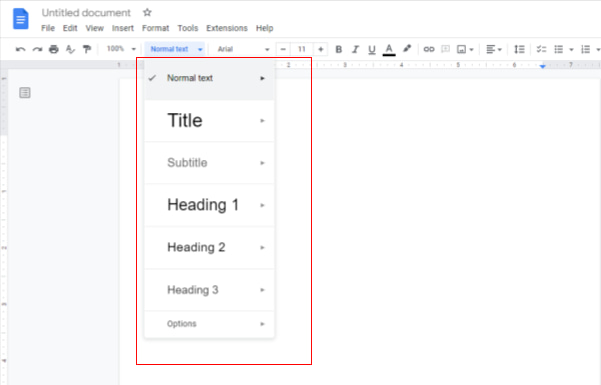
You can also add phrases and tags to your headings to clarify the type of featured snippet you are targeting. If your content outlines a step-by-step process, number the headings in chronological order. For a definition box, wrap your answer in a standard paragraph tag.
Stay Within Optimal Word Count Limits
Google featured snippets are designed to answer users’ queries as quickly and simply as possible. Google does not publish official word limits, but SEO experts recommend different counts for different snippet types.
- Recent analyses from SEMrush and other SEO researchers suggest the optimal word count for a featured snippet paragraph typically falls in the range of 40–60 words, though this varies by query and content type.
- A study by Portent found that listed featured snippets typically range between 5–8 points, with the most common word count landing around 40–45 words.
- The same study reports that most tabular snippets have 25 characters or fewer per table cell, with a maximum of five rows and three columns.
The optimal word count ultimately depends on the specific snippet type displayed for your target query. Look at the character or word count of the existing featured snippet and ensure yours stays within that range.
In Closing
Ranking in Google featured snippets increases brand exposure and drives meaningful traffic to your site. The best way to earn a featured snippet is by producing quality content that Google recognizes as the most direct, well-structured answer to a query. A strong featured snippet strategy also supports broader SEO reputation management goals by ensuring your best content — not a competitor’s — is what users see first.
Start by discovering your competitors’ featured snippets and studying how they have structured their content. Use long-tail keywords and questions in your headings. Recognize the search intent behind each query and create content that aligns with it. Finally, organize your content clearly and stay within optimal word count limits.
Follow these steps consistently, and you will be well-positioned to secure a featured snippet.
Frequently Asked Questions








Protect Your Online Reputation
Every day you wait, negative content gets stronger. Talk to our experts about a custom strategy for your situation.
Get Your Free Analysis