
SEO Reports: Traffic Ranking and Backlinks: What to Look For
Before your next SEO report lands in your inbox, know exactly which metrics signal real progress and which ones are just noise.

SEO reports should balance technical detail with clear, actionable insights that demonstrate real business value over time. A strong report covers five key areas: traffic quality, custom goal tracking, keyword rankings, backlink analysis, and future recommendations. Understanding these components helps you hold your SEO provider accountable and ensure their work aligns with your actual business goals.
How to Read and Evaluate an SEO Report
-
1
Review overall website traffic
Start by examining the total increase in website traffic, which is the most fundamental metric in any SEO report. Use tools like Google Search Console to view total clicks, impressions, click-through rate, and average position. Keep in mind that raw traffic numbers are only meaningful when measured against your business goals.
-
2
Analyze page-level traffic distribution
Look at where visitors go after landing on your website to understand which pages are resonating with your audience. If traffic is concentrated on product pages, consider optimizing those pages for better conversions. If visitors gravitate toward blog content, that signals an opportunity to produce more top-of-funnel resources.
-
3
Identify traffic sources
Determine which channels, pages, or content pieces are driving the most visitors to your site. If a particular blog post is attracting a significant share of traffic, consider creating similar content or repurposing it into other formats such as infographics or explainer videos. Understanding traffic sources helps you double down on what is working.
-
4
Set up custom goal tracking
Use Google Analytics to create custom goals during the onboarding process with your SEO provider. Set up your own Google Analytics and Google Search Console accounts so you can independently access and interpret your data. Custom goals allow you to assign monetary values and track specific conversion events tied directly to your SEO investment.
-
5
Evaluate conversion metrics
Review both site-wide and page-level conversion data to identify which products or pages are performing best. Ensure your reports include the source of each conversion so you understand which SEO efforts are generating the most return. Conversions are a direct measurement of ROI and should be treated as the most critical metric in your report.
-
6
Assess keyword ranking changes
Examine how your target keywords are performing across search engines and track any movement up or down in positions. Your SEO report should cover all ranking changes for various pages and keywords, including minor positional shifts. Search results change constantly, so the absence of any drops or fluctuations may indicate incomplete reporting.
-
7
Review your backlink profile
Evaluate the quality and quantity of backlinks your site has gained over the reporting period. A strong backlink profile signals authority to search engines and contributes to improved rankings over time. Your SEO provider should present this data clearly, showing growth trends and the sources of new links.
-
8
Check for actionable recommendations
A well-structured SEO report should conclude with concrete next steps and suggestions for future optimization efforts. These recommendations should be tied directly to the data presented in the report and should guide your strategy going forward. If your provider is not offering forward-looking guidance, ask them to include it in future reports.
As a client, you need to understand what your SEO provider is doing in an objective way. This article outlines the types of things you should look for in an SEO report.
SEO service providers must prove the value they are adding to your business both in the short and long term. Remember that SEO work is often a long game, so don’t expect to see massive changes overnight. It’s more important that your SEO service provider keeps you in the loop of changing search results with transparent reporting every step of the way.
With that said, with all of the terminology and charts understanding SEO reports can be a confusing task.
A good SEO report should strike a balance between necessary technical information and in-depth analytics in a way that showcases trends over time. If a report is too complex, it will be shoved aside for “later,” which may never come. If it’s too basic, then it’s difficult to see the value your service provider is adding to your business.
Ideally, an SEO report should be straightforward, easy to understand, and should contain information about the metrics that matter most. But what metrics are most important for SEO?
What is an SEO report?
SEO reports help you understand what you are doing to improve your rankings for specific keywords or phrases, how often you are ranking, which search engines you are ranking for, and which keywords are working. This information helps you track your search engine optimization (SEO) initiatives and make adjustments as needed.
There are many types of SEO reports. This article will discuss the following types:
Get a Free Reputation Assessment
Find out what people see when they search for you online. No obligation — results in 24 hours.
- Traffic report
- Custom goal creation and reporting
- Ranking analysis
- Backlink analysis
- Future suggestions
In the following sections, we will talk about the must-have metrics for a good SEO report, and how to use the information to improve your website and rankings. Let’s begin:
Traffic report
Traffic is one of the most common goals for search engine optimization. But traffic alone isn’t as important as the “right” traffic. For example, if you have traffic for search terms that are not relevant to your brand it will appear you have succeeded because your traffic numbers are going up. But traffic should always be measured against goals (discussed below).
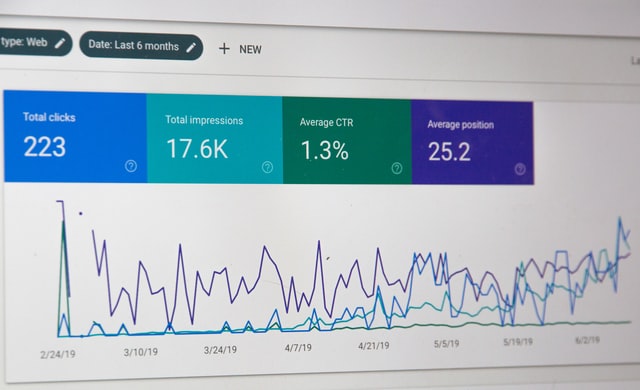
The graphic above is a traffic report for the free tool Google Search Console. It shows the total number of clicks, impressions, CTR (click-through rate), and the average position in Google.
A traffic report should contain information about three aspects of traffic. These are:
- Website traffic: This one is a no-brainer. The total increase in website traffic is the easiest metric to track, and should always be included in SEO reports.
- Page-level traffic: While website traffic tells us how many people are visiting your website, page-level traffic tells us where they go after entering your website. This information lets you determine what’s working for your audience and what isn’t. If, for instance, the traffic is going to product pages, then maybe you need to optimize your product pages for better conversions. Similarly, if the traffic is more interested in the resources/blog section of your website, maybe you should focus on putting out more valuable information for top-of-the-funnel visitors.
- Traffic sources: When an SEO report contains the source of new (and existing) traffic, you can gauge what is working for your website. For instance, if a particular blog post is attracting most of the traffic, you should consider producing similar content and maybe even repurposing that exact piece of content into an infographic or an explainer video.
Custom goal creation and reporting
You can have a lot of traffic without reaching goals. That’s where goal reporting comes in.
Free tools like Google Analytics (GA4) (and any other SEO tool that you may be using) can work to track custom key events. This is often one of the first steps of any SEO strategy. It is usually a part of the onboarding process with your SEO provider. But you should also set up your own Google Analytics and Google Search Console accounts (again, free) so you can slice and dice the information to your liking rather than just wait for your SEO provider to give it to you their way.
One of the most popular reporting tools is Google Analytics. Google Analytics offers a number of customizable features to track your goal progress. Here are a few things to know about Google Analytics:
- Monetary values: GA4 lets you associate a monetary value with each key event (formerly a “conversion,” and before that a “goal” in the now-retired Universal Analytics). Each time a key event fires, Google records the associated dollar value and provides you with a tangible ROI for your efforts.
- Custom events: These custom events can be marked as key events. Tracking key events is simple and provides a wealth of information that can be used to make future SEO endeavors more fruitful.
- Site-wide conversions and page-wise conversions: If certain product pages or products are performing better than the others, then this information can be very useful. Also, make sure your reports include the source of each conversion.
Conversions are perhaps the most important metric to track as they are a direct measurement of the ROI of your investment in SEO services.
Ranking analysis
Ranking for relevant keywords will drive traffic to your website and direct it to conversion events. This is an important metric to track and should be included in your SEO reports. Below is a screenshot from the SEO tool Ahrefs that shows volume and Google ranking for the New York Times.
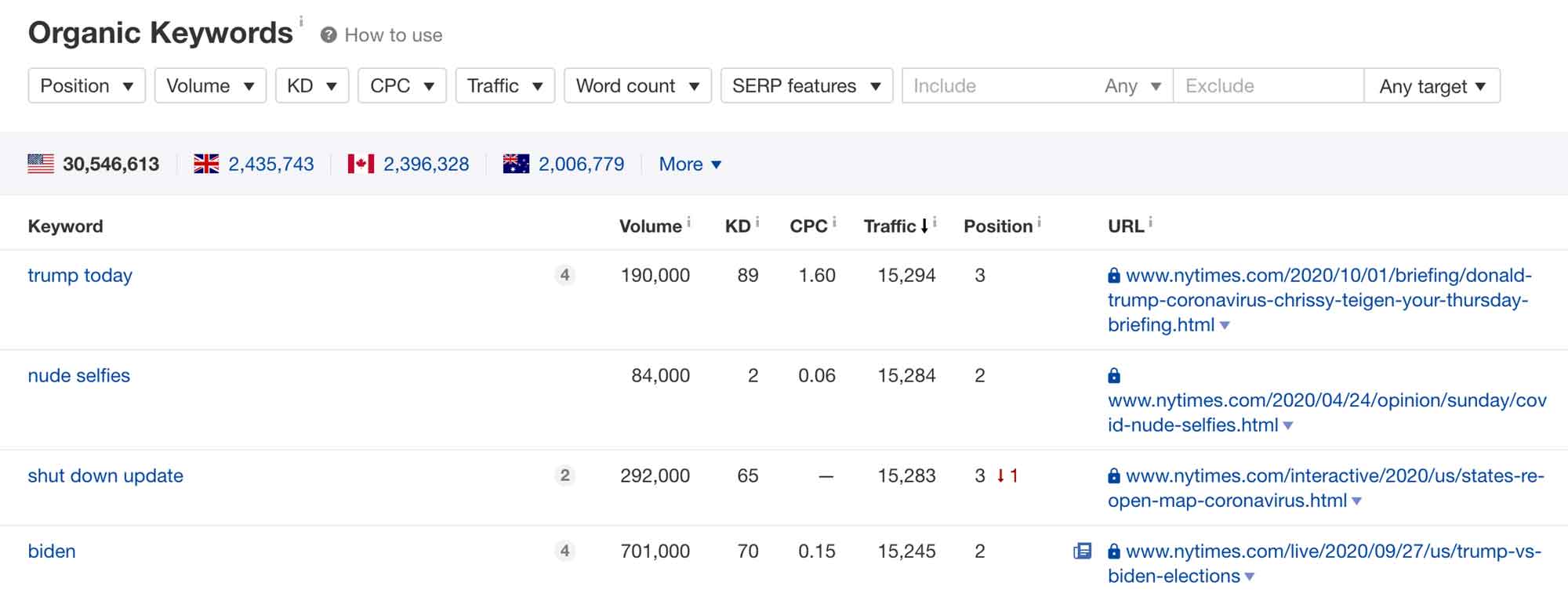
Your SEO reports should have information about all the changes in rankings of various pages for various keywords. This also includes the instances where a page may have moved up or down a few positions. In the graphic above you’ll see that the Times has dropped for one of the search terms by one position since the last check. Search results change all the time, so if there are never any drops in rank, you should be wary of the integrity of your SEO provider.
As a result, fluctuations in rankings are perfectly normal (especially with new algorithm updates being launched every few months), and tracking long-term data is important.
Backlink analysis
Building and strengthening the backlink profile from relevant websites is one of the most important, difficult, and time-consuming aspects of search engine optimization. Below is an example of a backlink report (also from Ahrefs).
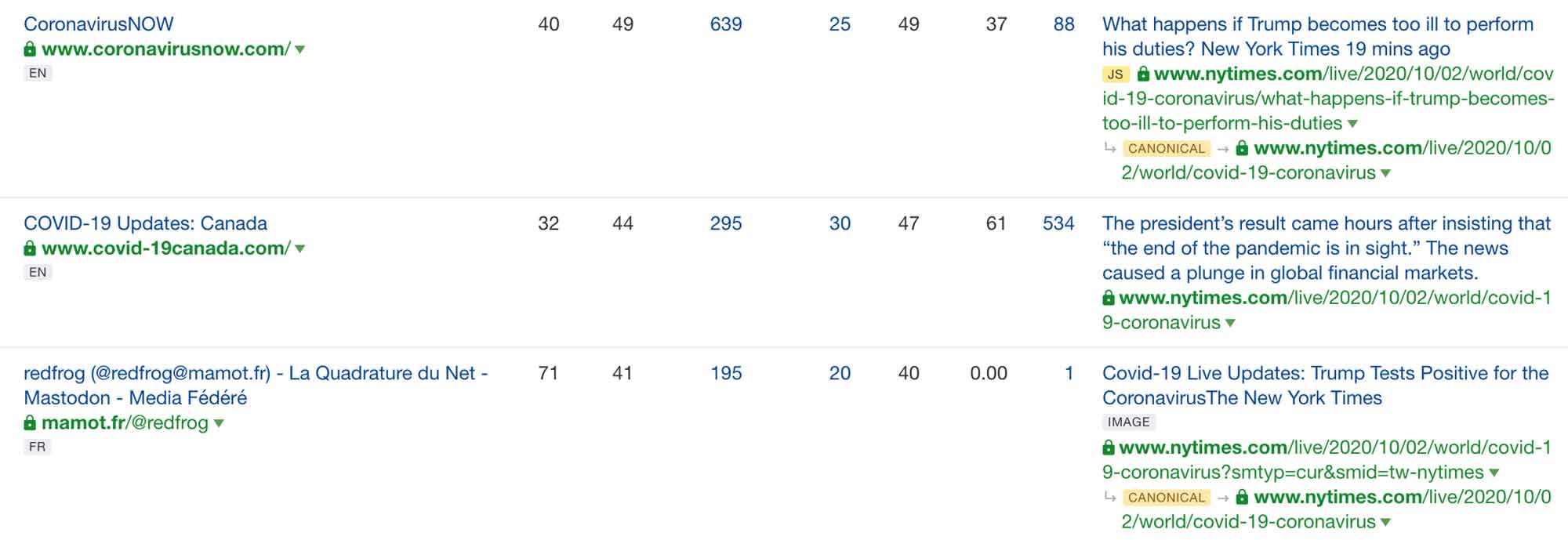
Thus, it makes sense to include information about the impact of your backlinking endeavors in SEO reports.
With that said, there are many easier but less effective ways of obtaining backlinks. Whether you should focus on quantity or quality, is a decision that you will have to make with your SEO professional.
Whatever you decide, make sure your SEO team clearly communicates the decision, the reasoning behind it, and its impact on your project.
Future suggestions
At this point, you should be clear about what is working for your website, which actions are bringing in the best results, and which website pages or content assets have moved up the SERP ranks.
With this intelligence, you can determine where you should focus your future efforts in order to drive impactful results.
A good SEO service provider will include any actions or suggestions that you can include in your SEO strategy to continue to move the project forward. This will align both your goals and your SEO provider’s action plan to ensure that you are always working together to reach the same goal.
Final thoughts
With the abundant availability of SEO tools and website activity tracking tools, detailed SEO reports can show off the excellence of your SEO services. The right mixture of key performance indicators, insights, and metrics will ensure that you can work with your SEO team to obtain maximum results.
Traffic, rankings, backlinks, and conversions are some of the most basic yet impactful and thus, important metrics that any SEO report is incomplete without. Check out this example to get an idea of what an SEO campaign looks like.
What metrics are in your SEO reports? Tell us about them in the comment section below.
Frequently Asked Questions







Protect Your Online Reputation
Every day you wait, negative content gets stronger. Talk to our experts about a custom strategy for your situation.
Get Your Free Analysis