
Entity SEO: Building Your Entity in Google’s Knowledge Graph
How to make search engines and AI systems recognize your brand as a distinct, trusted entity — and why it now determines your AI search visibility.
Entity SEO is the practice of building your brand so search engines and AI systems recognize it as a distinct, trusted entity in Google's Knowledge Graph. Unlike keyword SEO, which matches text strings, entity SEO establishes meaning and relationships. Build an entity home with Organization schema, add a Wikidata entry, earn corroborating brand mentions, and claim your Knowledge Panel. Entity strength is now the prerequisite for appearing in Google AI Overviews, Gemini, ChatGPT, and Perplexity — because AI systems use the Knowledge Graph to resolve and verify entities before citing them.
Entity SEO is the practice of building your brand’s presence so search engines and AI systems recognize it as a distinct, trusted entity in Google’s Knowledge Graph — a database that, per Google’s last publicly confirmed figure, held more than 500 billion facts about 5 billion entities as of 2020, the most recent total the company has disclosed. It optimizes for real-world meaning, not text strings, so your brand surfaces in Knowledge Panels and AI-generated answers rather than being invisible to the systems that increasingly decide what users see first.
When Google introduced the Knowledge Graph on May 16, 2012, its engineers framed the shift as “things, not strings” — search would recognize the real-world things words referred to, and the relationships between them. That idea underlies everything in this guide.
The stakes are straightforward. If Google does not recognize your brand as a distinct entity, it cannot confidently surface you in a Knowledge Panel or cite you in an AI-generated answer. This guide covers what entity SEO is, why June 2025 changed the rules, how the Knowledge Graph works, and the eight-step sequence to build and defend your brand entity.
What Is Entity SEO?
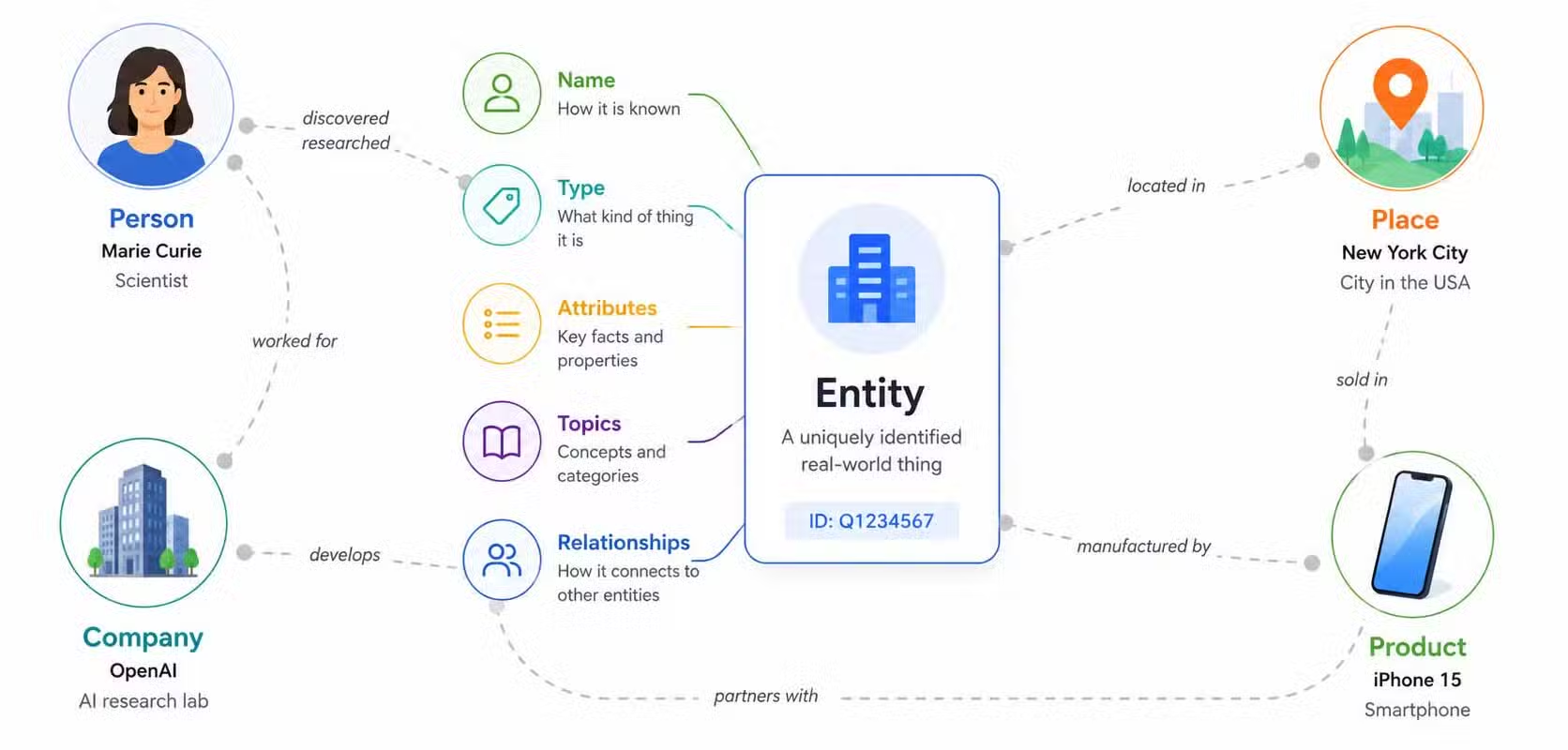
Entity SEO is the practice of optimizing your website and online presence to be recognized as a distinct, trusted entity by search engines. In Google’s model, an entity is “a thing or concept that is singular, unique, well-defined, and distinguishable” — a person, place, organization, concept, product, or event that can be told apart from everything else (SchemaApp, citing Google).
The distinction from traditional SEO is precise: “Keyword SEO focuses on matching strings of characters. Entity SEO focuses on matching real-world meaning” (The Content Beacon). Keyword SEO asks whether your page contains the words someone typed. Entity SEO asks whether Google understands what — and who — your page is about.
This shift did not happen overnight. Entity-based search began replacing string-based search around 2013 with Hummingbird, and every major update since has pushed further toward meaning: RankBrain in 2015, BERT in 2019, MUM in 2021, and AI Overviews in 2024 (Jottler). Each step moved Google closer to matching intent and entities rather than raw keyword strings.
Entity SEO does not replace keyword and link-based SEO — strong pages and strong backlinks still drive traffic. What has changed is the ceiling. For Knowledge Panels and AI answers, a brand Google cannot resolve as an entity is effectively invisible, regardless of keyword rankings. The practical move is to continue sound on-page and link work, then layer entity signals on top so Google can attach all of it to a single recognized “thing.”
Entity SEO vs. Keyword SEO
| Dimension | Keyword SEO | Entity SEO |
|---|---|---|
| What it matches | Text string | Real-world meaning |
| Primary signals | Backlinks, on-page keywords | Brand mentions, schema, Knowledge Graph edges |
| Role in AI search | Weaker signal | Primary signal |
| Reputation impact | Indirect | Direct (Knowledge Panels, AI answers) |
How Does Google’s Knowledge Graph Work?
Google’s Knowledge Graph is a knowledge base of entities and the relationships between them. Google describes it as “our database of billions of facts about people, places, and things,” built to answer factual questions directly (Google Knowledge Panel Help). The last figure Google has publicly confirmed is more than 500 billion facts about 5 billion entities as of 2020 (Wikipedia) — the company hasn’t published an updated total since, and has more recently focused on pruning the graph for accuracy rather than growing it.
Structurally, the graph is nodes, edges, and attributes. Each entity lives as a node with key attributes: a name, a type (person, organization, concept, product), a description drawn from high-trust references, identifiers such as a Wikipedia URL or an official website, and relationships to other entities (The Content Beacon). Entity SEO is, at bottom, the work of getting those attributes filled in correctly and corroborated widely.
Get a Free Reputation Assessment
Find out what people see when they search for you online. No obligation — results in 24 hours.
Google draws on multiple sources: public references, licensed data feeds, and “factual information directly from content owners… including from those who suggest changes to knowledge panels they’ve claimed” (Google Knowledge Panel Help). Two public sources dominate: “Wikipedia offers detailed articles, while Wikidata provides structured data about those entities, which Google uses to populate knowledge panels” (Clearscope). For a fuller picture of which sources Google’s Knowledge Panel actually relies on today — including the 200,000-plus trusted references beyond Wikipedia — the corpus index goes into considerable depth.
One distinction trips up almost everyone. The Knowledge Graph is the database; the Knowledge Panel is the display. As Semrush puts it, the Knowledge Graph “is an informational database, whereas a knowledge panel is a part of the SERP that displays information about an entity” (Semrush). For a side-by-side breakdown of how the Knowledge Graph and Knowledge Panel differ — and why the distinction matters for brand management — see our dedicated explainer. You cannot edit the Knowledge Graph directly — you influence it by strengthening the signals it reads.
Why Did June 2025 Change the Rules for Entity SEO?
In June 2025, Google removed more than three billion entities from the Knowledge Graph in a single week — the sharpest contraction the database has seen. Ahrefs interpreted the move as Google “prioritizing a leaner, higher-quality dataset to power its AI features more reliably” and drew the clear lesson for practitioners: “quality and consistency of entity signals matter more than ever” (Ahrefs, 2026).
Per third-party analysis by OutpaceSEO, the graph had expanded rapidly to roughly eight billion entities, much of it filed under the generic “Thing” type. That same analysis estimates the June 2025 update cut the database by about 6.26% overall and reduced “Thing”-labeled entities by 15.27% (OutpaceSEO). These percentages are third-party estimates Google has not confirmed; treat them as directional.
The entities that survived were consistently described, well-corroborated across independent sources, and clearly structured. A vague, thinly sourced, or contradictory entity was precisely the kind of “Thing” Google had reason to delete. Entity SEO stopped being a growth tactic and became a durability requirement.
Why Entity SEO Now Drives AI Search Visibility
Entity strength is the prerequisite for AI search visibility. AI Overviews, AI Mode, and Gemini “all draw on [the Knowledge Graph] to resolve entities, verify facts, and decide which brands deserve to be mentioned in AI-generated answers” (Ahrefs, 2026). A brand Google cannot resolve as an entity is a brand its AI systems have little reason to cite.
The signal mix has shifted, too. Per Ahrefs’ analysis of 75,000 brands, branded web mentions correlate more strongly with AI Overview citations than traditional backlinks (0.664 vs. 0.218) — a meaningful reversal of the old link-first playbook. The same analysis reports that the large majority of AI Overview citations come from pages already ranking near the top of organic results, though the AI rarely simply picks the number-one result. Being widely and consistently mentioned now competes with, and often beats, being linked.
This is why entity SEO is the foundation for Generative Engine Optimization. AI-powered systems — Google AI Overviews, ChatGPT, and Perplexity among them — “are built on entity recognition” and connect a query to entities they already know and trust before deciding whom to cite (Crawlvision). That is why generative engine optimization starts with entity data, not keywords. If your brand is associated with recognized entities, you are far more likely to appear in generated answers. Entity work is the groundwork; GEO is what it enables.
How Is Entity SEO Related to Online Reputation Management?
Entity reputation management is the part of online reputation management focused on how search engines and AI systems understand who you are. The goal is “improving those identity signals so the right details show up, the wrong ones stop sticking, and your branded search results become more consistent” (Erase.com). Entity clarity is a reputation asset; entity ambiguity is a reputation risk.
The connection runs directly through the Knowledge Graph. A recognized brand entity “may appear in Knowledge Panels and have stronger AI reputation signals,” which is why consistent naming, Organization schema, and mentions in credible publications form the technical backbone of reputation work (Devtrios). The same accuracy that helps Google build your entity also prevents misinformation from populating prominent search features — through Organization and Person schema, consistent NAP citations, Wikidata entries, and authoritative directory listings (ContentRemoval.com).
The clearest reputation failure mode is disambiguation. Consider an entrepreneur with a clean record whose reputation is damaged by a similarly named individual involved in negative press. Google and AI engines confuse the two, causing reputational harm by association (Kalicube). The fix is not deletion — it is teaching the algorithms to see the two as distinct, separate entities through a sustained effort to build unambiguous signals around the right person. How Wikipedia shapes your online reputation — and when its editorial dynamics work against you rather than for you — is a related dimension of this challenge worth understanding.
A related failure mode is not two people confused, but one person under-defined. When an entity is thin, Google fills the gap with whatever it can find — including negative results — because it lacks a richer, corroborated picture to draw on.
Working with a client who was both a licensed pharmacist and an avid comics enthusiast, the Reputation X strategy team analyzed a set of comparable individuals to understand how entity signals could be constructed across both identity dimensions. By developing content in both the medical and comics-fan domains, the team built a more complete, well-corroborated entity profile — one that gave search engines a clearer, richer picture of who this person was. Over the course of the project, the combination of medically oriented and fandom-oriented content contributed to reducing the visibility of negative results for searches on the client’s name.
— Reputation X Delivery Team
That work is entity SEO applied to reputation: not scrubbing content, but adding enough true, corroborating signal that algorithms understand the person well enough to surface the right things. Reputation results vary with the facts of each situation; questions about defamation or unlawful content belong with qualified legal counsel.
8 Steps to Build Your Entity in Google’s Knowledge Graph
The sequence below moves from diagnosis to durable maintenance. Each section explains the reasoning behind the moves that most often get done wrong; step-by-step instructional detail lives in the Steps module above.
Step 1 — Run an Entity Audit
Start by confirming whether Google already recognizes you — and what it thinks you are. Query the Knowledge Graph Search API for your brand name; if a result exists, it returns a Google-specific mid identifier (e.g. kg:/m/0d05w3), not a Wikidata Q-ID — note whether the entity type is correct. Google is explicit that the API is read-only and “not suitable for use as a production-critical service,” so use it as a diagnostic, not a dashboard. Polling it over time shows how your entity evolves as you build signals.
An audit is worth doing first because it changes the entire plan. A brand Google has already typed as “Organization” needs corroboration and cleanup. A brand Google does not recognize at all needs an entity home built from scratch. A brand Google has mistyped or confused with a namesake needs disambiguation work first. Skipping the audit means guessing at which situation you are actually in.
Step 2 — Build Your Entity Home
Your entity home is the single canonical URL that anchors how algorithms, crawlers, and people understand your brand — a concept formalized by Jason Barnard of Kalicube. In practice it is almost always your About page: the URL that carries your Organization JSON-LD block, with an @id pointing to your canonical domain and every sameAs declaration in one place (DigitalApplied).
At minimum, that Organization block should declare @type, @id, name, url, logo, foundingDate, description, and a sameAs array pointing to authoritative profiles — Wikipedia, Wikidata, LinkedIn, Crunchbase, and your verified social accounts. The @id is the load-bearing field: it gives every other page on your site a single canonical entity to reference, so your markup describes one consistent “thing” rather than a scattering of unconnected pages.
Step 3 — Create or Claim a Wikidata Entry
Wikidata stores structured data for Wikipedia and other Wikimedia projects, and a significant portion of the Knowledge Graph is built from it. Ahrefs makes the case directly: getting listed on Wikidata “is as important (possibly more important) than getting a Wikipedia page, because it’s considerably more achievable” (Ahrefs, 2026). Creating a Wikidata item is straightforward, but you must satisfy Wikidata’s notability policy and back every statement with good sources. Our guide on how and why to set up a Wikidata entry covers the property-and-statement structure in practical detail.
For reputation-sensitive brands, there is a real trade-off between Wikidata and Wikipedia. Wikipedia articles are editorially controlled by volunteer editors, which means the narrative — including any negative framing — is not yours to set, and a page can become a liability as easily as an asset. How Wikipedia affects brand reputation — including how its neutrality policies interact with promotional editing — is worth reading before you invest in either platform. Wikidata is more structured and less prone to editorializing. That makes it a lower-friction starting point for many brands. This is a practical observation about how each platform works, not a reason to avoid Wikipedia; for many brands a well-sourced presence on both is the right answer. Weigh the editorial exposure deliberately before investing.
Step 4 — Implement Schema Markup (sameAs, @id, FAQPage)
Schema markup is how you build an entity graph crawlers can read. Done consistently, it lets search engines “see how entities relate, forming a connected graph rather than isolated data points” (Search Engine Land). The sameAs property does the disambiguation heavy lifting: by linking your entity to its authoritative external definition, it helps “search engines align your content accurately with user queries” (SchemaApp).
The primary types for entity work are Organization, Person, FAQPage, and Article. One caveat governs all of them: “Google evaluates schema markup page-by-page” (Search Engine Land), so a single well-marked About page is not enough — entity references must be consistent across the site. Validate everything with Google’s Rich Results Test before relying on it.
Step 5 — Build Topic Cluster Content
Topical authority “is built by creating comprehensive content clusters that thoroughly cover a primary entity and its related sub-entities” (OutpaceSEO). The structure is pillar-and-spoke: each core entity gets one comprehensive, evergreen pillar, supported by narrowly focused spokes — comparisons, how-tos, case studies — that “always link up to the pillar and sideways to each other where logical” (The Content Beacon).
The reason this reinforces your entity is mechanical: every internal link between related pages is another edge in the graph Google reads. A dense, well-connected cluster tells Google not just that your brand exists, but that it is authoritative on a defined set of related topics — exactly the corroboration the June 2025 pruning rewarded.
Step 6 — Earn Brand Mentions Across Authoritative Sources
Corroboration does not require links. “Not every mention needs a link, because brand mentions without links still contribute to entity corroboration.” The aim is “unambiguous mentions of your organization name alongside attributes… in domains that Google treats as authoritative sources” (DigitalApplied). A mention that names your brand and its category in a trusted outlet feeds the entity even without a hyperlink.
This is where entity SEO and reputation work fully converge. Earned coverage in publications Google already trusts strengthens the entity and improves branded search results simultaneously. It is also why the mentions-versus-links shift in AI citation data matters for reputation: the surface where your brand is described consistently by third parties is increasingly the surface AI systems read.
Step 7 — Claim and Maintain Your Knowledge Panel
Once your entity signals are strong enough for a panel to appear, claim it. Search for your entity, click “Claim this knowledge panel,” and verify through an official profile — YouTube, Search Console, X (formerly Twitter), or Facebook. Note that “not all knowledge panels are claimable as of now” (Google Knowledge Panel Help), and that Google’s UI changes without notice, so verify current steps against the live support page.
After claiming, submit corrections through the Feedback option — flag a fact, describe what it should say, and provide verifying links — and add teammates at google.com/search/contributions/manage with Manager, Owner, or Contributor permissions. In our experience the review window typically runs several days to a week (Reputation X). For the complete, screen-by-screen process, see our guide on how to claim your Knowledge Panel. If your panel already shows information you need to correct, our walkthrough on how to update your Google Knowledge Panel covers both direct and indirect editing paths.
Step 8 — Monitor, Maintain, and Iterate
Entity SEO is not a one-time build. Monitor entity growth with tools such as Semrush, InLinks, and Kalicube, and track the KPIs that confirm the work is paying off: Knowledge Panel impressions, AI citations, organic engagement, and pipeline impact measured with multi-touch attribution (SingleGrain).
The June 2025 pruning is the argument for treating maintenance as permanent. Google demonstrated it will remove entities that go stale, generic, or contradictory. An entity that was well-corroborated a year ago can drift if profiles fall out of date, descriptors conflict across directories, or supporting content thins out. Steady upkeep is what keeps you on the surviving side of the next cleanup.
Common Entity SEO Mistakes to Avoid
Most entity SEO failures trace to a handful of repeatable errors (SingleGrain):
- Entity stuffing. Forcing brand, product, and person names into every paragraph or schema field without meaningful context. It reads as manipulation, not corroboration.
- Ignoring relationships. Focusing on your own brand entity while neglecting how it relates to the broader topics and sub-entities around it. The graph is built from edges, not isolated nodes.
- Shallow, fragmented content. Dozens of thin pages that briefly mention an entity will not beat a smaller number of deep, well-structured resources.
- Inconsistent external data. Old brand names, outdated descriptors, or conflicting locations persisting across profiles and directories erode algorithmic confidence — the single most common way a brand undermines its own entity (MarketingMix).
The through-line is consistency. Every one of these mistakes gives Google a reason to be less certain about who you are — and after June 2025, uncertainty is what gets an entity pruned.
Sources
- Ahrefs — Google Knowledge Graph (2026)
- Google Knowledge Panel Help — About the Knowledge Graph
- Google Knowledge Panel Help — Claim and verify a panel
- Google Developers — Knowledge Graph Search API
- Wikipedia — Knowledge Graph (Google)
- SchemaApp — What Is Entity SEO
- SchemaApp — What Is an Entity in SEO
- The Content Beacon — Understanding Entity-Based SEO
- Jottler — Knowledge Graph SEO
- Crawlvision — Entity-Based SEO Guide
- Clearscope — What Is Google’s Knowledge Graph
- Semrush — Knowledge Graph
- OutpaceSEO — Entity SEO
- Search Engine Land — Knowledge Graphs, Entities and SEO
- DigitalApplied — Entity SEO & Knowledge Graph Optimization
- Erase.com — What Is Entity Reputation Management
- Devtrios — SEO & Reputation Management
- ContentRemoval.com — ORM & SEO
- Kalicube — Entity Disambiguation
- Wikidata — Notability Policy
- SingleGrain — Entity Optimization and AI
Frequently Asked Questions
8 Steps to Build Your Entity in Google's Knowledge Graph
-
1
Run an entity audit
Before building, confirm whether Google already recognizes you and what it thinks you are. Query Google's Knowledge Graph Search API at https://kgsearch.googleapis.com/v1/entities:search?query=[YOUR BRAND]&key=API_KEY to see whether a result and entity type already exist. Google notes the API is read-only and "not suitable for use as a production-critical service," so treat it as a diagnostic. Polling the API over time shows how your entity evolves.
-
2
Build your entity home
Your entity home is the single canonical URL that anchors how algorithms understand your brand — almost always your About page. It carries your Organization JSON-LD block with an @id pointing to your canonical domain and all your sameAs declarations. At minimum, include @type, @id, name, url, logo, foundingDate, description, and a sameAs array of authoritative profile URLs.
-
3
Create or claim a Wikidata entry
Wikidata stores structured data that feeds a significant portion of the Knowledge Graph. Ahrefs argues that getting listed on Wikidata is as important "(possibly more important) than getting a Wikipedia page, because it's considerably more achievable." Creating a Wikidata item is straightforward, but you must comply with Wikidata's notability policy and back every statement with good sources.
-
4
Implement schema markup (sameAs, @id, FAQPage)
Schema markup connects entities across your site and links them to external references, forming "a connected graph rather than isolated data points" (Search Engine Land, 2025). The sameAs property aligns your content with the right external definition. Google evaluates schema markup page-by-page, so consistency across the site matters. Validate with Google's Rich Results Test at https://search.google.com/test/rich-results.
-
5
Build topic cluster content
Topical authority is built by creating comprehensive content clusters that thoroughly cover a primary entity and its related sub-entities. Give each core entity one comprehensive, evergreen pillar, then support it with narrowly focused spokes — comparisons, how-tos, case studies. Spokes always link up to the pillar and sideways to each other where logical.
-
6
Earn brand mentions across authoritative sources
Not every mention needs a link — brand mentions without links still contribute to entity corroboration. The goal is unambiguous mentions of your organization name alongside its defining attributes (category, founding context, expertise area) in domains Google already treats as authoritative. In ORM terms, earned media in trusted outlets builds entity strength and reputation at once.
-
7
Claim and maintain your Knowledge Panel
Search for your entity, then click "Claim this knowledge panel" and verify your identity through an official profile — YouTube, Search Console, X (formerly Twitter), or Facebook. Not all knowledge panels are claimable yet. After claiming, submit corrections through the Feedback option, and add teammates at google.com/search/contributions/manage with Manager, Owner, or Contributor permissions.
-
8
Monitor, maintain, and iterate
Entity SEO is not a one-time build. Track Knowledge Panel impressions, AI citations, organic engagement, and pipeline impact, and monitor entity growth with tools such as Semrush, InLinks, and Kalicube. The June 2025 pruning showed Google will remove entities that go stale, so treat maintenance as ongoing.






Protect Your Online Reputation
Every day you wait, negative content gets stronger. Talk to our experts about a custom strategy for your situation.
Get Your Free Analysis