
Do Expired Domains Still Work for SEO
Our hands-on research reveals when expired domains genuinely move the needle for SEO and the critical mistakes that make them worthless.


- Choose expired domains whose original content and theme closely match your target site
- Verify anchor text and surrounding link context using tools like Ahrefs before purchasing
- Use the Wayback Machine to confirm topical relevance of the expired domain's original content
- Implement a 301 redirect from the expired domain to the target site and allow weeks for crawling
- Expired domains must be paired with other SEO efforts — they cannot replace a full strategy
Expired domains can provide a modest SEO boost when used correctly, but they cannot be solely relied upon for high Google rankings. The key is selecting an expired domain whose original content, anchor text, and theme closely match the target site, then using a 301 redirect. Expired domains work best as a supplement to a broader on-page and off-page SEO strategy, not as a standalone tactic.
Expired domains can be used under certain circumstances to improve the Google rankings of websites. But it must be done right. Here is a summary of the contents of this article:
- Do expired domains work for SEO? Our studies say yes – sometimes – to a degree.
- Can you rely on expired domains for all SEO? No.
- Are expired domains Google-friendly? Yes if not abused.
- Should expired domains be used for the main website? Maybe.
- Can I use expired domains on websites I do not control? Yes, with limits.
What are expired domains?
Expired domains are the domain names (URL) of websites that have gone defunct. Over their life, most sites attract a certain number of links from other websites. When a site goes out of business or the domain is canceled for any reason – such as non-payment, the domain is then available for purchase along with all of the inbound links it has accumulated over time. Most people buy expired domains in order to redirect traffic and link power to another website in the hope that the extra links will help the target domain rise in Google search results.
Expired domains are sometimes used during the reputation management process because aged domains that support the reputation improvement campaign can carry more weight than brand-new domains.
How can expired domains be used for SEO?
Expired domains can be used for SEO, but cannot be exclusively relied on for high Google rankings.
The key to using expired domains effectively is picking the right site to redirect – one that was, before being taken down by its owner, was very similar to the target page. In other words – people clicking on the link and arriving at the new site must find the value they were looking for on the original domain. The user experience must be as good, or better, than the original.
Our study found that they must be augmented by other on and off-page SEO. Expired domains do appear to still work for SEO if done right. The basic steps for using expired domains for SEO are as follows:
- Find the right expired domain (the hard part)
- The right domain has high authority (Reputation X uses domain rating).
- The content on the original site must be similar to the new target site. Check Wayback Machine for this.
- Search phrase for the target site is in the URL of the expired domain to be used
- Links on 3rd party sites have the right anchor text (with the KW) and surrounding text is at least “OK” and in the same language.
- Buy the expired domain using GoDaddy or another domain registrar.
- Point the entire domain using a 301 redirect to the target domain.
- Wait a couple of weeks for Google to crawl the links.
- Measure your results.
Do expired domains work for SEO?
In our experience, expired domains do work for SEO but cannot be solely relied upon. In other words, they can give you a boost if done right (see below on how to do it right).
Get a Free Reputation Assessment
Find out what people see when they search for you online. No obligation — results in 24 hours.
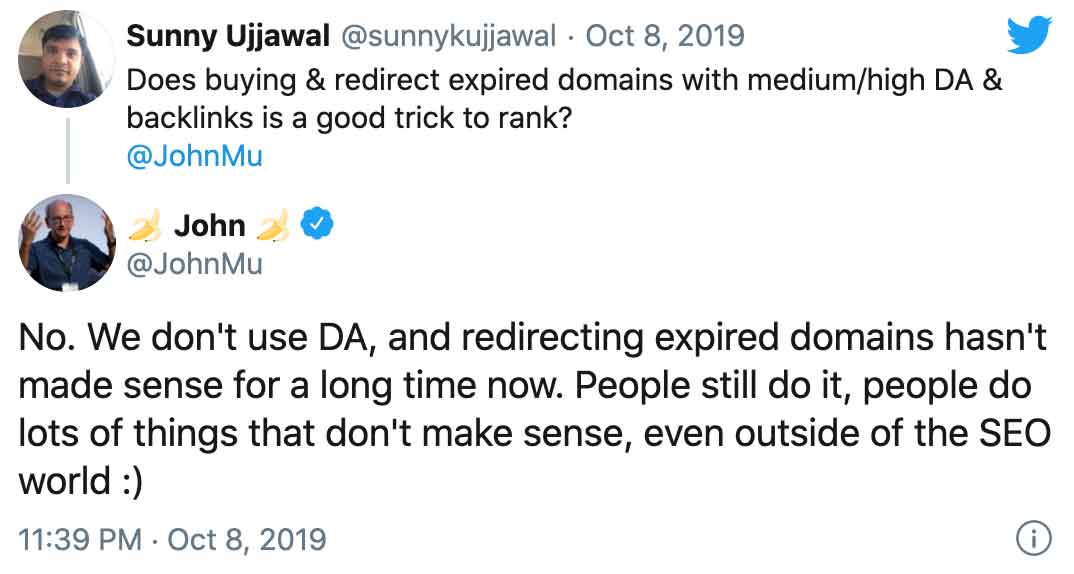
Google’s extremely smart person John Mueller essentially says expired domains do not work. But in our experiments they do, if done right. Most of the time expired domains are not done right – so in that case they do not work.
Domain anchor text
On 23 April we found a domain that closely matched that of the site we had created. That meant that the anchor text for the links pointing to the domain we found and intended to redirect to our test domain, from most links would also have the keywords in the domain (they did). Put another way, the domain we ended up purchasing and redirecting had a word like “plumbing” in the domain name, and we intended to redirect traffic and links to a new domain and website about plumbing.
Domains linking in
The domain we purchased for the expired domain experiment had only nine referring domains. See the excerpt from ahrefs.com below:
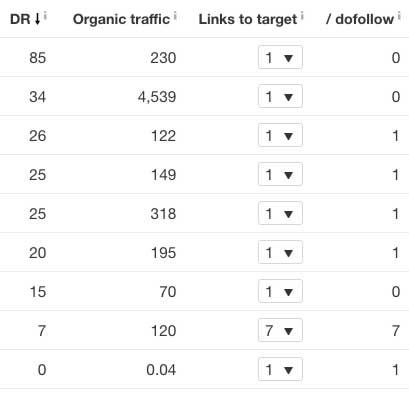
As you can see, this is a middling domain without a lot of strength. But the name and theme of the domain closely matched our target – that was the only really good thing about it. In fact, only five of the nine domains pointing to it were dofollow. The strongest dofollow link only had a Domain Rating (Ahrefs) of 26 (out of 100).
So what happened?
In the past two months, the domain rose from well beyond position 100 for the target search term to position 15 in Google. The chart below shows the Google ranking results of our test for the expired domain SEO:
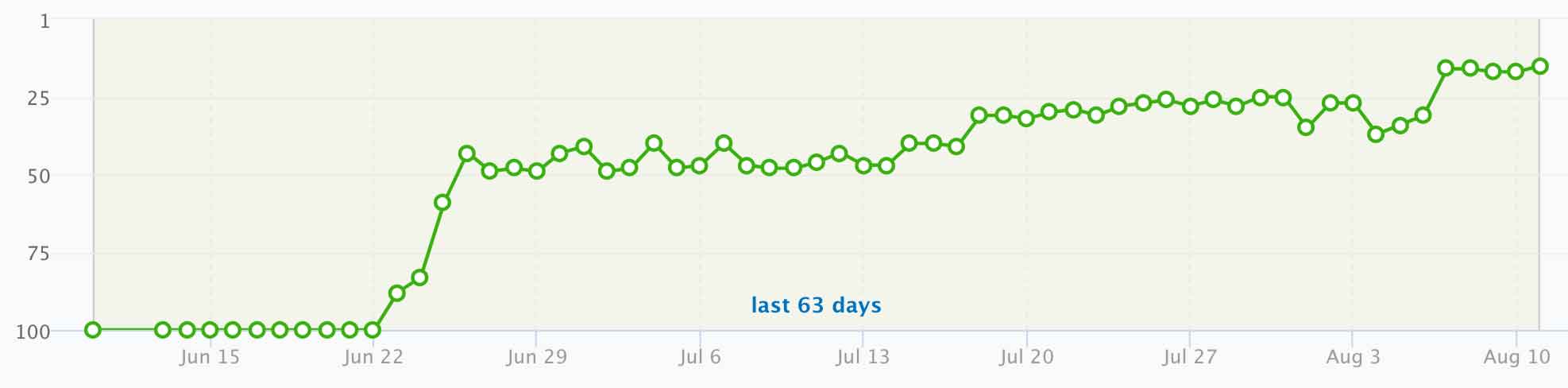
The expired domain we pointed to our relatively new site, one with thin content and no domain age to speak of, was pretty weak. This was intentional because we didn’t want a lot of other factors muddying our results.
No other on-page SEO made for the first month
- We made no other changes to the target website.
- The target domain was only a few months old.
- We did not refresh any content on the target domain for about 45 days.
- The Titles and Descriptions on the target were not changed.
- No other links were earned during the experiment.
Is expired domain SEO a long-term SEO tactic?
We don’t think so. While our study has definitely shown improvement, we don’t feel we would be able to get the target site to page one without normal SEO tactics.
During the experiment, we upgraded the content of the site. But all of the improvements for the first 45 days or so that you see in the chart above were done with very thin content – basically a placeholder site. Then, to get the site to nudge up we improved the content.
We feel the expired domain SEO used at the beginning got the domain off the ground, but that content has helped it the rest of the way. We don’t feel we will be able to get the site to position one without both content and organic links. Still, we think the expired domains helped.
Is there a danger to using expired domains for SEO?
Google has no problem with 301 redirected domains. 301 redirects are a perfectly natural aspect of web development. For example, many years ago we changed our name from Internet Reputation Management to Reputation X. We didn’t want to lose all of the valuable links to our old domain so we did a 301 redirect from our old URL to our new URL. Now, anyone who clicks on or searches for our old domain will be redirected to our new website.
Should expired domains be used for the main website?
Expired domains can be used for your main website if it’s a very good fit. In other words, if you are an SEO company and you are getting expired domain links from another SEO company – especially one that performs the same kind of SEO in the same location, then it’s probably safe.
Can the domains be used for sites you don’t control?
Yes, you can redirect domains that have expired to a website you don’t control. The difference is that with a site you control you can point individual pages to other individual pages on your site because you control the server. But if you point a domain at a page or a website you do not control, all of the links from the old domain will point to only one page on the site.
Don’t overuse expired domains
Expired domains can be misused. For example, if a website has multiple expired domain-based links to it, and there are few other naturally earned links, it may look odd to Google. It would seem unnatural so the links may not all be trusted. Why? Because the links and the content around the anchor text that point to the expired domain will not always translate perfectly to the new domain.
Why expired domains are rarely a perfect fit
For example, if you found a domain to buy that included the word “plumbing” in the domain name, and you pointed it to a website for a local plumber, many of the anchor text used on third-party websites would include the word “plumbing” somehow because that’s the domain name.
But let’s say the domain you bought was from a plumber in Florida, but the site you are 301 redirecting the links to is a plumber in San Francisco. While the anchor text may include the right search phrase, the text in the links you are redirecting would almost certainly be semantically tied to the old plumbing website in Florida. So it’s a good match, but never perfect.
How many domains can you 301?
We recommend using one or two expired domains only, and only if the expired domain is a very good fit – that is, very similar in content – to the target domain.
We also recommend building additional organic links to the new domain in addition to the expired domain.
High quality expired domains are key
A quality user experience is key here because anyone who clicks on a link and does not find what they are looking for will “bounce” – they’ll hit the back button – and Google will then know the content isn’t what the user was expecting.
What tools are recommended?
We recommend either Domain Hunter Gatherer or DomCop.
We’ve used both and prefer DHG. The one thing that kinda sucks about DHG is that it only works on PC’s which, to us, are weird. Reputation X is mainly a Mac shop, so we had to setup a virtual PC using the AWS Workspaces service so we can login to a virtual PC and use the software. On the upside, anyone in the company can login to the virtual PC and use the software whenever they want.
We also recommend using Ahrefs.com (a service that tells us the technical details about websites and links) with DHG because DHG pulls the Ahrefs data in using the Ahrefs API. But we also like to just have a tab open with Ahrefs so we can cut and paste URLs and really get in-depth information about them.
Finally, we recommend you use a domain registrar like GoDaddy (or something else) that has the ability to let you buy domains that have a lot of different country codes (TLD’s). Not all domain registrars give you a wide range of different country-coded domains.
Why is this important? Because most of the time you will want to buy expired domains that end in .com or .net, there are times when we are performing international reputation management and need domains in countries like Thailand, the Middle East, or elsewhere where the TLD’s (top level domains) are coded to the target country.
Thanks for reading! 🙂
Frequently Asked Questions









Protect Your Online Reputation
Every day you wait, negative content gets stronger. Talk to our experts about a custom strategy for your situation.
Get Your Free Analysis