
Fake Reviews – Like Fake News on a Smaller Scale
Fake reviews manipulate consumer trust at scale — here's how platforms, regulators, and savvy shoppers are fighting back against the deception.

- The FTC's 2024 rule bans fake reviews and carries penalties up to $51,744 per violation.
- Google removed over 170 million policy-violating reviews in 2023 alone.
- Fake reviews set expectations businesses can't meet, triggering real negative feedback.
- Consumer trust in online reviews is declining due to widespread review fraud.
- Addressing the root cause of poor reviews is more effective than masking them with fakes.
Fake reviews may seem like a shortcut to a better online reputation, but they create false expectations that lead to real negative feedback when businesses fail to deliver. The FTC's 2024 rule now makes fake reviews a legal liability, with civil penalties up to $51,744 per violation. Major platforms like Google and Yelp are aggressively removing fraudulent content and alerting consumers to suspicious activity. Building an authentic review profile is the only sustainable strategy.
Fake reviews are like fake news but on a smaller scale
(Almost) everybody knows that you can’t believe everything you read on the Internet — even reviews. A consumer review study found that 50% of consumers consider online reviews to be as trustworthy as personal recommendations, according to BrightLocal’s 2024 Local Consumer Review Survey — a notable shift that reflects growing skepticism about what people read online.
Still, from fabricated news stories to Photoshopped pictures, things aren’t always what they seem. Not all trickery is obvious, though, and many companies actively fabricate reviews online to portray a positive image and to try to boost their reputation.
Fake reviews have become such a big problem that companies like Amazon, Yelp, and Google have taken measures — and in some cases, legal action — to help block the influx of fake reviews on their sites. The regulatory environment has also intensified: in August 2024, the FTC finalized a rule explicitly banning fake reviews and testimonials, with civil penalties of up to $51,744 per violation.
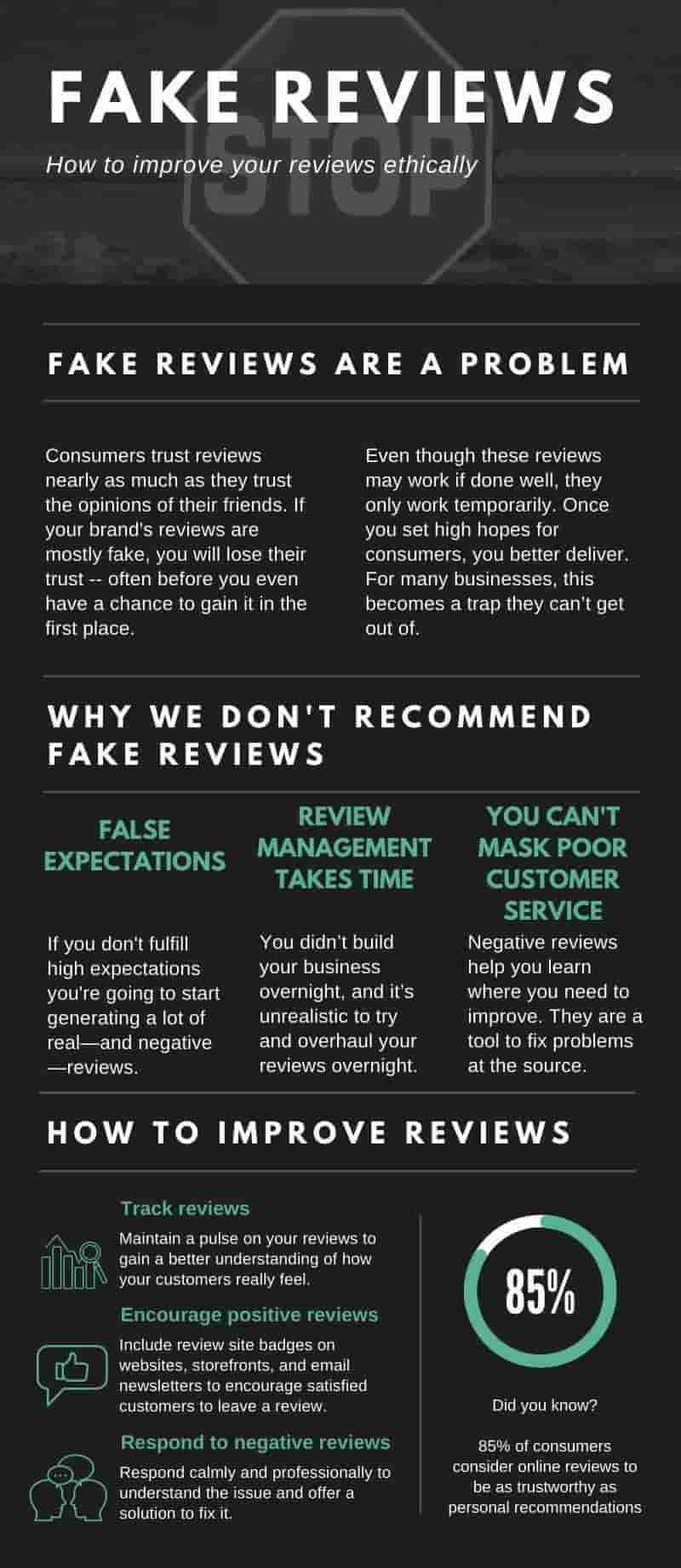
of consumers trust online reviews as much as personal recommendations
BrightLocal 2024 Local Consumer Review Survey
Why consumers trust the opinions of strangers
We trust reviews nearly as much as we trust the opinions of our friends. BrightLocal’s 2024 Local Consumer Review Survey found that approximately 50% of consumers trust online reviews as much as personal recommendations — down considerably from figures reported just a few years ago, reflecting a measurable rise in consumer skepticism around review authenticity.
Get a Free Reputation Assessment
Find out what people see when they search for you online. No obligation — results in 24 hours.
If consumers know that many reviews they read online are fake, at what point do they stop believing the real ones? Fake reviews are a disservice to both the business being reviewed and the consumers who read them.
But a lot of the time, fake reviews work. Like anything deceptive on the Internet, they persist because there’s something to be gained. The catch: they only work temporarily. Once a business sets high expectations through inflated reviews, it must deliver — and for many, that becomes a trap they can’t escape.
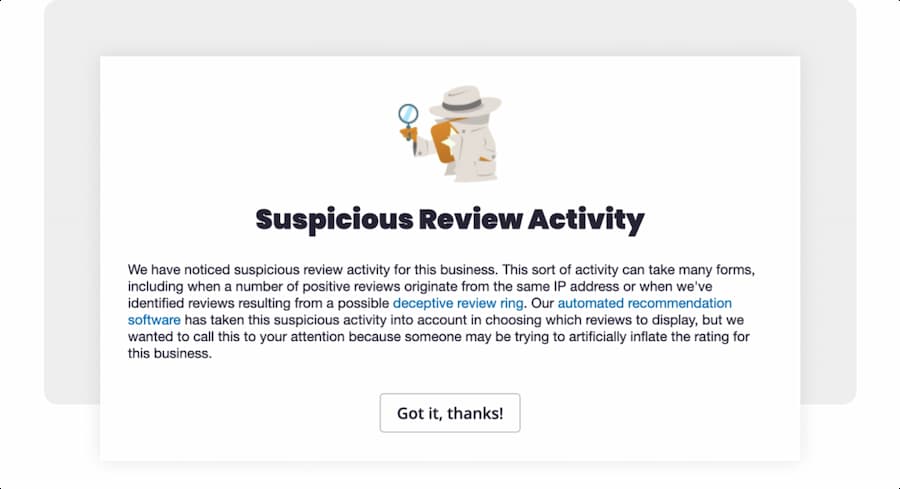
The major review platforms are pushing back with real consequences:
- Yelp consumer alerts: If Yelp detects suspicious activity on a business profile, it may add a consumer alert to the page. Alert types include Compensated Activity, Questionable Legal Threats, Unusual Activity, Public Attention, and Racist Behavior alerts.
- Review removal: It has become standard practice for review platforms to remove illegitimate reviews. In 2023, Google removed over 170 million policy-violating reviews and nearly three million fake business profiles, according to its Prohibited and Restricted Content Report — a dramatic increase from figures reported just a few years prior.
Struggling With Your Online Reviews?
Reputation X helps businesses build authentic, lasting review profiles — no shortcuts, no risk. Let's talk about a strategy that works.
The problem with fake reviews: false expectations
The main problem with fake reviews is false expectations. If a consumer sees a glowing review and then interacts with the business, they expect a certain level of service. When the business falls short, real — and negative — reviews follow.
In other words, if your company isn’t generating positive reviews organically, buying fake ones won’t solve the underlying problem. It will most likely resurface.
Why we don’t recommend fake reviews
Businesses turn to fake reviews for two reasons:
- They have a negative online reputation they are trying to hide.
- They have no online reputation and need to get the conversation going.
On the surface, both reasons make fake reviews seem like a reasonable shortcut. Surely good reviews are better than no reviews — and certainly better than bad ones. But fake reviews aren’t the right choice, for several reasons.
Negative reviews can be addressed legitimately
Negative reviews can be removed or offset with genuine positive reviews over time. They also help companies identify where they need to improve. Do poor work and your reviews will reflect it. Go above and beyond for your customers and your online reputation will improve. Learn more about analyzing online reviews and feedback to improve your reputation.
Long-term success requires real work
In a free-market economy, the best businesses survive and prosper. There’s a competitor around every corner, but you can’t beat them with fake reviews. Real, consistent, high-quality work is what drives lasting positive reviews — and lasting competitive advantage.
Patience is essential
You didn’t build your business overnight, and you can’t build your online reputation overnight either. Review platforms flag accounts when many reviews appear in quick succession — a red flag that can trigger removal of legitimate reviews alongside fake ones. The FTC’s 2024 rule adds another layer of risk, explicitly prohibiting bulk review purchases and artificial review surges, with civil penalties attached.
What to do instead of buying fake reviews
At Reputation X, we believe in the power of a genuine review. We recommend using review management software to track reviews — good and bad — alongside a proactive internal process for earning authentic feedback. The right review management strategy combined with the right tools can make a significant difference.
That means providing exceptional service and then encouraging — but not pressuring — customers to share their experience online. Trust builds over time, and the consequences of being flagged for fake reviews have never been more serious. Beyond reputational damage and platform penalties, the FTC’s August 2024 final rule means businesses now face potential civil fines of up to $51,744 per violation.
Understanding how positive and negative reviews affect business revenue is a good first step toward building a review strategy grounded in authenticity. If your reputation has already taken a hit, our guide on solutions for a bad company reputation can help you chart a path forward.
Let Reputation X help shape your online presence — so that when people search for you, they see not just a positive image, but a trustworthy one.
Frequently Asked Questions









Protect Your Online Reputation
Every day you wait, negative content gets stronger. Talk to our experts about a custom strategy for your situation.
Get Your Free Analysis