
How to Find Hidden Bad News In Corporate Search Results
Before you can fix your online reputation, you need to see exactly what skeptical prospects find when they search your brand name.

- Start with your exact brand name, common misspellings, and associated product or service names.
- Pair Google Analytics 4 with Search Console to get real insight into branded search phrases.
- Search combinations like "[brand] + scam" or "[brand] + complaints" to see what skeptical prospects find.
- Check results across Google, Bing, and DuckDuckGo — each surfaces different content.
- Test navigational, informational, commercial, and transactional query types to get a full picture.
A drop in branded organic traffic may signal that negative search results are driving prospects away before they ever reach you. To address the problem, you first need to identify the exact queries people use to find damaging content about your brand. This article walks through how to uncover those phrases using analytics tools, related search features, negative modifiers, and multiple search engines.
How to Find Hidden Bad News In Corporate Search Results
-
1
Search your brand's basic phrases first
Start with your exact brand name, common misspellings, and any product or service names associated with your company. Document everything you find — both positive and negative — so you have a clear baseline to work from before digging deeper.
-
2
Pull data from Analytics and Search Console
Dig into Google Analytics 4 and pair it with Google Search Console to get meaningful insight into the search phrases people actually used to find your site. Keep in mind that neither tool will reveal the negative phrases driving people to competitor sites, so treat this as a starting point rather than a complete picture.
-
3
Use related searches to expand your phrase list
After conducting a basic branded search, look for suggestions like 'People also search for' or 'Related topics' on the results page. These features reveal additional phrases real users associate with your brand, including potentially damaging ones. Be sure to proactively include negative modifiers like 'reviews,' 'complaints,' 'scam,' and 'alternatives' in your searches.
-
4
Test all four search query types
People interact with your brand through navigational, informational, commercial investigation, and transactional searches — each can surface different results. Run branded queries across all four types to see exactly what a skeptical prospect encounters before deciding whether to contact you. Also consider that results vary by location and whether users are logged into a Google account.
-
5
Search across Google, Bing, and DuckDuckGo
Run your branded phrases across all three major search engines, since each surfaces different results. Pay particular attention to AI-driven features like Bing Copilot and Google AI Overviews, which can amplify negative content in ways traditional search result reviews might miss. Document every negative URL you find, including review sites, critical blog posts, and attack sites.
-
6
Check Facebook, X, and Reddit directly
Not all reputation-damaging content appears in traditional search engines, so search your brand on X, Facebook, Reddit, LinkedIn, YouTube, TikTok, and Instagram as well. Reddit is especially critical — Google significantly boosted Reddit's visibility in 2023–2024, meaning negative threads can now rank on the first page of branded searches within days of being published. A damaging Reddit post may already be reaching thousands of prospects before you are even aware it exists.
-
7
Set up ongoing brand monitoring alerts
Use tools like Google Alerts or Talkwalker Alerts for free basic monitoring, or invest in paid platforms like Brand24, Mention, or Semrush's Brand Monitoring tool for stronger coverage and more actionable reporting. Ongoing alerts will surface new mentions far faster than periodic manual spot-checks, giving you a chance to respond before negative content gains traction.
Why did organic traffic for your branded searches just drop off? Was it a Google algorithm change, or did your search results change? It’s a nightmare when you find your brand ranking for negative phrases like “fraud” or “scam.” Prospects are fleeing, and your sales team is panicking.
Negative reviews ward off consumers like a leaky septic tank parked right in front of your storefront. You’re a legitimate company. You’ve been in business for years and do great work. But somehow, the internet has stamped a scarlet letter on your business’s brand, and it won’t go away.
You may never be able to remove negative online content completely, but you can mitigate the damage. First, you need to know which queries people are using to find the bad stuff. Then you can act.
Note: We provide a link to a simple reputation plan at the bottom of this post.
Search Your Brand’s Basic Search Phrases First
Start with your exact brand name — it’s the obvious starting place. Include common misspellings and any product or service names associated with your company. Document everything you find, both positive and negative, so you have a baseline to work from.
Get a Free Reputation Assessment
Find out what people see when they search for you online. No obligation — results in 24 hours.
Uncover Search Phrases People Actually Use
Check Google Analytics and Search Console
Dig into your Google Analytics 4 (GA4) or other analytics dashboards. GA4’s organic keyword data is largely reported as “(not provided),” so pair it with Google Search Console to get meaningful insight into the search phrases people actually used to find your site. Neither tool will show the negative phrases that drove people to competitor sites — for that, you’ll need to dig deeper.
Use Related Searches for Additional Phrases
After you conduct a basic branded search, look for related search suggestions on the results page. Google’s layout has evolved — you may see these as “People also search for,” “Related topics,” or similar features. When these suggestions appear, they reveal what other phrases people use to find your business. For example, for the search term “Goddard School,” here are related searches:
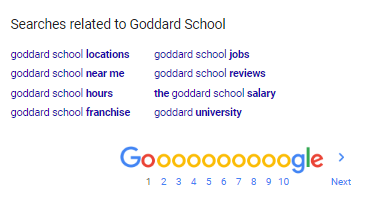
If you own a Goddard School, these are examples of additional branded search phrases to target in a brand reputation campaign. To learn more about how these suggestion features work, see our post on People Also Search For behavior in queries about individuals.
Understand the Four Search Query Types
People perform four basic types of searches when interacting with your brand online.
- Navigational: They are trying to find your site or a specific page within it.
- Informational: They’re not looking for your site but for information it might contain.
- Commercial investigation: They’re researching products or services and comparing options before committing — this is where reputation matters most.
- Transactional: They want to buy something and may never have heard of you before.
Try different kinds of queries to see what your prospects see before they decide to do business with you. Understanding how search results appear differently to different people and locations is also critical — what you see logged into your own account may not reflect what a stranger in another city sees.
Not Sure What People Are Finding About Your Brand?
Our team runs comprehensive reputation audits to surface hidden negative content and build a plan to address it.
Search Across Multiple Engines and Platforms
Use Google, Bing, and DuckDuckGo
Search your branded phrases in Google, Bing, and DuckDuckGo, which has a substantial privacy-conscious user base. Bing now powers AI-driven chat results through Copilot, and Google’s AI Overviews can surface negative content in ways that traditional SERP reviews might miss. When you find something negative — a review site, a critical blog post, or an attack site — document the URL. The search phrases you uncover during ORM (online reputation management) research will reveal what your prospects are actually seeing.
Use Facebook, X, and Reddit
Not all reputation-damaging content shows up in Google and Bing. If pages are public on X (formerly Twitter) and Facebook, search those platforms directly. Reddit has become especially critical — Google significantly increased Reddit’s visibility in search results in 2023–2024, and Reddit threads now frequently appear on the first page of branded searches. LinkedIn, YouTube, TikTok, and Instagram are also worth checking as part of any thorough ORM social search strategy.
Set Up Ongoing Brand Monitoring
Several tools can monitor your brand online and flag new mentions before you’d catch them manually. Free options include Google Alerts and Talkwalker Alerts — though Talkwalker was acquired by Hootsuite in 2024, so its free product’s feature set may evolve. For more robust monitoring, paid tools like Brand24, Mention, and Semrush’s Brand Monitoring tool offer stronger coverage and more actionable reporting. Ongoing alerts will surface new mentions far faster than periodic manual spot-checks. For a deeper look at available tools, see our overview of the top online sentiment monitoring platforms.
What to Do Next
If you found no negative search results, bad reviews, or damaging articles, your traffic drop may be due to an algorithm change rather than a reputation problem. To check for major algorithm updates, consult tools like MozCast, Semrush Sensor, Google’s Search Status Dashboard, or RankRanger’s Rank Risk Index while reviewing your GA4 data. Compare spikes in algorithm volatility with drops in your traffic to identify any correlation.
Once you know what people are seeing and have monitoring in place, your list of problem websites will help you determine what can be removed, suppressed, or promoted. Our guide on running an online reputation audit for your brand walks through this triage process in detail.
If you’d prefer to have someone else manage your brand’s reputation, you can review the various costs of reputation management on this page.
Frequently Asked Questions







Protect Your Online Reputation
Every day you wait, negative content gets stronger. Talk to our experts about a custom strategy for your situation.
Get Your Free Analysis