
Content Efficiency: Five Types to Create at the Same Time
Produce these five content types together, in a specific sequence, to run a smarter inbound and SEO campaign without doubling your workload.

- Create long-form gated content first so your blog posts have a rich source to draw from
- Never purchase email lists — build your list organically to avoid legal and deliverability risks
- Embed a CTA in every short-form post to convert readers into email subscribers
- All five content types should be created together and deployed in a deliberate sequence
- Measure blog post success by the number of email subscribers each article generates
Effective inbound marketing relies on five content types — gated long-form content, short-form blog posts, CTAs, earned or paid off-site content, and a newsletter — created together and in a specific order. The strategy works by attracting readers with blog posts, converting them into subscribers via gated content, and nurturing them toward a purchase. This approach doubles as an SEO effort and builds an audience that trusts your brand before you ask them to buy.
Create these five types of content at the same time, and in a specific order, to give your inbound and SEO campaign consistency and make it easier to execute.
Inbound marketing is one of the most effective online marketing methodologies today. Done right, it doubles as an SEO effort. The core concept is to attract the right audience to your site and win its trust through useful, high-quality, actionable content. Once you have a subscriber base that trusts you, converting it into paying customers becomes much easier through a process known as “nurturing.”
Here’s an overview of the inbound methodology, which includes search engine optimization (SEO). We use this strategy for online reputation management (ORM) and SEO projects.
A Note About Where Other Expert Content Lives
This guide doesn’t seek to replicate already complete information on inbound. See this guide by Hubspot for more in-depth information. Generally, the inbound marketing strategy aims to achieve two main goals:
- Converting readers into subscribers
- Turning subscribers into paying customers
The 5 Most Important Content Types for Inbound Marketing
There are five content types to be aware of. Most should be created at the same time if possible, and in a certain order.
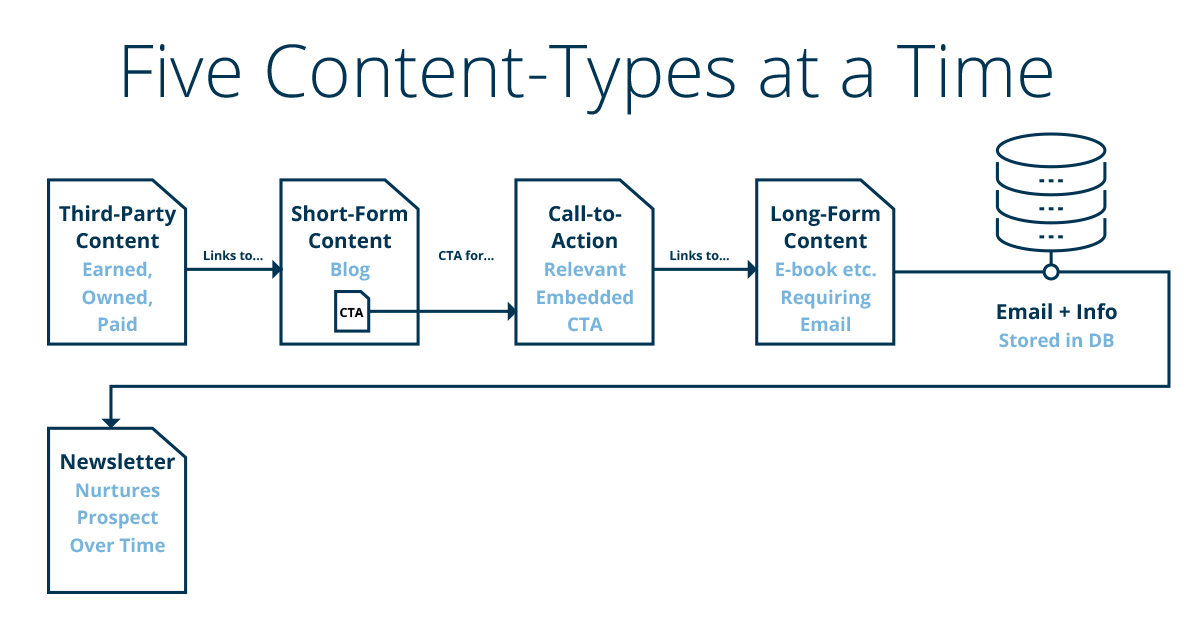
Above is a diagram of the five content types to create.
The Five Main Content Types for Inbound Are:
- Earned, owned, or paid content on another site
- Short-form content on your blog
- A CTA (call-to-action) embedded in your short-form content
- Long-form content such as a guide or eBook
- A newsletter or similar way of staying in touch with the prospect
These five content types work together to attract people, engage them with short-form content, drive them to click the CTA, and offer longer-form content in exchange for their email address. That email address is then used to reach out with helpful information until the prospect is ready to convert.
Get a Free Reputation Assessment
Find out what people see when they search for you online. No obligation — results in 24 hours.
Note: Different types of content appear in different places in search results. This guide to the main areas of Google search results explains how to get content to rank.
First: Create Long-Form Content to Gather Emails
Gated content is free content — usually an eBook, email course, or video tutorial — that readers access by entering their email address in your site’s opt-in box. It’s typically longer than a blog post, and sometimes it’s a full book.
Building your list organically through gated content is the preferred approach. People who opt in have already visited your site and shown genuine interest, making them far more receptive than contacts sourced elsewhere. Purchased lists carry significant risks: poor deliverability, spam complaints, and potential violations of GDPR and CAN-SPAM regulations.
Second: Create Short-Form Content to Drive Interest
Once you’ve created the long-form content, create short-form content like blog posts drawn from it. These can be teasers, statistics, research highlights, or related insights. Creating the long-form content first gives you a rich source to pull from.
The success of an article can often be measured by the number of email subscribers it generates. This means blog posts serve two purposes:
- To inform your audience
- To prompt that audience to act — specifically, to provide their name and email address in exchange for free long-form content
Include a CTA in your content and promote your offer with banners in various locations on the page. When writing short-form content, think about how to write for both search engines and people — your blog posts need to satisfy reader intent while also being structured for discoverability.
Need Help With Your Content Strategy?
Our team can help you build a content and SEO plan that drives real results for your brand's online reputation.
Third: Create the Calls-to-Action
Once the short-form content is done, create one or more CTAs. A CTA (call-to-action) is a banner or link that entices people to get more information. It goes into the body of the blog post or in the sidebar of the page — wherever readers are most likely to see and click it.
Align CTAs with the Content
Use CTAs that match the audience of the specific page. If your long-form content is a guide, your short-form content should cover topics from that guide — and your CTA should reflect the same subject. Misaligned offers reduce click-through rates significantly.
You need to attract people already interested in the solution your product offers. If your CTA promotes red widgets but the guide covers blue widgets, few readers will click through to the long-form content.
Fourth: Drive People to Your Content
Creating and promoting gated content on your own site is just one side of the equation. To accelerate subscriber growth, actively promote your offer on third-party platforms.
Use Guest Blogging to Drive Traffic
Instead of publishing only on your own site, create high-quality posts and offer them to established blogs and publications in your niche. Your article would include a CTA linking to your offer’s landing page.
Guest blogging can build brand visibility and referral traffic. That said, Google’s guidance on guest blogging for link-building has tightened. Links within guest posts are generally expected to carry a rel="nofollow" or rel="sponsored" attribute, and scaled guest posting purely for link acquisition may be treated as a link scheme under Google’s spam policies. Used selectively and focused on genuine audience value, guest blogging remains worthwhile — just don’t rely on it as a primary link-building strategy. For more, see our guide on what guest posting is and how marketers can use it.
Create content in this order:
- Long-form content
- Short-form content
- Guest blogging content
How to Find Guest Blogging Opportunities
Use the following search queries on Google to find guest blogging opportunities in your niche:
- [search term] + write for us
- [search term] + guest post
- [search term] + contribute
- [search term] + guest author
Guest Blogging Resources
Using Social Media Marketing to Drive Traffic
Use social networks like Facebook, X (formerly Twitter), Instagram, LinkedIn, and Pinterest to engage your target audience and promote your latest content. This includes both free and paid social media marketing.
Facebook remains a powerful platform for paid promotion, though organic reach for Facebook Pages has declined sharply — current estimates put it at under 5% of followers for most pages. Meaningful reach now typically requires a paid budget. Depending on your audience, platforms like Instagram, LinkedIn, and TikTok may offer strong organic or paid results worth testing alongside Facebook.
Social Media Resources
Influencer Outreach
Influencer marketing has grown into a major industry — valued at approximately $24 billion globally as of 2024, up from just $1.7 billion in 2016 (Influencer Marketing Hub). Partnering with bloggers, social media creators, and subject matter experts in your niche can significantly accelerate email list growth.
Micro-influencers and nano-influencers — those with smaller but highly engaged audiences — have emerged as particularly cost-effective options for many brands. Note that the FTC updated its endorsement guidelines in 2023, requiring clear and conspicuous disclosure of paid partnerships in all influencer content.
global influencer marketing industry value as of 2024, up from $1.7B in 2016
Influencer Marketing Hub
Influencer Marketing Resources
- The Step-by-Step Guide to Influencer Outreach
Fifth: Nurturing Leads with Email Marketing
As soon as a reader joins your email list to access gated content, begin engaging them with timely emails. The content of those emails is just as important as the content on your site.
Subscribers are most likely to act when they’re new. Make your first few emails count by understanding what the person wants — and delivering it. The objective is to keep subscribers engaged, build credibility through useful content, and convert them into customers through exclusive offers.
A strong email nurturing sequence also supports your broader online reputation management strategy by keeping your audience informed and connected to your brand over time.
Email Lead Nurturing Resources
Inbound Marketing Strategy Checklist
- Create the long-form content first
- Create the short-form content second
- Create a CTA to embed in the short-form content
- Create or promote content on third-party sites or platforms
- Create an email autoresponder campaign with targeted content
For more on how content strategy intersects with your brand’s visibility, see our overview of link building for SEO reputation campaigns and our guide to 10 effective strategies to improve online reputation for your business.
Frequently Asked Questions








Protect Your Online Reputation
Every day you wait, negative content gets stronger. Talk to our experts about a custom strategy for your situation.
Get Your Free Analysis