
Using NPS to Both Measure Brand Image and Protect Reputation
Discover how a single customer loyalty metric can reveal brand perception gaps and give you the data needed to protect your company's reputation.

- NPS is calculated by subtracting % Detractors from % Promoters, yielding a score from -100 to 100.
- Responses are grouped into three tiers: Detractors (0–6), Passives (7–8), and Promoters (9–10).
- Detractors generate disproportionate negative word-of-mouth and should not be ignored.
- Follow up NPS ratings with an open-ended question to turn raw scores into actionable insights.
- A positive NPS signals that satisfied customers outnumber dissatisfied ones and brand growth is likely.
Net Promoter Score (NPS) is a proven metric that measures customer loyalty by asking how likely customers are to recommend your brand. Calculated by subtracting the percentage of Detractors from Promoters, it produces a score between -100 and 100. Companies can use NPS data to identify weaknesses, improve customer satisfaction, and strengthen brand reputation over time.
When it comes to running a successful company, customer satisfaction is one of the most important elements to keep in mind. A satisfied customer is more likely to be loyal to your brand. They are also more likely to recommend your brand to others, improving your brand’s reputation and your likelihood of attracting new buyers.
One metric to measure customer satisfaction is Net Promoter Score (NPS). You can use NPS to quantify customer loyalty and leverage that data to improve satisfaction initiatives and the likelihood of customers promoting your brand. In the process, you’ll boost your brand’s image and trustworthiness.
- What is Net Promoter Score?
- How is Net Promoter Score calculated?
- How companies can improve their brand image with NPS
What is Net Promoter Score?
Net Promoter Score is a measurement used to better understand customer experience and business growth. It is one of the most popular ways to measure online sentiment.
NPS has been a cornerstone of customer experience measurement for over two decades. It was introduced in 2003 by Frederick F. Reichheld, who discussed the metric in his article “The One Number You Need to Grow.” Reichheld and his team conducted two years of research, measuring the relationship between customers’ survey responses and their actual referral and purchase behavior.
One question correlated directly with differences in growth rates among competitors across multiple industries: “How likely is it that you would recommend [company X] to a friend or colleague?” This question became the basis of NPS.
Get a Free Reputation Assessment
Find out what people see when they search for you online. No obligation — results in 24 hours.
Since its introduction, NPS has become a popular method of measuring and improving customer loyalty and satisfaction. Its popularity stems from its proven ability to support company profit and growth, as well as its simplicity as a metric.
NPS is an uncomplicated yet effective way to gather data about your company’s strengths and weaknesses from a customer’s perspective. Understanding how reputation and sentiment analysis work together can make your NPS data even more actionable.
How is Net Promoter Score Calculated?
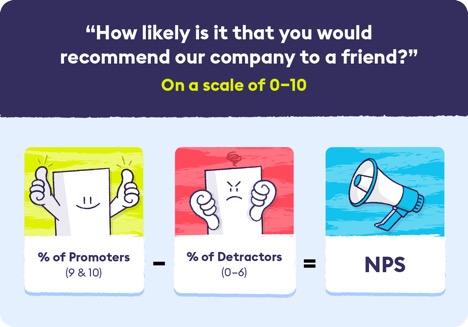
Image source: Chattermill.com
Calculating NPS is straightforward. You can distribute your NPS survey through email campaigns, in-app prompts, SMS, or dedicated platforms like Delighted, Medallia, or Qualtrics — as long as you can reach your customers directly.
Step 1. Gather customer data via an NPS survey
To calculate NPS, you need to determine how loyal your customers are. Ask them: “How likely are you to recommend our product to a friend or colleague?” Responses use a scale of 0 to 10, where 0 means “Not at all likely” and 10 means “Extremely likely.”
Step 2. Categorize responses into detractors, passives, and promoters
Group responses into three categories based on where they fall on the scale:
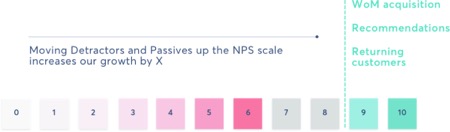
- Detractors = 0–6
- Passives = 7–8
- Promoters = 9–10
Detractors are unsatisfied customers who are unlikely to recommend you — and they account for a disproportionately large share of negative word-of-mouth. Passives are satisfied but not loyal, so they rarely advocate for your brand. Promoters are highly satisfied, loyal, and likely to recommend you to others.
Your goal is to maximize Promoters while minimizing Detractors.
Step 3. Calculate your company’s NPS
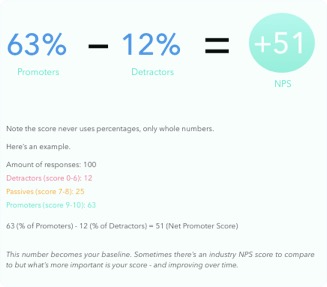
Subtract the percentage of Detractor responses from the percentage of Promoter responses. The result is a number between -100 and 100.
A negative NPS means more Detractors than Promoters — most customers are dissatisfied and unlikely to recommend you. A positive NPS means the opposite: Promoters outnumber Detractors, and most customers are satisfied and likely to refer others.
Want to Know How Your Brand Really Looks Online?
RepX helps businesses measure, monitor, and improve their online reputation — from customer sentiment to search results.
How Companies Can Improve Their Brand Image with NPS
Once you’ve calculated your NPS, you can leverage the data to improve your brand image. Your score reflects the current state of your brand’s reputation and provides a starting point for growth.
The most valuable aspect of NPS is knowing which customers to target. Promoters help you identify what works so you can keep doing it. Detractors reveal where you need to improve. Communicating with both groups is essential to making NPS effective.
As you act on feedback, your NPS will likely improve over time. It’s worth noting that the relationship between NPS and revenue growth is more nuanced than it may appear — researchers and analysts have increasingly debated the strength of that correlation. The real value lies in what you do with the data, not in the score itself.
Once your company has an NPS you’re proud of, you can publish it to help customers view you as trustworthy. A high NPS signals that customers are satisfied and willing to recommend your business. This reassures potential customers and reinforces loyalty among existing ones. It also ties directly to the broader benefits of maintaining a good online reputation — trust built through genuine customer advocacy compounds over time.
Determining your Net Promoter Score helps you understand what keeps customers loyal, satisfied, and eager to recommend your brand. That understanding drives growth as you learn from the data you gather. Pairing NPS insights with a broader online reputation management strategy ensures that the satisfaction you’re building internally is reflected in how the world sees you online.
Frequently Asked Questions









Protect Your Online Reputation
Every day you wait, negative content gets stronger. Talk to our experts about a custom strategy for your situation.
Get Your Free Analysis