
Measuring Corporate Sentiment in Todays Online Environment
Corporate sentiment influences everything from stock prices to employee retention — here is how to measure it before it shifts against you.

- Positive corporate sentiment drives stock value, reduces churn, and attracts top talent — negative sentiment does the opposite.
- Google search results are often the first and most lasting impression people form about your brand.
- There is no single standard metric for corporate sentiment, but Net Promoter Score is a widely used starting point.
- Sentiment analysis should be a recurring practice, not a one-time audit, to catch reputation shifts early.
- Online sentiment and corporate sentiment are effectively the same thing — what people find online shapes what they believe.
Corporate sentiment is the collective mood and confidence people have toward your brand, and it directly affects stock prices, employee retention, and customer loyalty. Because sentiment is shaped largely by what surfaces in online search results, managing your digital presence is essential to managing your reputation. This article explains how corporate sentiment is formed, why it is difficult to measure, and what tools and approaches can help you track and improve it.
Corporate sentiment, or business sentiment, is how people feel about your brand. In more technical terms, it’s the level of confidence that shareholders have in a corporation or business—the prevailing mood or attitude about that company’s success (or lack thereof).
Reputation management cares a great deal about corporate sentiment and the practice of sentiment analysis. How people feel about your company defines your business, and understanding this sentiment can help you smooth over attacks on your reputation and promote a positive feeling toward your company.
This article unpacks the concept of corporate sentiment—how it’s formed and what factors go into it—and explains how to measure the sentiment surrounding your company.
Why Corporate Sentiment Matters
When corporate sentiment is positive, stock prices climb, churn rates drop, customer lifetime value increases, and top talent gravitates toward the company. Employees pursue objectives with purpose and hit revenue goals.
When corporate sentiment sinks, the opposite unfolds. Stock prices nosedive, customers defect, employees resign, and candidates flee toward healthier-looking companies.
Corporate sentiment can spell the success or the demise of your company.
Like many features of reputation management, mood and attitude are hard to quantify. The business confidence index (BCI), for example, is an indicator from the Organisation for Economic Co-operation and Development (OECD) that provides a qualitative measure of global economic sentiment.
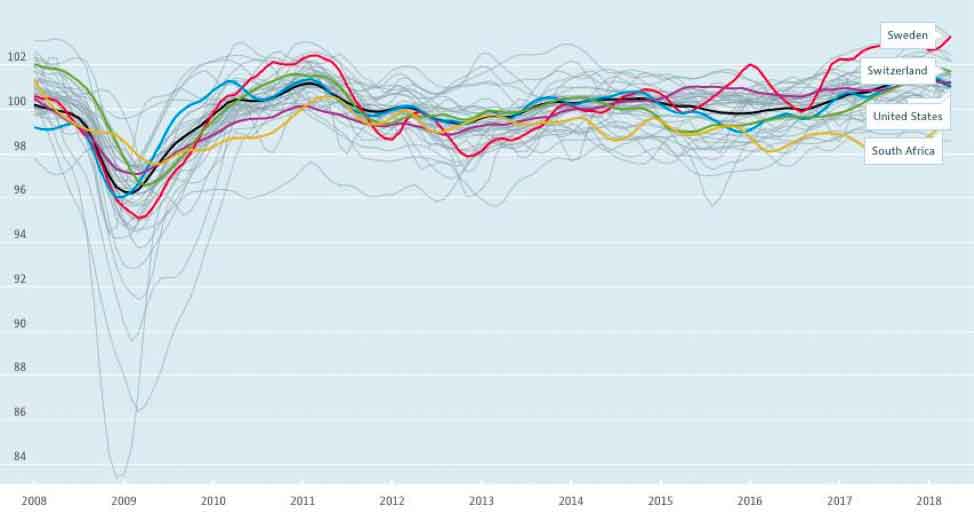
Corporate sentiment eludes easy metrics because it has so much to do with individual perceptions and quantity-defying feelings. That nebulous nature is a challenge for businesses whose success depends on those moods.
There is no single standardized way to quantify corporate sentiment. The closest thing to consensus is the Net Promoter Score, which asks customers one question: On a scale of 1–10, how likely are you to recommend this company to a friend or colleague?
The Net Promoter Score is not perfect, but it is part of the toolbox.
What Shapes Corporate Sentiment?
To understand the genesis of corporate sentiment, look no further than Google. Corporate sentiment is shaped by online sentiment, and online sentiment is shaped by what surfaces in search results.
Get a Free Reputation Assessment
Find out what people see when they search for you online. No obligation — results in 24 hours.
Corporate sentiment begins online
When people want to find out about something, they search for it. Google now processes approximately 8.5 billion searches per day, making it the undisputed gateway through which most people first encounter a brand.
Clicking the “News” tab on a Google search reveals a mashup of stories from disparate sources that can skew positive or negative depending on what has been covered.
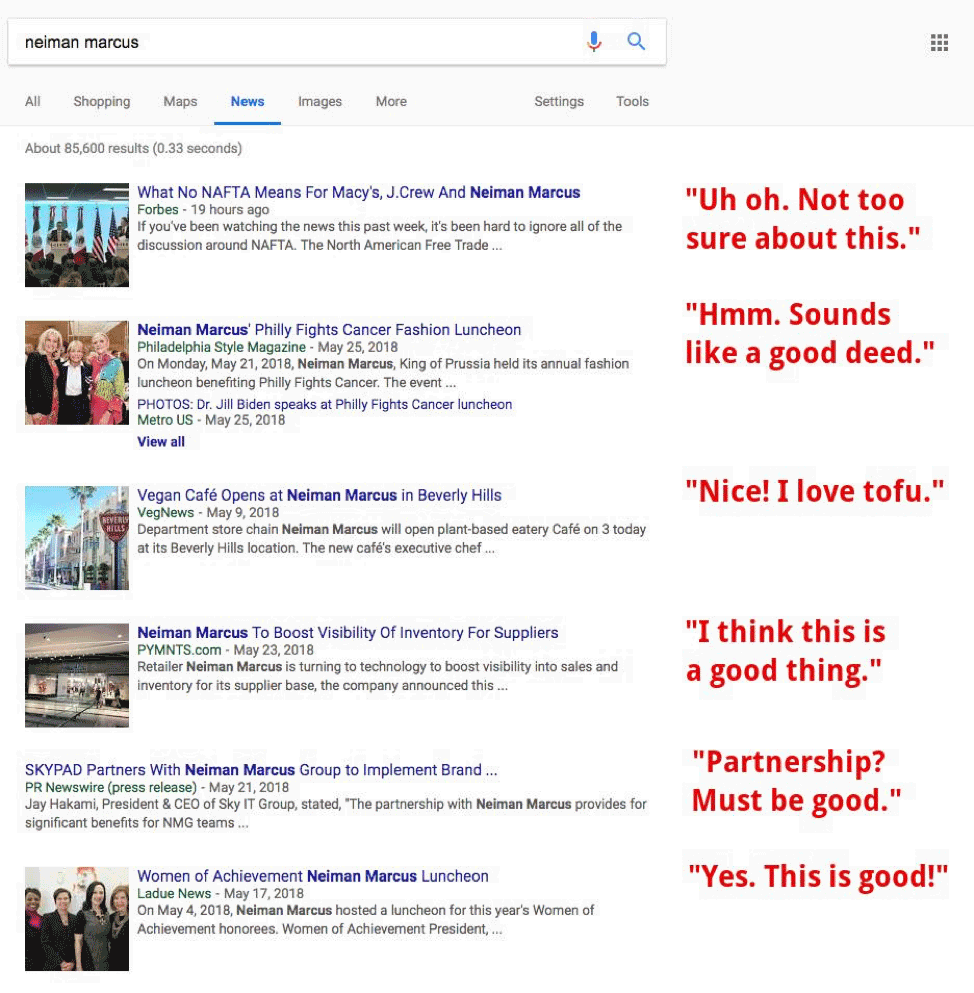
A company navigating trade policy shifts, leadership changes, or financial restructuring will see those stories surface prominently—shaping perception before a visitor ever reaches the company’s own website.
If someone has never heard of a company before, their attitude toward it is set quickly and often permanently. A clean slate filled with positive stories creates a favorable impression that takes a massive upheaval to shift.
The reverse is equally true. Consider searching for a company embroiled in scandal:
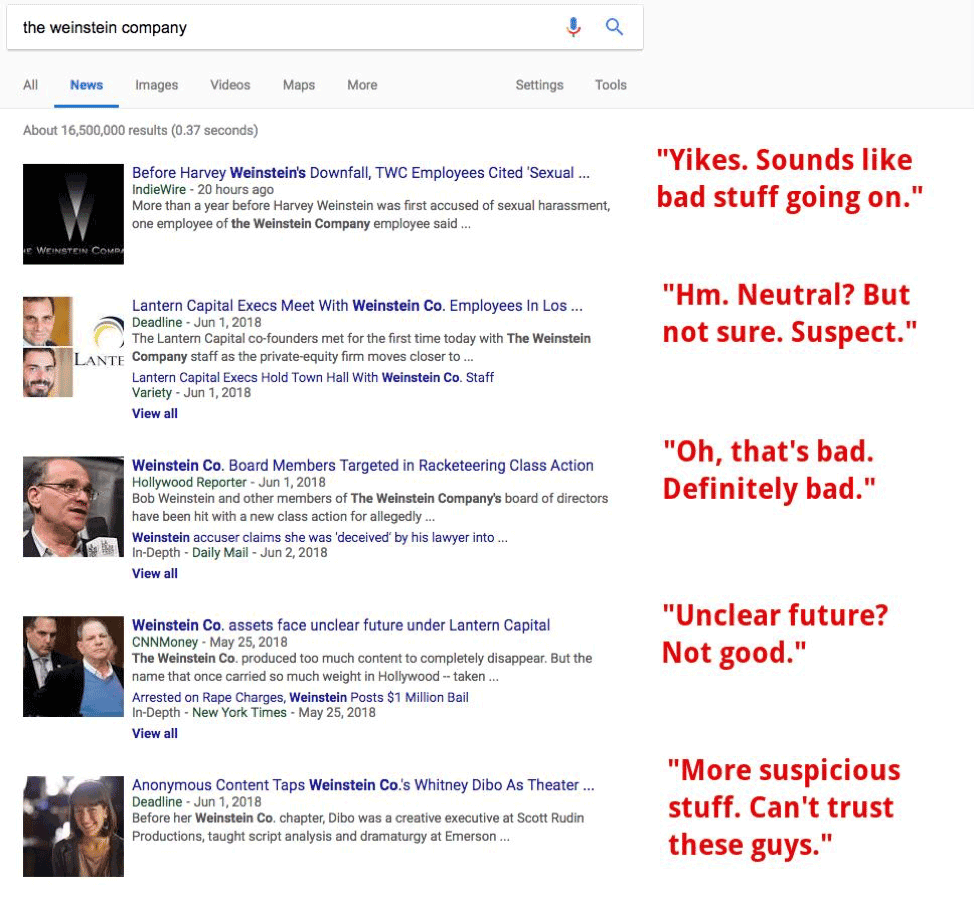
Even though The Weinstein Company no longer exists as an operating entity—it filed for bankruptcy in 2018 and was formally dissolved—its search results remain a textbook example of catastrophic negative sentiment. What Google surfaces shapes opinion, often permanently.
This is why online sentiment is corporate sentiment. The cycle works like this:
- People seek information on a given subject.
- They search online and trust Google as a primary source of answers.
- What they see becomes their opinion, especially without any preexisting attitudes toward the company.
Google’s search results are not static, either. The algorithm personalizes results based on interests, location, device, search history, and apparent preferences. That personalization gives Google enormous power in shaping corporate sentiment at the individual level.
Corporate sentiment is shaped by individual interests
Different people hold different viewpoints of a company based on their interests. A stockholder looks for different information than the average customer, and an employee is interested in different things still.
Although overall corporate sentiment may trend positive or negative, individual attitudes are shaped by different pieces of information.
Corporate sentiment is a collection of individual opinions
Corporate sentiment is a collection of opinions from all kinds of people, each with differing interests. It begins with an online search, and first impressions formed there tend to stick.
When someone encounters information that contradicts their original opinion, they rarely change their view. Instead, the mind performs confirmation bias—the human tendency to seek out and remember information that aligns with existing beliefs while ignoring anything contradictory.
Corporate sentiment is complicated, individualized, and subject to the vagaries of human cognitive bias. But it can still be measured to a meaningful degree.
Need Help Understanding Your Corporate Sentiment?
Our team can conduct a full sentiment analysis and reputation audit for your brand—identifying risks and opportunities before they impact your bottom line.
How to Measure Corporate Sentiment
Measuring corporate sentiment is often called sentiment analysis. Sentiment analysis attempts to understand why people feel the way they do about your company.
There are four components of sentiment analysis:
- Search engine research: analyzing top search results to gauge the mood surrounding your company
- In-depth research: selectively reviewing blogs, articles, and reviews to understand the why behind your corporate sentiment
- Social research: performing social listening to find out what the social buzz is around your business
- Competitor research: comparing your company with industry peers to identify what is expected versus unusual in your sector
Search engine research
Search engine research should focus on Google, since that is the search engine used by most people. The goal at this stage is to understand what results are appearing and the general tenor of those results.
Perform private searches
Search in private mode so your results are not influenced by your web cache or personal data. Here is how to enable private browsing:
- Chrome: More → New Incognito Window (Command+Shift+N or Ctrl+Shift+N)
- Safari: Pages → Private (Command+Shift+N)
- Firefox: Menu → New Private Window (Command+Shift+N or Ctrl+Shift+N)
- Microsoft Edge: More → New InPrivate Window (Ctrl+Shift+N)
Perform location-specific searches for local variation
If your business has an international presence, search results from one country may differ significantly from another. A company headquartered in Berlin will surface different results when searched from New York.
Use a VPN service or location-based SERP preview tools—such as those built into Ahrefs or SEMrush—to simulate searches from other countries, devices, and languages.
Google your company name and variations
Start with your business name, then search for variations, common misspellings, and abbreviations. Each variation may surface different sentiment signals.
Google your company’s major products or services
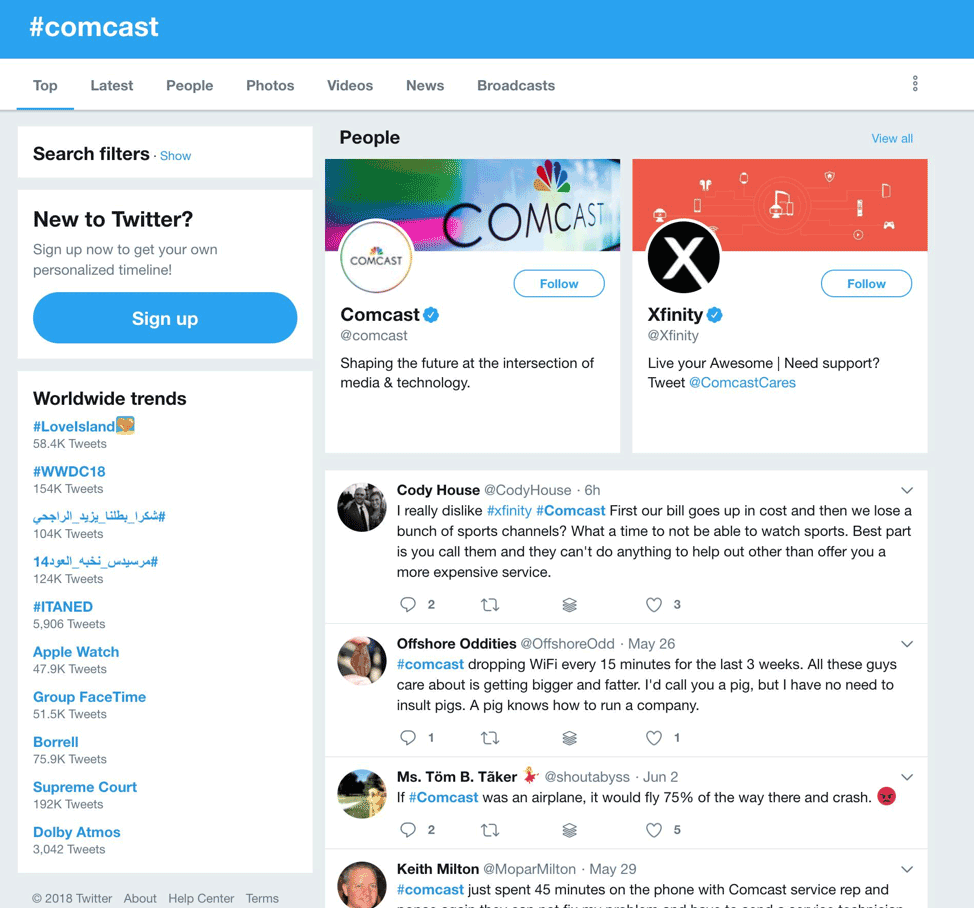
Corporate sentiment often circulates around products and services rather than the company as a whole. Comcast’s primary product is Xfinity, and many people have stronger associations with that name. Search all major products and services separately.
Google the names of company executives
A business’s reputation rises or falls on the actions of its senior leadership. Search the names of the most influential people at your company and note what surfaces—company profiles, Wikipedia articles, or critical news stories. For a deeper look, see our guide to corporate and executive reputation.
Google your company name with qualifying words
As you build a picture of corporate sentiment, look for keywords that appear regularly in search results. These may be tied to recent events—a product recall, an executive departure, a data breach, or a viral customer complaint.
If no specific terms emerge, try these generic qualifiers alongside your business name:
- Review
- Scandal
- News
- Controversy
- Scam
In-depth research
Search engine research surfaces what exists. In-depth research explains why it matters. Focus on three main targets:
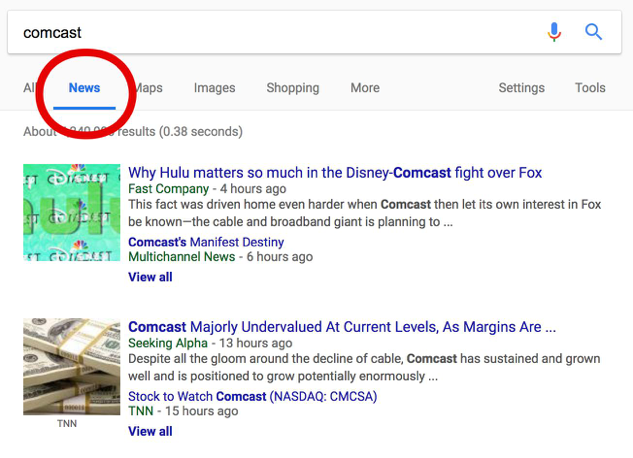
- News articles. Use Google and filter by the News tab to aggregate top-ranked sources and trending topics. This is the single most effective method for weighing business sentiment.
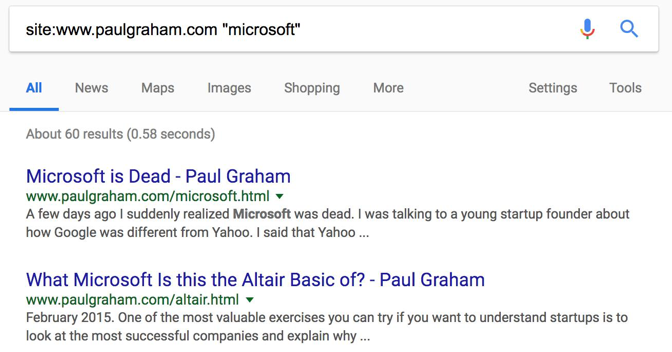
- Blogs. Industry blogs may have written about or mentioned your company. To find all mentions on a specific blog, use a site-specific search:
site:www.example.com "your business name"
- Reviews. Nearly every business—or its products and services—is reviewed somewhere. Check the relevant platforms for your category:
- Local businesses: Google, Yelp, Facebook
- Restaurants: Yelp, Google Reviews, OpenTable, Zomato
- Products: Amazon
- Hotels or tourist attractions: TripAdvisor
- Movies: Rotten Tomatoes
- Startups: Crunchbase
- Publicly traded companies: Bloomberg
- Employers and company culture: Glassdoor
- General business reputation: Trustpilot, Better Business Bureau (BBB)
- Software and SaaS products: G2, Capterra
In-depth research takes you beyond the SERP to hear directly what people are saying about your business. For a broader look at how to interpret and act on this data, explore our overview of sentiment analysis and its role in brand building.
Social research
Social listening can be an unwieldy prospect—every post contains its own ecosystem of likes, comments, and shares. The goal is not exhaustive coverage but a general understanding of the sentiment surrounding your brand.
Look at all your company’s social accounts
Review your social accounts and note what people are discussing in your posts. A quick look at a brand’s Instagram account, for example, may reveal recurring themes around product choices or company practices.
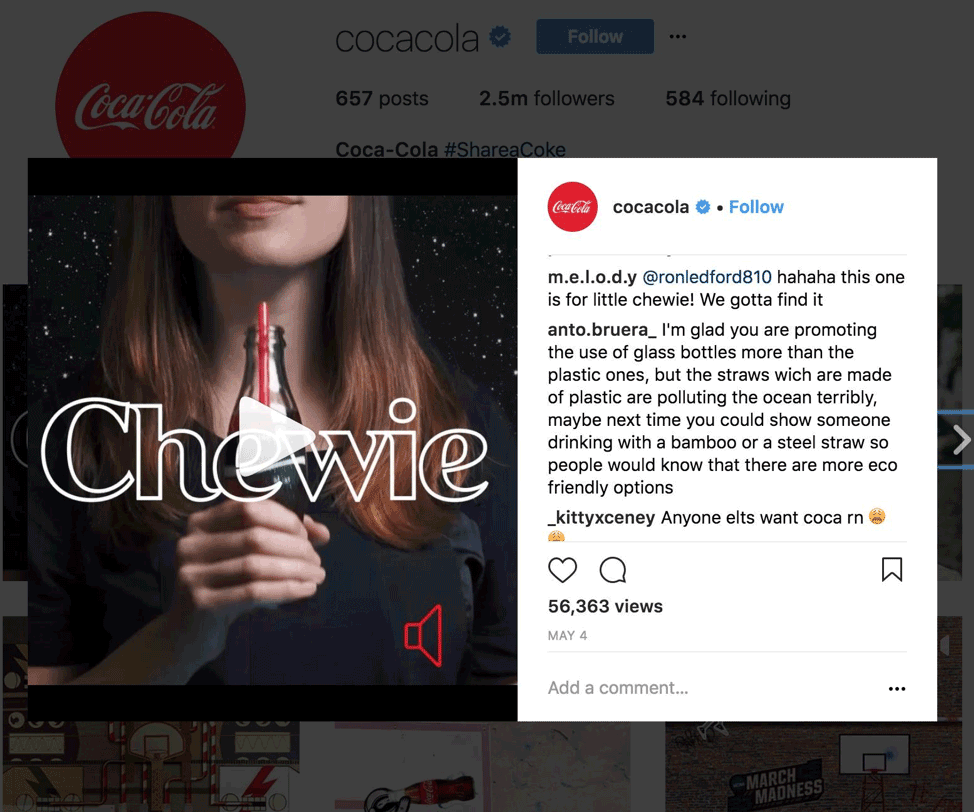
Do not limit social research to the obvious platforms. Beyond Instagram and Facebook, conversations about your brand may be happening on X (formerly Twitter), TikTok, Threads, and Reddit—all significant arenas for corporate sentiment. Reddit has grown into a trusted source of unfiltered brand opinion, and TikTok’s viral nature means a single critical video can shape perception at scale almost overnight.
Search for hashtags related to your company
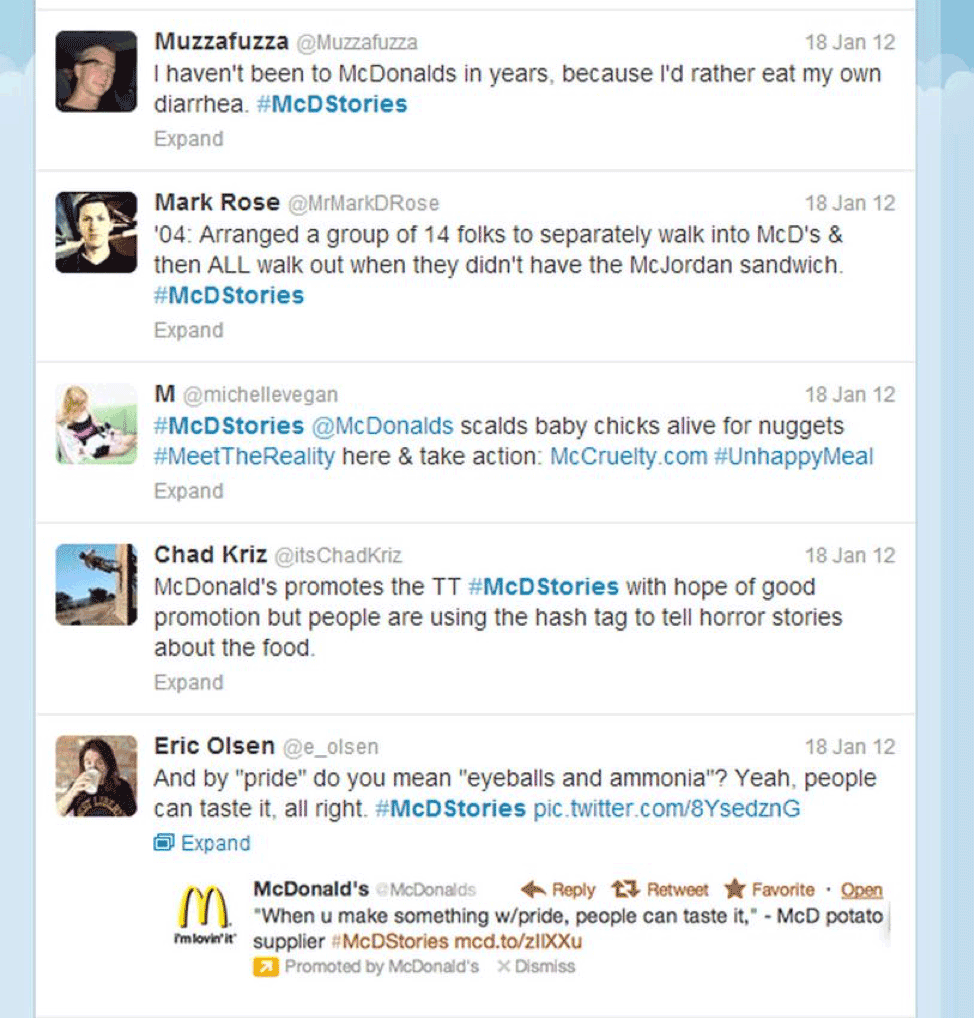
Many companies remove unflattering comments from their social pages. If the comment section appears clean, search hashtags to find candid public opinion.
If your company has had a promotional hashtag backfire, search that hashtag—popularly called a “bashtag”—to understand the nature and theme of the backlash.
Competitor research
By this point you should have a solid understanding of your own corporate sentiment. Competitor research adds nuance by revealing whether public feelings toward your company reflect industry-wide attitudes or are specific to your brand.
Walk through the same analysis process with at least two direct competitors of roughly the same size operating in the same geographical area. You may discover, for example, that a competitor’s Wikipedia page ranks prominently while yours does not—an opportunity to improve your own search presence.
Tools for corporate sentiment analysis
The best tool for understanding corporate sentiment is the human mind. The following tools support the research process, but synthesizing the findings requires human judgment:
- Mention
- Google Alerts
- Ahrefs
- Moz
- BuzzSumo
- Talkwalker
- Brandwatch
- RapidMiner
- MonkeyLearn
- Sprout Social
- Sprinklr
- Qualtrics XM
searches processed by Google every day — the primary gateway shaping corporate sentiment worldwide
Internet Live Stats
Conclusion
There is no standardized measurement system for corporate sentiment, but it can be assessed qualitatively. If you are in leadership or PR, measuring corporate sentiment is a routine marketing activity that should happen on a regular basis.
Awareness of the search results and conversations surrounding your company helps you anticipate and defend against attacks on your reputation. For a structured approach to what comes next, explore our guide to corporate reputation management strategy.
Frequently Asked Questions







Protect Your Online Reputation
Every day you wait, negative content gets stronger. Talk to our experts about a custom strategy for your situation.
Get Your Free Analysis