
Net Promoter Score as a Measure of Corporate Reputation
One simple question can reveal exactly where your brand stands — and who you need to win over to protect your company's reputation.

- NPS is based on one question: how likely customers are to recommend you on a 0–10 scale
- Subtract the percentage of detractors (0–6) from promoters (9–10) to calculate your NPS
- Passives (7–8) are prime conversion targets — use personalized outreach based on their history
- Promoters respond well to loyalty programs; detractors need to feel heard and acknowledged
- 88% of consumers trust personal recommendations, making a strong NPS a direct reputation asset
Net Promoter Score (NPS) is a single-question metric that measures how likely customers are to recommend your business, making it a direct indicator of corporate reputation. Calculated by subtracting the percentage of detractors from promoters, NPS offers a simple yet powerful benchmark against competitors. While NPS has real limitations, its simplicity and actionability make it a valuable tool for targeting promoters, passives, and detractors with tailored engagement strategies.
Imagine for a minute that there was an easy-to-understand metric that told you:
- Where your company stands in your customer’s eyes
- How your company’s reputation measures against your competition
- Exactly who you need to concentrate on to win over
If you had that metric at hand, you would pay close attention to it, right? That powerful measurement does exist, and it’s called a Net Promoter Score, or NPS for short. Your NPS is a robust indicator of your company’s reputation, and its rise and fall can have a powerful effect on that reputation.
- Customer-centric focus: NPS places your customers at the center of the conversation, helping you gauge their satisfaction and loyalty.
- Competitive insight: It provides a comparative benchmark against competitors, enabling you to identify areas where your reputation shines or needs improvement.
- Targeted strategies: NPS pinpoints the individuals or groups you should prioritize to win over, cultivating a community of brand advocates who can keep your reputation in good standing.
This article covers Net Promoter Score and its implications on your company’s reputation, including how to calculate it, what makes it useful, where it falls short, and how to act on your results.
What is Net Promoter Score?
While many scoring systems of the past relied on multiple questions or long surveys, your Net Promoter Score is based on one simple question only:
“On a scale of 0-10, how likely are you to recommend this company to a friend or colleague?”
If you think about it, that is your business’s reputation encapsulated in a single sentence. Understanding how customers perceive your brand is also central to what corporate reputation really means — and NPS gives you a direct, quantifiable window into that perception.
Net Promoter Score Methodology
To calculate NPS, take the percentage of your customers who would highly recommend your business, company, or service and subtract the percentage of those who would rank it negatively.
Get a Free Reputation Assessment
Find out what people see when they search for you online. No obligation — results in 24 hours.
On the standard 0–10 scale, the detractors (those who score your company anywhere from 0 to 6) are subtracted from the promoters (anyone scoring you a nine or ten). Leave out the passives, which are those in the middle with sevens and eights.
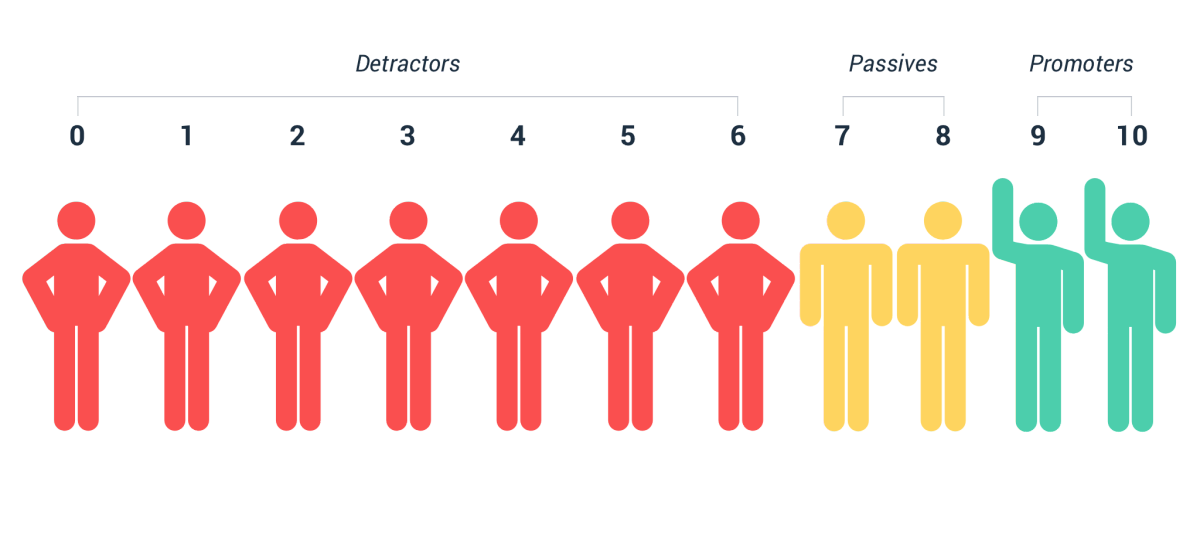
(source: https://medium.com/trustfuel/understanding-net-promoter-score-6f6ca862064f)
Why is Net Promoter Score Important?
Personal recommendations are incredibly important to consumers.
of consumers trust recommendations from people they know above all other forms of advertising
Nielsen Trust in Advertising
An NPS score indicating how many of your customers would recommend you to others is a clear indicator of your reputation. It also connects directly to the broader question of how to measure brand reputation using meaningful, actionable metrics.
Is NPS a Trustworthy Performance Measure?
How useful your Net Promoter Score is depends on what you hope to get out of it. There are meaningful advantages and real limitations to consider.
NPS Pros
One thing in favor of NPS is its simplicity. NPS is easy for you to evaluate, and it’s also straightforward for your customers to complete. You don’t have to depend on them to fill out a lengthy survey that takes even more time to collate and interpret.
NPS also helps companies target customers in very specific ways. Promoters typically want a different kind of attention than detractors do — promoters respond well to loyalty programs or exclusive offers, while detractors usually want to air their grievances and be heard. That distinction makes passives a natural target for your full sales pitch.
By identifying who in your market needs what, you will interact with them more effectively and efficiently.
NPS Cons
NPS is not always a clear KPI for customer satisfaction. Research examining NPS across IT support organizations found that while NPS correlates with customer satisfaction, it doesn’t correlate as closely as its adherents claim. A 2022 study published in the Journal of the Academy of Marketing Science by Keiningham et al. added to a growing body of evidence challenging NPS’s predictive validity.
The chart below graphs customer satisfaction against NPS for 74 different IT support organizations.
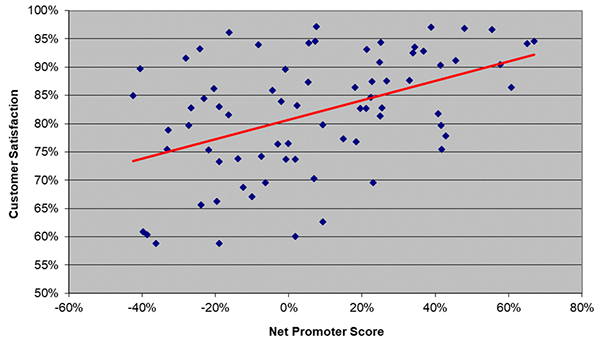
(source: https://www.thinkhdi.com/library/supportworld/2018/metric-of-month-net-promoter-score)
NPS can also be a good measure of intention, but not necessarily of action. Research published in the Harvard Business Review found that only half of the people who intended to recommend a company actually followed through. Consumer behavior has shifted considerably since then — social media and online reviews have changed how recommendations spread — but the gap between intention and action remains a meaningful limitation. While NPS may measure how many fans you have, it may not reliably indicate how many of those fans will actively enhance your reputation.
Want to Strengthen Your Brand Reputation?
Our team helps companies translate customer feedback signals like NPS into actionable reputation strategies that build lasting trust.
How to Improve Your Net Promoter Score
Your promoters are worth their weight in gold as influencers. They are essentially free advertising. But that doesn’t mean you can assume they will remain loyal and simply forget about them.
You can’t ignore promoters. You will reward them differently than you would your detractors, and you want to make sharing their positive feelings about you as effortless as possible.

(Source: SurveyMonkey.com)
Detractors are equally valuable but in a different way. By self-identifying, they give you the opportunity to know exactly who you must reach out to and ask where you’ve gone wrong. By listening to them and addressing any issues they raise, you can:
- Convert them to promoters
- Prevent future detractors from having the same problem
- Improve your company and business offering as a whole
This process of turning detractors into advocates is a core component of analyzing online reviews and feedback to improve reputation — the same principles apply whether the signal comes from an NPS survey or a public review platform.

Finally, by giving the full sales pitch to your passives, you have the chance to convert passives to promoters. This is a triple win because it simultaneously improves your NPS, loyalty, and bottom line. You may also discover that certain passives are not your prime demographic at all, freeing up resources for more attentive audiences and markets.
What is Considered a Good Net Promoter Score?
Achieving a perfect NPS of 100 remains essentially unheard of in practice. It is best to measure your NPS against your previous rankings and the scores of your current competitors rather than chasing an absolute number.
If you need a general benchmark, an NPS above 50 is broadly considered excellent — though what qualifies as “good” varies meaningfully by industry. According to Retently’s current NPS benchmarks, average scores differ significantly across sectors:
- Technology: ~35
- Retail: ~45
- Financial Services: ~34
- Healthcare: ~38
Knowing your industry’s baseline is essential context for interpreting your own score.
Final Thoughts
Your Net Promoter Score is not just a number; it’s a reflection of your company’s reputation in the eyes of those who matter most — your customers. Its fluctuations hold the potential to impact brand perception significantly, and ultimately, your success.
By continuously monitoring and improving your NPS, you can ensure that your reputation remains robust and resilient in the face of challenges. For a broader view of how metrics like NPS fit into a larger strategy, explore our guide on corporate reputation management strategy.
Frequently Asked Questions








Protect Your Online Reputation
Every day you wait, negative content gets stronger. Talk to our experts about a custom strategy for your situation.
Get Your Free Analysis