
The Very Good Guide to Corporate Reputation Online
Everything businesses need to know about corporate reputation — from measurement and risk mitigation to building a strategy that protects long-term value.

- Corporate reputation is built on consistently meeting the expectations you set for your brand.
- 70–80% of a company's market value comes from intangible assets like brand equity and goodwill.
- A damaged reputation can directly reduce revenue, market value, and your ability to attract top talent.
- Reputation monitoring and management are essential investments in today's connected digital environment.
- Building a proactive reputation strategy is more effective than reacting to damage after it occurs.
Corporate reputation is the gap between what a company promises and how consistently it delivers — and it directly affects market value, talent acquisition, and customer loyalty. This guide covers everything from defining corporate reputation and measuring it, to managing reputation risk, leveraging corporate social responsibility, and building a long-term reputation strategy. With 70–80% of a company's market value tied to intangible assets like brand equity and goodwill, protecting your reputation is one of the highest-ROI investments a business can make.
How to Manage and Protect Your Corporate Reputation Online
-
1
Define your corporate identity
Start by answering basic questions about what your company stands for and what promises it makes to customers, stakeholders, and the public. Corporate reputation is the byproduct of what a company says it will do weighed against how consistently it delivers on those promises. Use examples from your own brand to clarify the expectations you set and how reliably you meet them.
-
2
Understand why reputation affects your bottom line
Recognize that approximately 70% to 80% of a company's market value comes from intangible assets such as brand equity, intellectual capital, and goodwill, according to Harvard Business Review research. A strong reputation can boost sales, increase market value, reinforce customer loyalty, and attract top talent. This makes your reputation one of the most financially significant assets your organization holds.
-
3
Measure reputation using the Corporate Reputation Quotient
Apply the Harris-Fombrun Corporate Reputation Quotient Model, which uses six dimensions made up of 20 attributes graded by research participants to measure stakeholder perception. This standardized tool gives you a comprehensive view of how various stakeholders — including customers, investors, and employees — perceive your brand. Track your results against annual Harris Poll rankings to benchmark your standing relative to competitors.
-
4
Track your Net Promoter Score
Use a Net Promoter Score to get a quick, easy-to-understand snapshot of where your company stands in the eyes of customers. NPS measures the likelihood that customers will recommend your business to others, making it a direct indicator of brand loyalty and satisfaction. Review your NPS regularly to spot trends and identify areas where customer experience may be hurting your reputation.
-
5
Monitor shareholder value as a reputation signal
Pay attention to shareholder value as a measurable reflection of your corporate reputation, since market perception directly influences how investors value your company. As Andrew Lester of FreshBusinessThinking.com notes, corporate reputation is the sum of all views and beliefs held about a company based on its history and future prospects compared to competitors. Declines in shareholder value can serve as an early warning that your reputation is under pressure.
-
6
Benchmark against respected reputation rankings
Regularly consult resources like The Harris Poll and Fortune's World's Most Admired Companies list to see how your brand compares to industry leaders. These rankings evaluate companies across multiple dimensions and are widely used by investors, partners, and job seekers to assess corporate credibility. Appearing favorably on such lists can significantly increase your market value and public trust.
-
7
Invest in reputation monitoring and management
Because the internet allows bad news and misinformation to spread rapidly, actively monitoring your brand's online presence is essential. Set up systems to track mentions, reviews, and sentiment across search engines, social media, and news outlets so you can respond quickly to emerging threats. Consider partnering with a reliable reputation management company to ensure consistent oversight and swift action when issues arise.
-
8
Integrate corporate social responsibility into your strategy
Corporate social responsibility is a measurable factor in how the public, customers, and stakeholders perceive your brand. Evaluate your company's environmental impact, community engagement, and ethical business practices, and communicate your commitments clearly and consistently. Demonstrating genuine responsibility beyond profit signals trustworthiness and strengthens long-term reputation across all audiences.
“It takes 20 years to build a reputation and five minutes to ruin it. If you think about that, you’ll do things differently.” – Warren Buffet
Corporate reputation has so many facets that it’s hard to get all the information in one place. We’re here to remedy that. This corporate reputation guide will break down everything you need to know about corporate reputation:
- Definition of corporate reputation
- Why corporate reputation is important
- How corporate reputation is measured
- Reputation risk – What it is and how to mitigate it
- The value of corporate social responsibility
- How to build a corporate reputation strategy
- How to find a reliable, respectable reputation management company
At this point, it might not yet seem obvious just how vital a good company reputation is to your business’s success, how a bad reputation can torpedo your best efforts, or how massively it impacts your revenues and profits. We promise that after reading this, it will.
The definition of corporate reputation
Understanding the definition of corporate reputation begins by answering a few basic questions about your company’s identity and the expectations for its actions. Consider big-name companies like Apple, for example. When you think of the tech giant, you immediately jump to the technology, reliability, and usability of its products. When you think of Disney, you think of its reputation for entertainment, hospitality, and customer service. These brands did not build up these reputations overnight, but it is these expectations — and, more importantly, continuously meeting those expectations — that are crucial to the bottom line of their businesses.
At its very core, corporate reputation is the byproduct of what a company says it is going to do weighed against how consistently that company delivers on its promises.
Get a Free Reputation Assessment
Find out what people see when they search for you online. No obligation — results in 24 hours.
In the words of Andrew Lester of FreshBusinessThinking.com, “A company’s corporate reputation is the sum of all the views and beliefs held about the company based on its history and its future prospects, in comparison to close competitors.”Many factors go into establishing corporate reputation, and knowing these various factors is the key to understanding corporate reputation. The illustration below depicts the different influences on a company’s reputation.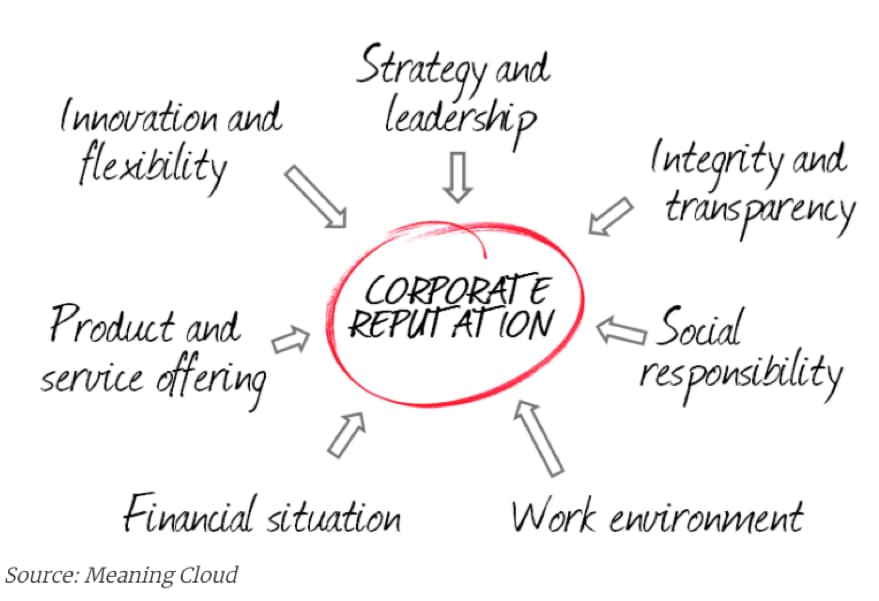
Why corporate reputation is important
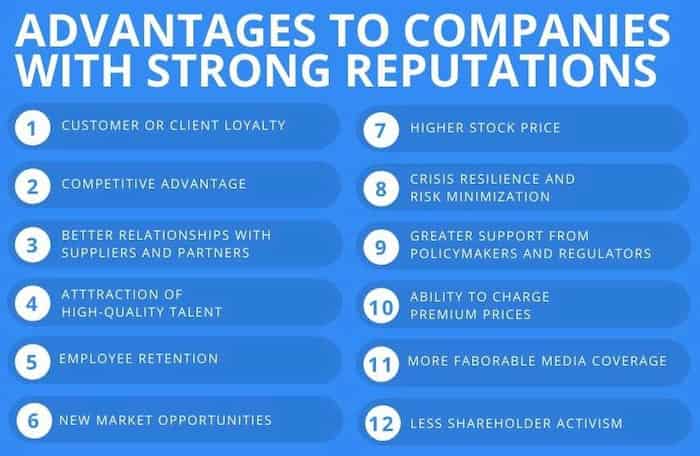
We’ve explained what corporate reputation is, but why is it so important to a business’s bottom line and overall success? Corporate reputation is important because it influences tangible and intangible assets that have direct and indirect impacts on the future of your company. According to research conducted by the Harvard Business Review, approximately 70% to 80% of a company’s market value comes from hard-to-assess intangible assets such as brand equity, intellectual capital, and goodwill. This means organizations are especially vulnerable to anything that damages their reputations. Reputation is a growing factor in the corporate world. Reflective of this is the amount of scholarly content that can be found on the web with a simple Google search on the subject.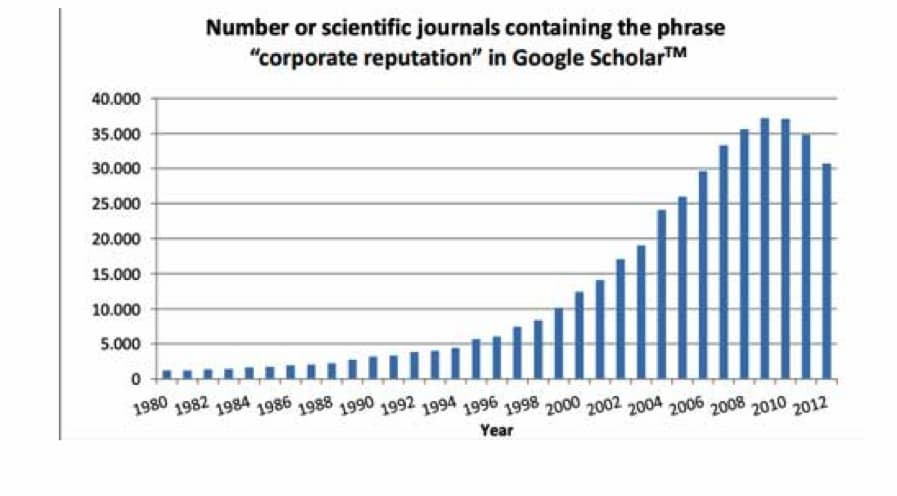
- Boost sales
- Increase company market value
- Appeal to top talent when hiring
- Reinforce customer loyalty
Measuring corporate reputation
So, how do you measure your company’s most valuable intangible asset? There are several factors to consider when gauging where your corporate reputation currently stands. From the quality of products and services to the work environment and corporate culture to community engagement and environmental responsibility, all of these need to be monitored and analyzed to get the full picture of how your brand is viewed by the masses. Keeping tabs on these many nebulous variables may seem like a daunting task, but there are places to look that can make it much easier. Ways to measure corporate reputation include:
Fortune – The World’s Most Admired Companies
Many of the companies you see atop The Harris Poll will also appear on Fortune’s list of the World’s Most Admired Companies. Like The Harris Poll, Fortune Magazine is a well-respected resource for gauging corporate reputation. You have probably heard of the Fortune 500, a renowned ranking of the largest companies in the United States based on revenue. Here, we are talking about the same well-respected publication but a different list, one that focuses on the admirability of global companies based on key attributes and how those attributes are perceived by a large pool of qualified professionals. The attributes that form Fortune’s World’s Most Admired Companies list are:
- Quality of Management and Leadership
- Quality of Products and Services
- Innovativeness
- Community Responsibility
- Wise Use of Company Assets
- Effectiveness in Running a Global Business
- Value as a Long-Term Investment
- The soundness of Financial Position
- Ability to Attract and Retain Talent
A network of more than 3,000 business insiders (i.e., board directors, executives, analysts, etc.) who have an active interest in the relevant markets uses these nine attributes as criteria to rate the companies that make the list. Fortune and Korn Ferry publish the World’s Most Admired Companies list annually — rankings and full methodology are available at Fortune.com. But not every industry qualifies for consideration. Rankings are only available for food and drug stores, general merchandisers, construction and farm machinery, crude oil production, network and other communications equipment, metals, mining, and wholesalers.
Net Promoter Score (NPS) and its effect on reputation
A Net Promoter Score (NPS) is an easy-to-understand snapshot of where a company stands in the eyes of customers. It is also a metric that can be used to gauge how a company compares to its competition. Whereas many corporate reputation measurements require long surveys or networks of executives weighing criteria, an NPS is based on one simple question: “On a scale of 1-10, how likely are you to recommend this company to a friend or colleague?”A company’s NPS is important because personal recommendations have proven to be a top driver of consumer purchase decisions at every stage of the purchase cycle across multiple industries. Customers that rank your company as a 9 or 10 are your “Promoters,” or customers that would highly recommend your business. Customers that rank your company from zero to six are your “Detractors” because those scores represent a negative view of your company. Those that rank your company with a seven or eight are indifferent and considered “Passives.”Once this information is collected, calculating your NPS is as simple as subtracting the percentage of Detractors from the percentage of Promoters. A visual representation of the NPS methodology looks something like this: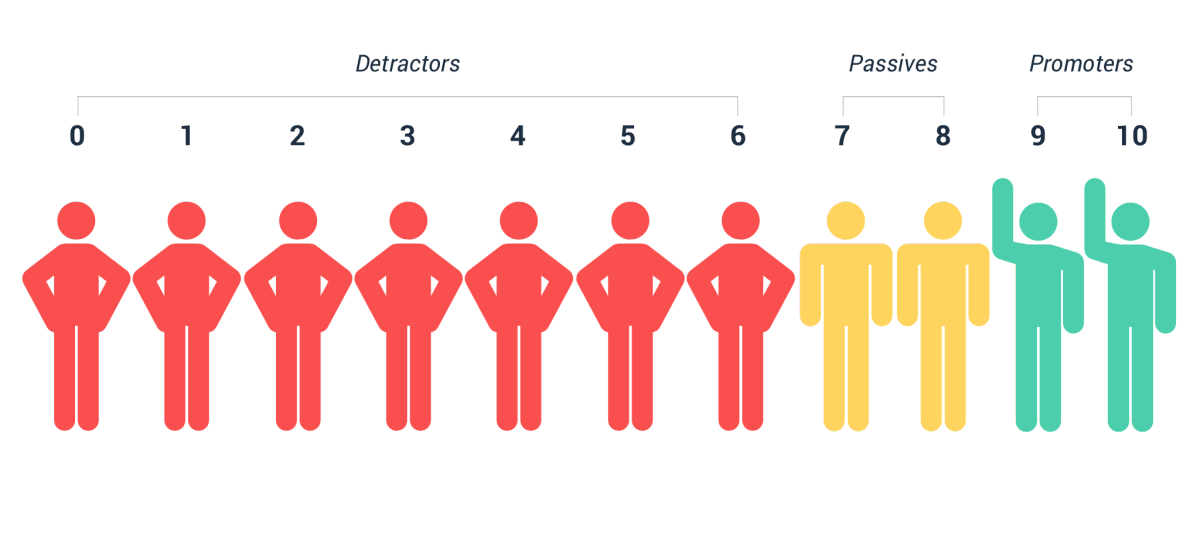 Photos courtesy of Medium.com
Calculate net promoter score
As an example, if you do an NPS survey, and 70% of your respondents give your company a 9 or 10 (Promoters), while 16% of your respondents give you a ranking of 0-6 (Detractors), then your Net Promoter Score is 54 (70 – 16 = 54). No company has ever received a perfect NPS of 100, but there is nothing wrong with trying to hit this mark. While it varies based on industry, an NPS of 50 is considered to be an excellent score. What is most important about monitoring your NPS is measuring your current ranking against your previous rankings, as well as how your score compares to current competitors, to see if your reputation is rising or falling and how you measure up to your competition.
Measuring corporate reputation based on shareholder value
It is only logical that investors would be more likely to buy stock in a company that has a good corporate reputation than one with a poor reputation. There is even a term for the percentage of a company’s market value that can be attributed to corporate reputation. It’s called Reputation Contribution. For those wanting to understand just how much corporate market value is at stake with your company’s reputation, here is a hard-number breakdown of how some of the top-ranking global companies fared in the market, thanks to their strong reputations.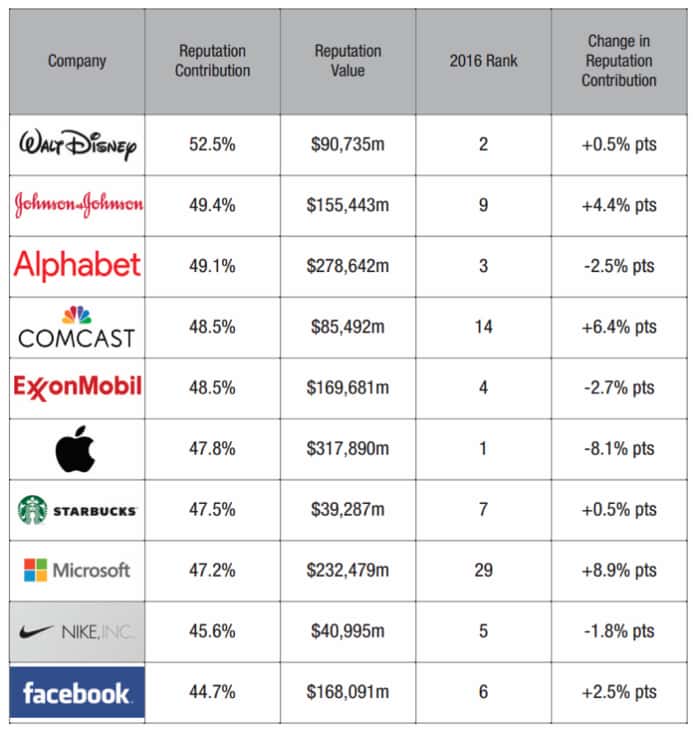
Reputation risk – What it is and how to mitigate it
We previously discussed how news – both good and bad – can travel quicker than ever in this age of the Internet and social media. Bad press or negative sentiment about your company can go viral and reach a global market almost instantaneously if you are not proactive about protecting your corporate reputation. For an example of just how fast, you don’t have to look any further than the speed at which the walls around former Seattle Mariners CEO Kevin Mather came tumbling down. This challenge of threats to your company’s good name is called reputation risk, and those threats are gaining more traction among executives as a serious danger to corporate success. A reputation risk is anything that jeopardizes the reputation of your company, institution, or organization. However, it’s also important to know that reputational risks can be categorized in two ways: direct and indirect.
Examples of direct reputational risk
Direct reputational risk is created as a result of deliberate action or inaction of a company when it comes to its standards or governance. Examples of direct reputational risks include:
- Employment conditions
- Executive compensation
- Product quality relative to the price
- Working practices across supply chains
- Customer privacy and security
- Product recalls
- Fraud and corruption in foreign market subsidiaries
- Conflict of interest and difficulty with regulatory changes
- Financial or reporting irregularities
- Tax avoidance and tax evasion
- Scrutiny of business practices from stakeholders and media
- Social responsibility
- Discrimination
- Excessive cost-cutting maneuvers
- Inappropriate credit decisions
- Questionable investments
- Earnings not meeting expectations
Examples of indirect reputational risk
On the other hand, indirect reputational risk is caused by negligence or deliberate action of peripheral parties like employees. While this type of risk is unintentional by company leadership, its damage can be just as impactful as direct risks because it makes a company look unprepared for risk mitigation and unable to manage its employees and affiliates properly. Examples of indirect reputational risks include:
- Employee error or negligence
- Physical security breach
- IT breach
- Social media posts and behavior
- Any direct reputation risk executed by affiliates or employees
Mitigating reputational risks takes a group effort internally within a company. Leadership needs to be proactive in developing reputational risk strategies — something that should be included in every business plan. Establishing corporate values and procedures related to ethics and compliance is a good way to mitigate indirect reputational risk. There should be a focus on providing all stakeholders — from employees to consumers to shareholders — with a positive experience when they interact with your company. Making sure all of your company’s public reporting and financial statements are accurate will help mitigate direct reputational risk. Discrepancies or a lack of transparency can reflect poorly on the company. All of these risk mitigation factors should be incorporated into a competitive business model. Planning a crisis response plan should be at the forefront of these models. Having these processes in place, along with competent leadership, is the best way to protect your company from reputation risks.
The value of corporate social responsibility
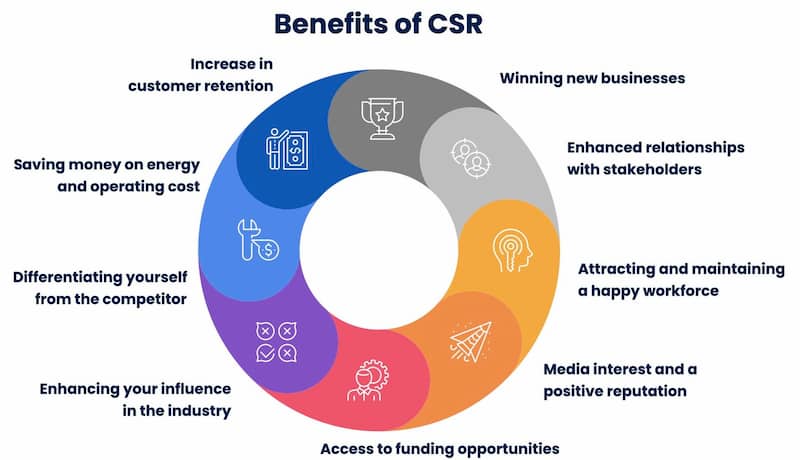
Part of your company’s reputation risk mitigation should be a corporate social responsibility plan. Corporate Social Responsibility (CSR) is a strategy that simultaneously builds and protects your corporate reputation.CSR holds companies accountable for their effects on the environment and society as a whole. It is particularly useful for keeping corporate giants in check. Millennials have reached the buying power and decision-making stages of their lives, and studies have shown that they are more likely than previous generations to place a higher priority on a company’s social responsibility when making their consumer decisions. Companies that overtly show that they care about social issues, fair trade, environmental sustainability, and their local community are being favored by consumers these days. Remember The Harris Poll we talked about? It, too, agrees that social responsibility is a growing factor in the corporate reputation world.
Four categories of social responsibility
While it might seem like a broad term, social responsibility can be categorized into four types:
- Philanthropy
- Labor
- Environmental conservation
- Volunteerism
By giving back to the consumers and other stakeholders that support and help build the company, CSR goes a long way toward maintaining a positive corporate reputation.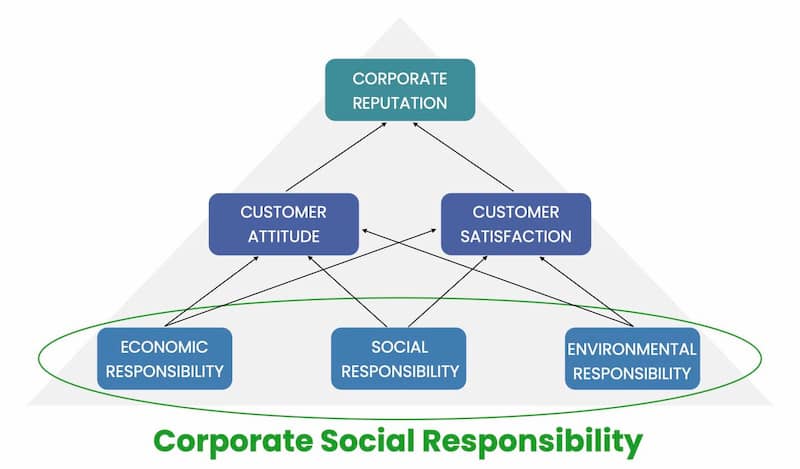
Corporate reputation strategy overview
Now that we have defined corporate reputation explained why it is important and how to measure it, and examined reputation risks and how corporate social responsibility can help mitigate them, it’s time to dive into developing a corporate reputation strategy for your company. While CSR needs to be incorporated into your corporate reputation strategy, a marketing campaign built around your company’s social accountability alone will not be enough. You need to tell your Brand Story through your corporate reputation strategy. Your Brand Story should depict your company’s transparent leadership and strong corporate values. It will be foundational to your reputation management strategy. When it comes to corporate reputation management, it is important to make sure you are checking off certain items for a well-rounded plan. First, you should be monitoring your brand’s mentions on social media and the Internet as a whole. Monitoring services and tools are available to assist with these efforts. Once you are aware of the conversation surrounding your brand, you can figure out the weak areas that need more attention and the strong areas that need to be continuously highlighted. Corporate social responsibility, if managed correctly, is one pillar of a reputation management strategy that will organically and regularly bolster the positive public perception of your company. However, there are other elements to a corporate reputation strategy that require a proactive approach on the company’s end. They include:
- Perception of leadership
- Financial performance
- Products and services
- Workplace environment
- Emotional appeal
Reputation management is so crucial to a company’s success that it requires a holistic approach. However, in this digital age, online reputation management takes priority. This requires developing a strong online presence built around your brand story. Publish as much positive content as possible to help add to this online portfolio. Claim and optimize all social media accounts. Responding to online mentions and bolstering positive online reviews on all platforms are powerful and visible ways you can improve and grow your company’s web presence. The idea is to build brand authority online, and that takes some time. More importantly, it takes strategy. And that strategy is best developed with the aid of skilled and experienced reputation management professionals who work in the reputation management space every day.
How to choose a dependable reputation management company
Not all online reputation management companies are the same, but a good one can make a world of difference in executing a corporate reputation strategy. But how do you choose a good reputation management company? Think like a consumer. Just as your stakeholders are going to inquire about your reputation as a company, you should do the same when you hire an online reputation firm. Only work with a reputation management firm that has a good reputation. Head to the web, read reviews and research their online profiles. Ask business colleagues about their experiences with reputation management and consult with multiple agencies before you make a final decision. It is important to be methodical and smart in your approach to hiring a reputation management company because, when done correctly, your research can pay major dividends in the success of your business. If done with haste and neglect, your choice can leave you with a bigger mess than you started with. Now that you have a better idea about the varied aspects of corporate reputation ask yourself: Are you doing everything you can to build and protect your corporate reputation?
Frequently Asked Questions








Protect Your Online Reputation
Every day you wait, negative content gets stronger. Talk to our experts about a custom strategy for your situation.
Get Your Free Analysis