
All About the Reputation Quotient Model and How It Works
The Harris-Fombrun Reputation Quotient has ranked top companies since 1999 — here is exactly how it works and what it means for your business.

The Harris-Fombrun Corporate Reputation Quotient (CRQ) is a standardized model that measures corporate reputation across six dimensions and 20 attributes using a two-phase survey methodology. First published in The Wall Street Journal in 1999, it has become the benchmark tool for ranking and comparing corporate reputations annually. With 70-80% of market value tied to intangible assets like reputation, the CRQ gives businesses a reliable framework for quantifying what is otherwise difficult to measure.
How to Improve Your Company's Reputation Quotient
-
1
Assess your emotional appeal
Evaluate how well your company generates good feelings, admiration, respect, and trust among stakeholders. Conduct surveys or focus groups to understand how consumers, investors, and employees genuinely feel about your brand. Use this feedback to identify gaps and guide initiatives that strengthen your company's emotional connection with the public.
-
2
Strengthen your products and services
Audit whether your offerings demonstrate quality, innovation, strong warranties, and good value to customers. Gather customer feedback and competitive benchmarks to identify where your products or services fall short. Invest in improvements that make your offerings stand out and reinforce that your company stands behind what it sells.
-
3
Demonstrate vision and leadership
Ensure your leadership team communicates a clear, compelling vision for the company's future both internally and publicly. Highlight how your organization recognizes and capitalizes on emerging market opportunities. Regularly showcase executive decision-making and strategic foresight through thought leadership content, press releases, and stakeholder communications.
-
4
Optimize your workplace environment
Evaluate how your company is perceived as an employer by reviewing employee satisfaction scores, turnover rates, and public employer ratings. Work to build a culture and management structure that makes your organization genuinely attractive to top talent. Publicize employee programs, workplace awards, and company culture initiatives to strengthen your external reputation as a great place to work.
-
5
Highlight your financial performance
Demonstrate a strong record of profitability, low investment risk, and solid prospects for future growth to reassure stakeholders. Share transparent financial reporting and forward-looking statements that build investor and consumer confidence. Position your company as a stable, well-performing organization through earnings announcements, annual reports, and media outreach.
-
6
Conduct regular CRQ audits
Make regular checks against all six dimensions and 20 attributes of the Harris-Fombrun CRQ model a standard part of your reputation management process. Compare your performance within and across your industry to identify where you lead and where you lag. Use audit findings to prioritize reputation improvement initiatives and track progress over time.
- We live in an economy where about 70-80% of market value is derived from intangible assets such as corporate reputation.
- A company’s reputation is easier to gauge than you might think thanks to the Harris-Fombrun Corporate Reputation Quotient Model (CRQ).
- Many people consider The Harris Poll/CRQ to be a reliable validation of corporate reputation, so it can drive public perception of a company positively or negatively.
- The CRQ has become an invaluable tool for companies when managing corporate reputation and identifying new market risks and opportunities.
Brand reputations are notoriously difficult to quantify. We can easily assign a numerical value to assets like cash, accounts receivable, and inventory. But there are plenty of intangible assets like copyright and your online reputation.
That’s where the Corporate Reputation Quotient Model comes in. It gives companies a concrete framework for measuring something most people only talk about in vague terms. RepuScore does the same for individuals and brands with a free 0–100 score.
What is the Corporate Reputation Quotient Model?
Reputation carries enormous financial weight for businesses. Lose it, and the consequences show up fast in stock price, customer retention, and employee morale. After all, we live in an economy where about 70-80% of market value is derived from intangible assets such as brand equity and public perception.
Academic research on corporate reputation has surged in recent years, with journals like the Strategic Management Journal and Corporate Reputation Review publishing hundreds of studies linking reputation to financial outcomes. That research reflects what executives already know firsthand: reputation is a business asset worth managing deliberately.
Monitoring your corporate reputation, as well as comparing your reputation both within and across industries, is an integral part of running a business. The Corporate Reputation Quotient (CRQ) Model by Harris-Fombrun is one of the best sources for this information.
The Harris-Fombrun reputation quotient model is a standardized and comprehensive corporate reputation measurement that is different than the Net Promoter Score. Savvy business owners and their reputation managers use the model to better understand the perceptions of their corporate stakeholders, such as consumers, investors, employees, and key influencers.
Get a Free Reputation Assessment
Find out what people see when they search for you online. No obligation — results in 24 hours.
The first annual reputation quotient results were published by The Wall Street Journal in September 1999. Health and pharmaceutical giant Johnson & Johnson made headlines by taking the top spot in the report that year.
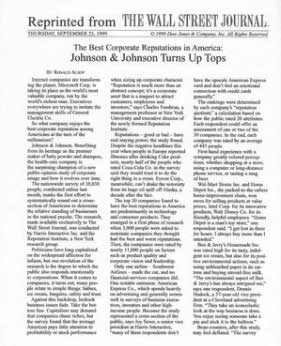
Since then, the report has been published annually to rank the top 100 companies based on corporate reputation and become better known as The Harris Poll.
Besides a few minor adjustments, the model’s fundamental structure has remained unchanged since its original development. The Harris-Fombrun CRQ Model is made up of six dimensions and 20 attributes that are graded by research participants on a 1-7 scale (1 = “Does not describe well” and 7 = “Describes very well”).
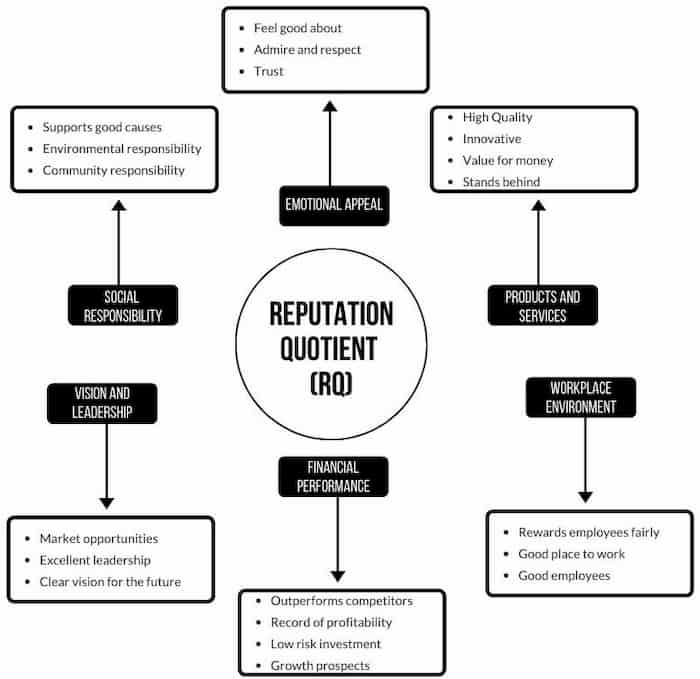
Harris-Fombrun Reputation Quotient Methodology
The Harris-Fombrun CRQ uses a 2-phase data collection process to gather the information that is run through the model and then published as a report. The methodology of that 2-phase process is as follows:
Phase 1: Nominations
Interviewees answer two open-ended questions:
- Of all the companies you know or are familiar with, which two would you say have the best reputations?
- Of all the companies you know or are familiar with, which two would you say have the worst reputations?
Responses are then tallied, subsidiaries are placed within parent companies, and a list of the “most visible” companies (nominations) is created.
Phase 2: Ratings
A separate sample of interviewees provides detailed ratings of up to two companies with which they are “very” or “somewhat” familiar. Ratings on the 20 attributes determine the company’s reputation quotient. Results are carefully weighted to ensure generalizability to the national population.
Why is the corporate reputation quotient important?
A company’s reputation can make or break a business.
“Good corporate reputations are critical because of their potential for value creation, but also because their intangible character makes replication by competing firms considerably more difficult.”
— Corporate reputation and sustained superior financial performance by P.W. Roberts & G.R. Dowling – Strategic Management Journal (2002)
Plenty of tools exist for measuring public sentiment — from social listening platforms to Net Promoter Score surveys. The corporate reputation quotient stands out because it captures six distinct dimensions of perception, giving a fuller picture than any single metric.
Many people consider The Harris Poll/CRQ to be a reliable validation of corporate reputation, so it can drive public perception that either positively or negatively affects a business’s bottom line.
As a result, the reputation quotient model has become an invaluable tool for companies to use when managing their corporate reputation and identifying new market risks and opportunities.
Here are some examples of the reporting you will find in the Harris Poll.
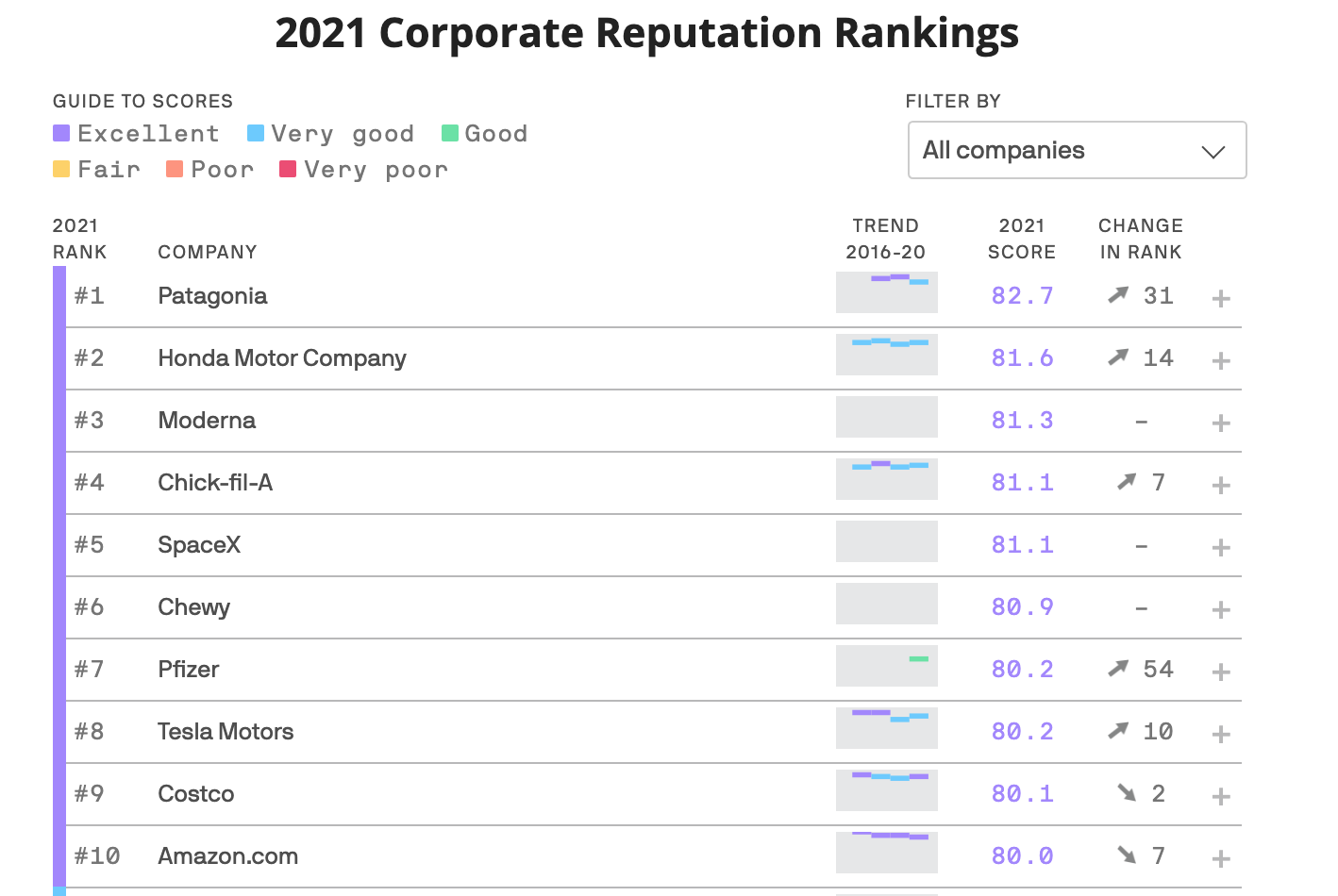
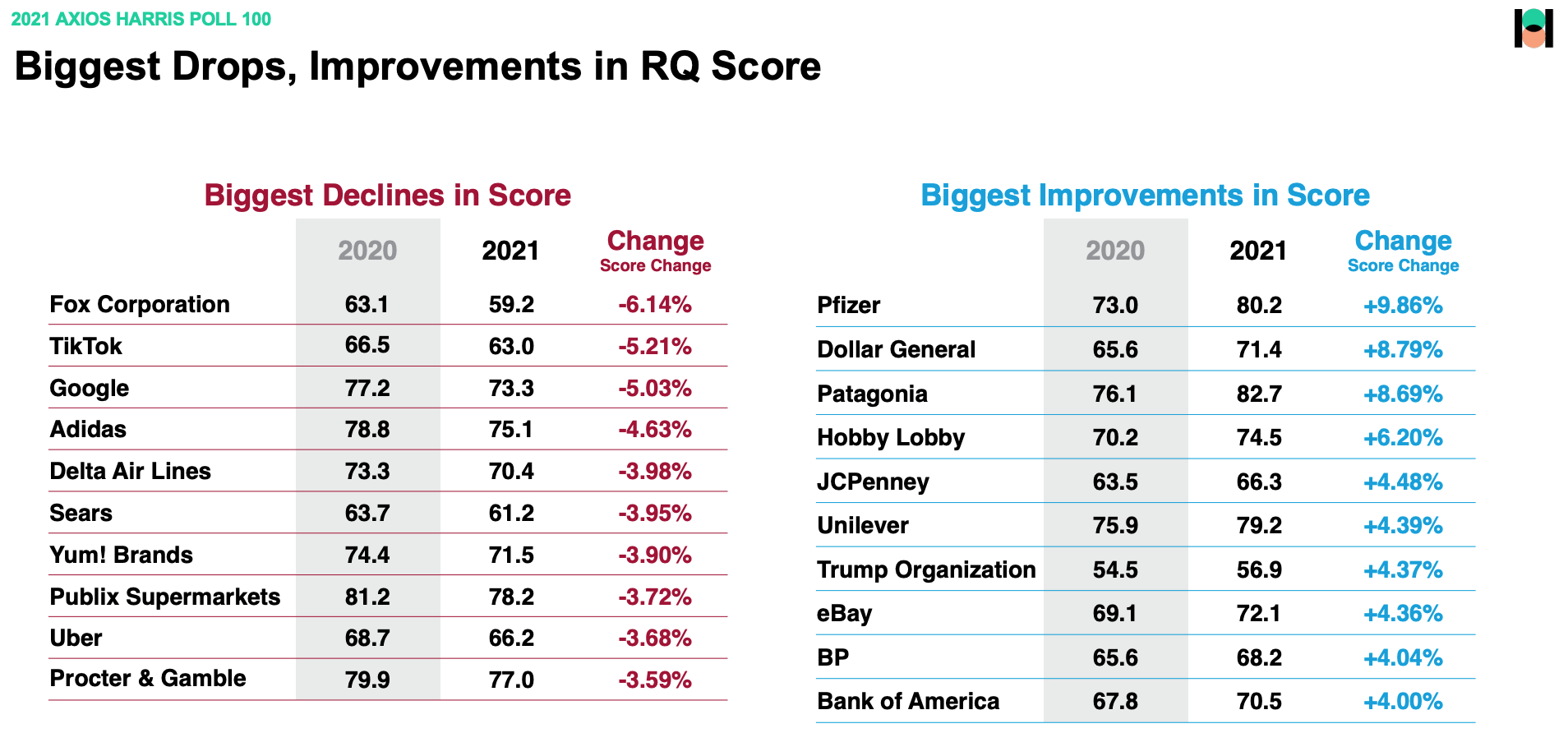
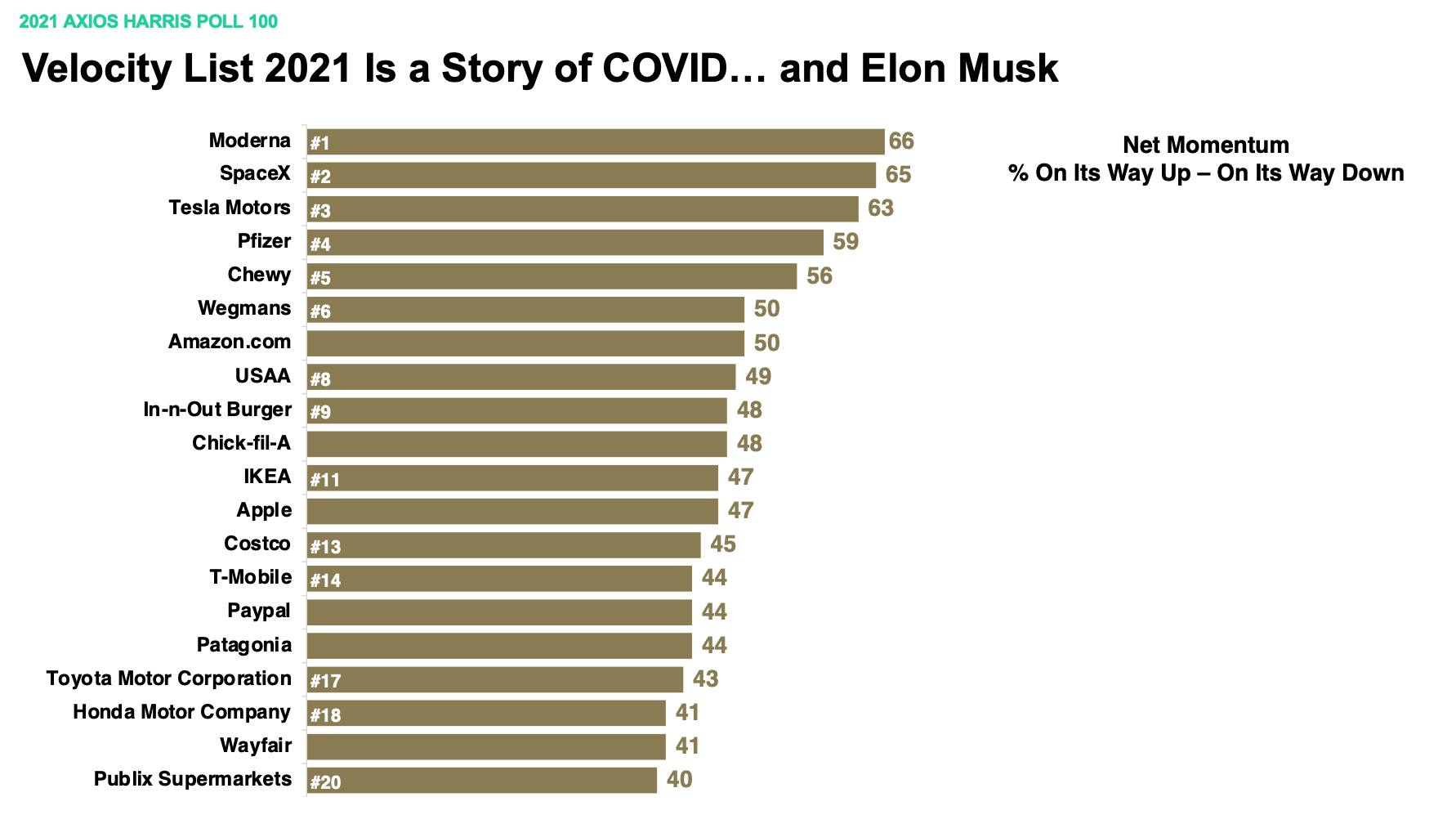
Photos courtesy of The Harris Poll
How can you improve a company’s reputation quotient?
If you need to improve your organization’s corporate reputation quotient, start by making regular checks and audits of how your company measures up with all the reputation quotient criteria. Here’s a quick checklist of the CRQ model’s six drivers of corporate reputation and their 20 attributes:
- Emotional Appeal
- Good feeling about the company
- Admire and respect the company
- Trust the company
- Products and Services
- Stands behind products/services
- Offers high-quality products/services
- Develops innovative products/services
- Offers products/services that are good value
- Vision and Leadership
- Has excellent leadership
- Has a clear vision for the future
- Recognizes/takes advantage of market opportunities
- Workplace Environment
- Is well managed
- Looks like a good company to work for
- Looks like it has good employees
- Financial Performance
- Record of profitability
- Looks like a low-risk investment
- Strong prospects for future growth
- Tends to outperform its competitors
- Social Responsibility
- Supports good causes
- Environmentally responsible
- Treats people well
Monitoring all of these dimensions takes dedicated time and resources that most executives simply don’t have. That is where a reliable reputation management company can be a lifesaver – or company saver.
A reputation management firm can handle the day-to-day work — managing online reviews, creating or updating Wikipedia pages, monitoring media mentions, and building content strategies that strengthen how the public sees your brand.
Frequently Asked Questions








Protect Your Online Reputation
Every day you wait, negative content gets stronger. Talk to our experts about a custom strategy for your situation.
Get Your Free Analysis