
Confirmation Bias ? Thinking With Guts vs. Brains
Your brain is wired to agree with itself — here's how confirmation bias quietly controls what you believe and why that matters.

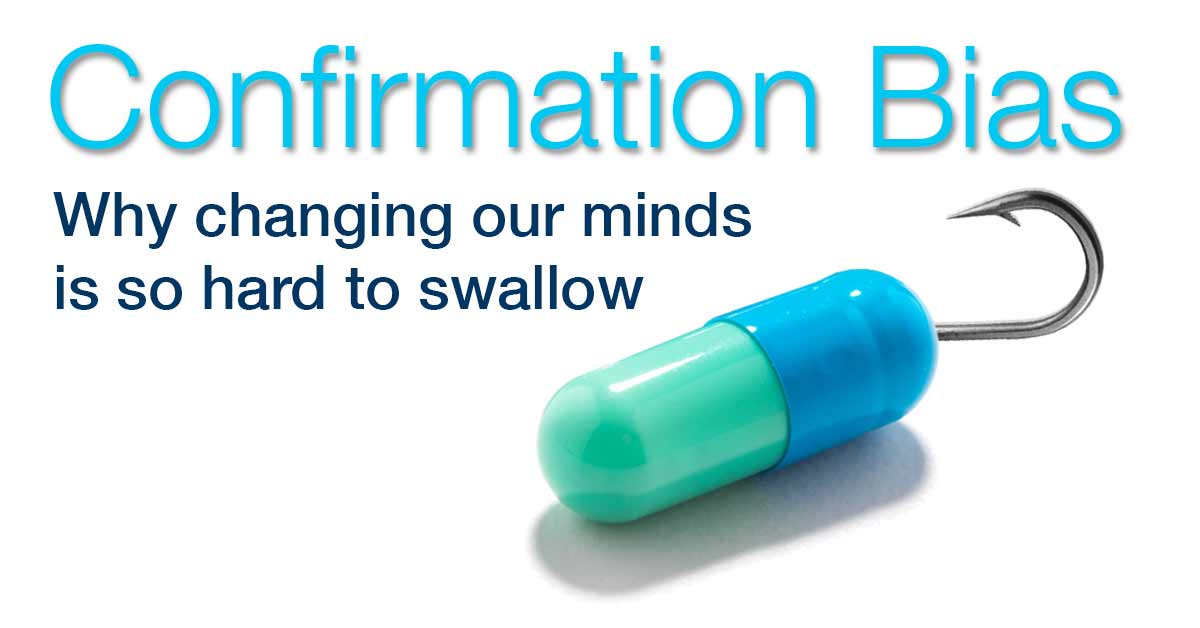
- Confirmation bias causes people to favor information that supports what they already believe.
- Cognitive biases like confirmation bias operate subconsciously and are a normal part of human thinking.
- Heuristics are mental shortcuts the brain uses to make faster decisions with less cognitive effort.
- Political polarization is a direct consequence of confirmation bias shaping how people consume news.
- Awareness of confirmation bias is essential for making better decisions in business and daily life.
Confirmation bias is our tendency to seek out and favor information that already aligns with our existing beliefs, often without realizing it. It is one of many cognitive biases and mental shortcuts the brain uses to process a complex world efficiently. Understanding confirmation bias helps explain political polarization, flawed business decisions, and why people across all backgrounds struggle to change their minds. Recognizing this bias is the first step toward more objective, informed thinking.
Why do you believe the things that you believe? Why do you defend your beliefs? Why do you like others who think as you do? We like to think that our beliefs are our own, formed from our unique, individual experiences, informed by our own logic, devoid of outside bias. But confirmation bias is one factor that quietly pushes us to one side of the fence or the other. In short, people agree with things they already agree with.
Our environment very much shapes our beliefs, the people we grow up with, and what we’re taught when we’re young. But there’s another way our beliefs take root, and it has a lot less to do with our individual experiences and principles and more to do with cognitive functioning.
- What is confirmation bias?
- What are cognitive biases?
- Confirmation bias in politics
- Confirmation bias in business
- The benefits of self-deception
- How confirmation bias is harmful
- How to avoid confirmation bias
- What we can learn from confirmation bias
What is confirmation bias?
Confirmation bias is our tendency to find, favor, and remember information that already confirms our existing beliefs.
It causes us to pay considerably less attention to information that does not support what we already think we know. Research from the Pew Research Center consistently shows that conservatives and liberals not only consume different news sources but interpret the same events in starkly different ways — a vivid illustration of confirmation bias shaping our social media realities.
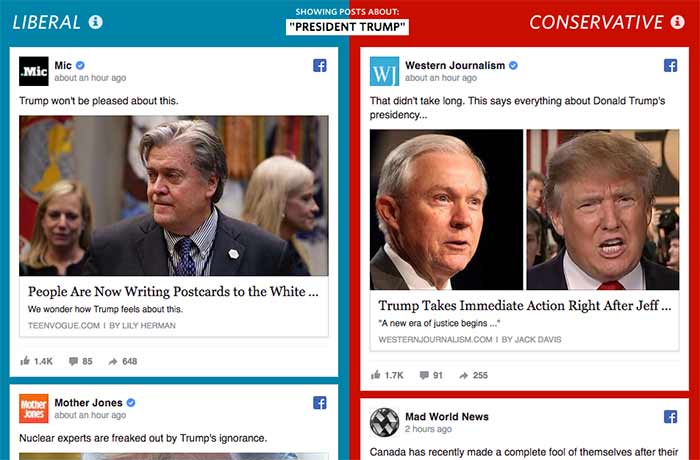
Image credit: WSJ
Whether we decide to challenge our confirmation bias is up to each one of us and our commitment to living an informed life. But even then, we can’t fully overwrite the way our brains make sense of the world around us.
What are cognitive biases?
There are a number of cognitive biases that affect how we see and understand the world, confirmation bias being just one of them. A cognitive bias is any sort of interpretive error in thinking that goes on to affect our decisions and judgments.
Get a Free Reputation Assessment
Find out what people see when they search for you online. No obligation — results in 24 hours.
Our brains are complex, and they are also imperfect. Cognitive biases often result from attempting to simplify information processing and make decisions quickly. They occur subconsciously — not usually as a direct effort to support our own beliefs, but as simply human responses to a large and confusing world.
What are heuristics?
Mental shortcuts, including cognitive biases, are known as heuristics. Heuristics are a bit like algorithms in your head. Input comes in and your brain’s built-in simplification process sorts it automatically based on what it already knows. This serves an important mental function, allowing you to operate and make decisions without having to stop and sort out all of the facts every time.
Think of the last time you went to see a new doctor. You probably didn’t diligently study their credentials or case history. You know they graduated from medical school, so you assume they can help you. It’s significantly easier to function this way, without having to find evidence to support every claim you believe.
Heuristics aren’t the only function behind cognitive biases. Memories, societal pressures, emotions, values, personal goals, and physiological brain limitations all play a role in sustaining the mental shortcuts that allow us to function with more dexterity.
Other types of cognitive bias
Aside from confirmation bias, other cognitive biases include:
- The halo effect: Our overall interpretation of a person determines how we see their individual actions.
- Attentional bias: Our ability to pay attention to some things while ignoring others at the same time.
- Optimism bias: The belief that we are less likely to suffer misfortune than others, and more likely to achieve success.
Confirmation bias in politics

The role of confirmation bias in political discourse is significant. It doesn’t just impact what information we choose to gather — it influences how we interpret that information and what our brain remembers. This perpetuates a cycle of beliefs that bolsters what we already think. Whether we’re discussing local politics at the dinner table or global affairs, we all come to the conversation with confirmation bias.
Confirmation bias and climate change
Consider the debate over climate change. The fact that peer-reviewed scientific evidence fails to sway so many people is a clear illustration of confirmation bias in practice. A person will always be able to find support — legitimate or not — for their existing beliefs. It’s why some continue to insist the moon landing never happened, and why others call climate change a hoax in the face of overwhelming scientific consensus.
How social media amplifies confirmation bias
Confirmation bias makes people seek out information that supports their beliefs, shaping the news channels they watch, the blogs they read, and their entire social media experience. This dynamic also drives how search results appear differently to different people — personalization algorithms amplify whatever worldview a user already holds.
Take a trip through the social feed of someone who holds opposite political beliefs, and you’ll feel like you’ve entered an alternate reality. Google feeds this too, because personalized search results reflect what you’ve already shown interest in.
One reason confirmation bias is so visible in politics is that it’s inherently emotionally charged. It’s rooted in deeply held beliefs and memories. It doesn’t matter if members of both parties are exposed to the exact same information — what matters is what they believed before that point. This makes changing someone’s political views a very difficult task.
Is Confirmation Bias Affecting Your Brand's Reputation?
Perception gaps between what your brand believes about itself and what the public actually thinks can be costly. Our team helps you see — and close — that gap.
Confirmation bias in business
Even the savviest business leaders fall victim to confirmation bias in their decision-making. Google Glass is a clear example. First discontinued for consumers in 2015 less than two years after its release, the product was relaunched as an enterprise tool, only for Google to discontinue that version as well in 2023 — a full arc of optimistic assumptions colliding with market reality.
The device was touted as a revolutionary integration between real life, recorded life, and social media. It offered real-time facial recognition, social integration, and hands-free photo and video capture. What Google failed to anticipate was that users cared more about privacy and social acceptability than innovative features.
How confirmation bias hurts business decisions
Confirmation bias often prevents those inside an industry from accurately predicting the behaviors of those outside it. Google executives believed Glass would succeed because it was the kind of technology they themselves would want. In doing so, they failed to accurately anticipate the wants of their average consumer.
The benefits of confirmation bias
We may criticize confirmation bias for the limitations it places on our thinking, but there are scenarios where it works in our favor. Consider health outcomes. Confirmation bias can explain everything from the placebo effect to the power of positive thinking in reducing the symptoms of illness.
Imagine you’re diagnosed and told you have a 50% chance of recovery. If you believe you will heal, that optimism can positively impact your outcome. Even if recovery doesn’t happen, believing it will tends to reduce overall suffering.
“Fake it ’til you make it” is another example of confirmation bias working in a positive direction. Choosing to believe in your own competence can inspire you to stay positive and work harder — which in turn can produce the very success you hoped for.
How confirmation bias is harmful
One of the core problems with confirmation bias is that if you are wrong, you’re either unlikely to ever know it — or you’ll only discover it when something so significant happens that you can no longer deny reality.
We saw this during the first major push to repeal the Affordable Care Act in 2017. In the same week that repeal efforts began, people started speaking out against losing their healthcare — many of them the same people who had strongly opposed Obamacare. The problem was that they didn’t know the ACA and Obamacare were the same thing.
Conservative media had attached such derision to the term “Obamacare” that many people opposed it while simultaneously benefiting from it. That contradiction only came to light when they faced the real possibility of losing their health insurance.
Confirmation bias can also trap people in genuinely dangerous beliefs. Those who join cults or refuse to vaccinate their children based on disproven autism claims are putting themselves and others at risk — and yet they persist in those beliefs in the face of clear evidence to the contrary.
How to avoid confirmation bias
You have no power to affect someone else’s confirmation bias, but you can attempt to challenge your own. Just don’t expect it to be easy.
What is falsification?
Falsification is the practice of challenging a belief by actively looking for evidence that it is wrong. In theory, a climate change denier could search for scientific proof and experience an immediate shift in belief. In practice, it’s far more complicated. People often persist in incorrect beliefs even when confronted with contradicting evidence — not because they can’t interpret what they’re seeing, but because their brain is interpreting it differently.
Challenging confirmation bias requires active choice. It means accepting that you could be wrong, opening your mind to alternatives, and allowing your hypotheses to change when new information contradicts your expectations. For many people, that’s uncomfortable — especially when their social circle reinforces the same worldview.
What we can learn from confirmation bias
Simply being aware of your own confirmation bias — even if you can’t fully eliminate it — is a step toward more open-minded thinking. Accepting that what you believe might not be entirely right, even when you hold that belief deeply, can make you a more effective thinker and leader.
Encouraging debate, gathering information from diverse sources, and genuinely accepting that other people’s perspectives can be as valid as your own are hallmarks of strong leadership. These same principles apply to online reputation management — understanding how your audience perceives you, rather than how you perceive yourself, is the foundation of any effective strategy.
It may seem counterintuitive to constantly question your own beliefs. But doing so is how we grow. Having as many tools at our disposal as possible — including the ability to recognize and challenge our own confirmation bias — is one more asset toward a more honest and informed life.
Frequently Asked Questions








Protect Your Online Reputation
Every day you wait, negative content gets stronger. Talk to our experts about a custom strategy for your situation.
Get Your Free Analysis