
How to Avoid the Corporate Pitfalls of Online Reputational Risk
Reputational risk can erase shareholder value overnight — here's what every executive needs to know to identify, measure, and manage it effectively.

Reputational risk — anything that threatens a company's standing — is directly tied to revenue, shareholder value, and investor interest. It comes in two forms: direct risk from company actions or inactions, and indirect risk from employees or third parties. Reputation damage can cost companies millions or billions of dollars and affect nearly every aspect of operations. Understanding the sources and types of reputational risk is the first step toward managing and mitigating it effectively.
How to Avoid the Corporate Pitfalls of Online Reputational Risk
-
1
Understand what reputational risk means
Reputational risk is anything that threatens the reputation of your company, institution, or organization. It is directly linked to shareholder value, revenue, recruiting, and investor interest. There are two types to be aware of: direct and indirect, both of which can cause severe and sometimes irreparable damage.
-
2
Identify direct reputational risks
Direct reputational risk arises from deliberate actions or inactions by the company itself regarding employment, governance, and social responsibility. Common sources include executive compensation, product quality, customer privacy, fraud, tax avoidance, and financial irregularities. Recognizing these risks early gives you the best chance of preventing serious damage.
-
3
Recognize indirect reputational risks
Indirect reputational risk stems from employee negligence, physical or IT security breaches, social media behavior, or the actions of affiliated parties. Even though these risks are unintentional from the company's perspective, they can be just as damaging as direct risks. They signal to the public an inability to manage employees, affiliates, or internal security.
-
4
Assess the potential impact of reputation damage
Reputation damage can affect virtually every aspect of your business, from lost revenue and reduced share price to weakened recruiting ability and negative media coverage. According to a 2013 Deloitte survey, 87% of executives rated reputational risk as more important than other strategic risks. Understanding the full scope of consequences helps prioritize your risk mitigation efforts.
-
5
Take deliberate steps to address reputational vulnerabilities
Because information is more accessible and harder to verify than ever, any company can fall victim to reputational damage at any time. Proactively audit your business practices across all areas — supply chains, financial reporting, social media, and employee conduct. Without deliberate preventive action, your organization remains unnecessarily exposed.
-
6
Quantify reputational risk after an event occurs
Once a risk event has occurred, you can measure its impact in four steps: identify the potential for reputational damage, estimate what stock performance would have been without the event, compare that estimate to actual stock performance, and calculate the difference as your reputational risk impact. This process helps you understand the financial cost of each incident and improves future risk planning.
What is reputation risk, and how to reduce it
Reputational risk is finally starting to gain some traction among executives and decision-makers as a legitimate and essential part of their business strategy.
Considering the massive and sometimes devastating effects of reputation damage, it’s a wonder there are still so many businesses leaving themselves vulnerable.
Learn more about what reputational risk is, where it comes from, and how you can protect your company from the losses it causes.
Sections
- What does “reputational risk” mean?
- What is reputation damage?
- What causes reputational risk?
- How do you measure reputation risk?
- What is reputation risk management?
What does “reputational risk” mean?
Reputational risk or reputation risk is anything that threatens the reputation of your company, institution, or organization.
Corporate reputation is directly linked to shareholder value, revenue, recruiting, and investor interest and should therefore be carefully managed.
There are two types of reputational risk to watch out for: direct and indirect. In either case, reputational risk can arise seemingly out of nowhere and cause severe, irreparable damage to even the largest, most well-established, and most admired companies. Damage caused by reputational risk has been known to cause the loss of millions or even billions of dollars in revenue and market capitalization.
Direct reputational risk
Direct reputational risk is risk created as a direct result of deliberate action or inaction of the company regarding established and evolving standards of employment, governance, social responsibility, and more.
Get a Free Reputation Assessment
Find out what people see when they search for you online. No obligation — results in 24 hours.
While direct reputational risk presents far more opportunities for damage than indirect reputational risk, both are prevalent and should be mitigated to the best of a companies’ ability.
Indirect reputational risk
Indirect reputational risk can be caused by the negligence or deliberate action of employees or tangentially through peripheral parties.
This type of risk is unintentional from the company’s perspective, but the damage can be just as severe because the risk puts a spotlight on the inability or unwillingness of the company to prioritize risk mitigation and security or otherwise manage their employees and affiliations.
What is reputation damage?
Reputational risk causes a ripple effect that is sometimes quickly recoverable and other times is catastrophic. Damage caused by reputational risk is known as reputational damage or reputation damage.
Reputation damage is measured in lost revenue, increased operating costs, increased capital and regulatory costs, and loss of shareholder value, but it can affect virtually every aspect of a business.
In a 2013 survey conducted by Deloitte, 87% of executives rated reputational risk as either “more important” or “much more important” than other strategic risks because of the potential consequences of reputation damage.
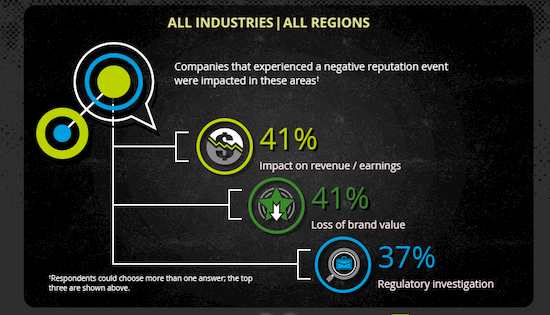
Potential impact of reputation damage
- Loss of revenue from existing customers
- Loss of volume of existing customers
- Reduced ability to attract new customers
- Reduction in share price
- Reduced ability to invest
- Reduced valuation for mergers and acquisitions
- Loss of vital staff
- Reduced recruiting ability
- Aggressive competitor takeover
- Increased compliance
- Negative brand perception
- Negative media coverage
- Employment conditions
- Executive compensation
- Product quality relative to price
- Working practices across supply chains
- Customer privacy and security
- Product recalls
- Fraud and corruption in foreign market subsidiaries
- Conflict of interest and difficulty with regulatory changes
- Financial or reporting irregularities
- Tax avoidance and tax evasion
- Scrutiny of business practices from stakeholders and media
- Social responsibility
- Discrimination
- Excessive cost-cutting maneuvers
- Inappropriate credit decisions
- Questionable investments
- Earnings not meeting expectations
- Employee error or negligence
- Physical security breach
- IT breach
- Social media posts and behavior
- Any direct reputation risk executed by affiliates or employees
What causes reputational risk?
We live in a society that is connected to everything at all times. Information is more easily accessible today than ever before, and less easy to verify. Without taking deliberate steps to address potential reputational risk and avoid reputational damage, virtually any company or organization can fall victim to the effects at any time.
Direct causes of reputational risk
- Employment conditions
- Executive compensation
- Product quality relative to price
- Working practices across supply chains
- Customer privacy and security
- Product recalls
- Fraud and corruption in foreign market subsidiaries
- Conflict of interest and difficulty with regulatory changes
- Financial or reporting irregularities
- Tax avoidance and tax evasion
- Scrutiny of business practices from stakeholders and media
- Social responsibility
- Discrimination
- Excessive cost-cutting maneuvers
- Inappropriate credit decisions
- Questionable investments
- Earnings not meeting expectations
Indirect causes of reputational risk
- Employee error or negligence
- Physical security breach
- IT breach
- Social media posts and behavior
- Any direct reputation risk executed by affiliates or employees
How do you measure reputation risk?
There is no way to put a number on the amount of risk your company could potentially incur because there are virtually infinite opportunities for reputational risk and damage.
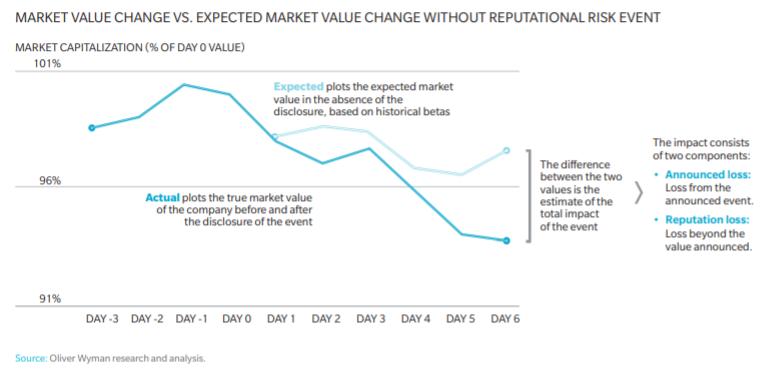
Once a risk event has occurred, you can quantify the risk. Quantifying reputational risk can be done in four steps.
First, a business needs to identify the potential for reputational risk damage. Then, estimate what its stock performance would be if the event had not occurred. Compare that estimate with actual stock performance. The difference is your reputational risk impact.
Identify the potential for loss
Any event that has a potential effect on reputation can be assessed for reputational risk as long as:
- The event is related to a publicly listed company that has a relevant index to compare stock performance,
- the event date is known, and there is no indication of a leak, and
- The announced financial loss has a noticeable impact.
Estimate hypothetical stock performance
Using historical stock betas, estimate the would-be stock performance (as if the event didn’t happen). Continue to track the market in the days following the event for future comparison.
Compare hypothetical and actual performance
Calculate the difference between the hypothetical estimate and the actual stock performance for ten days after the event. Ten days is a good window because it’s long enough to encompass the impact and short enough that additional factors won’t begin to skew the results.
Determine impact
Compare the actual loss relative to the hypothetical performance versus the loss announced due to the event. The difference can be attributed to reputational risk if the actual loss is greater.
The reputational damage might be due to market suspicion of the company underestimating the potential loss. In a study of risk events, more than 55% of events had a reputational impact.
What is reputation risk management?
Reputational risk management is when a company mitigates its reputational risk by identifying, assessing, and controlling threats to its reputation and, thereby its market value and revenue.
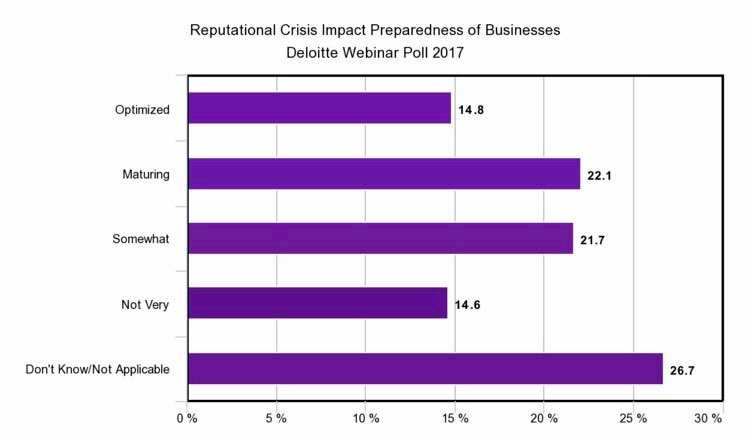
Reputational risk is arguably the most unpredictable type of risk to a business or organization and should, therefore, be managed as strictly as possible, but many companies admit they are unprepared.
About 44% of companies see themselves as “somewhat” prepared or “maturing” in their preparedness. Less than 15% feel their reputational risk mitigation is “optimized,” and a similar number feel their reputational risk mitigation is inadequate.
Begin the process by performing a reputational risk assessment. Segment your stakeholders and evaluate their perception of key company factors such as financial performance, leadership, social responsibility, and work environment. You can check external perception and risk factors by analyzing the quantity and density of unfavorable content and discussion topics in Google’s index. Develop a strategy based on the type of exposure your company is facing. Work with a PR firm or crisis management team to resolve active crises.
Reputational Risk Insurance
There are reputational risk insurance providers such as Steel City RE. Firms like Steel City work with companies, for the most part, rather than people. Examples of services include predicting reputational risk, enterprise value protection, and promoting risk management.
Internal Reputational Risk Mitigation
Most reputational risk mitigation happens within the company itself. To reduce the potential for reputational risk, the Board of Directors should be active in the development, execution, and enforcement of reputational risk strategies, which should be integrated into business planning.
Maintaining strong and well-established corporate values can help mitigate indirect reputational risk. Policies and procedures related to ethics and compliance should start at the top and be taught as part of company culture. All stakeholders, from employees to customers and shareholders, should have a positive experience with the company as a priority.
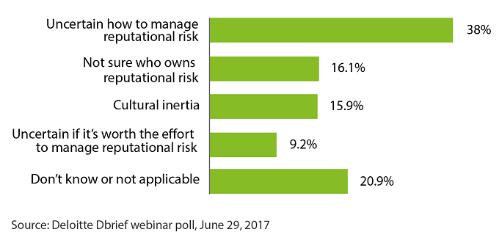
Survey of Executives on Reputational Risk Mitigation
Deloitte Debrief webinar poll, June 29, 2017
Any and all public reporting and financial statements should be accurate and of high quality. Discrepancies are noticed by investors and reflect poorly on the company. Reporting, operations, and compliance should be carefully controlled in the interest of company objectives. A competitive business model is essential to maintaining a reputation as a competent leadership team. Finally, planning and execution of crisis response will have a significant impact on your reputation and related risk and should, therefore, be a high priority.
Online Reputation Management
Your online presence greatly contributes to your overall corporate reputation and often has a hand in reputational risk. A professional online reputation management firm can get a handle on your social media, content, outreach, digital assets and creation, SEO, and brand management. Strategic marketing campaigns can amend a negative narrative to repair damage.
Frequently Asked Questions







Protect Your Online Reputation
Every day you wait, negative content gets stronger. Talk to our experts about a custom strategy for your situation.
Get Your Free Analysis