
Branded vs Non-Branded Content: What is the Difference?
Understanding the role each content type plays is the first step to building an online presence that ranks well and protects your reputation.


- Branded content should clearly identify your brand in the headline, title tag, and opening paragraph.
- Non-branded content acts as support content, ranking further back and funneling clicks toward branded content.
- Branded content should rank on page one of search results for your target brand keywords.
- Social shareability is a key goal of branded content — design it to be passed along.
- Both branded and non-branded content are necessary for a complete online reputation strategy.
Branded content explicitly promotes a company or product and is designed to rank prominently in search results for brand-related keywords. Non-branded content supports branded content indirectly by building awareness and driving traffic without directly referencing the brand. Both types of content work together to build and maintain a positive online reputation.
Understanding the role each content type plays is the first step to building an online presence that ranks well and protects your reputation.
Key Takeaways
- Branded content should clearly identify your brand in the headline, title tag, and opening paragraph.
- Non-branded content acts as support content, ranking further back and funneling clicks toward branded content.
- Branded content should rank on page one of search results for your target brand keywords.
- Social shareability is a key goal of branded content — design it to be passed along.
- Both branded and non-branded content are necessary for a complete online reputation strategy.
TL;DR
Branded content explicitly promotes a company or product and is designed to rank prominently in search results for brand-related keywords. Non-branded content supports branded content indirectly by building awareness and driving traffic without directly referencing the brand. Both types of content work together to build and maintain a positive online reputation.
Every brand’s online presence is built on two kinds of content — and knowing how they differ is the key to a strategy that actually ranks. According to the Content Marketing Institute’s 2025 B2B report, 87% of B2B marketers say content marketing helped build brand awareness in the past twelve months. Yet most companies don’t distinguish between branded and non-branded content when planning campaigns, leaving significant SEO value on the table. Understanding the benefits of a strong online reputation starts with getting this distinction right.
What Is the Difference Between Branded and Non-Branded Content?
What Is Branded Content?
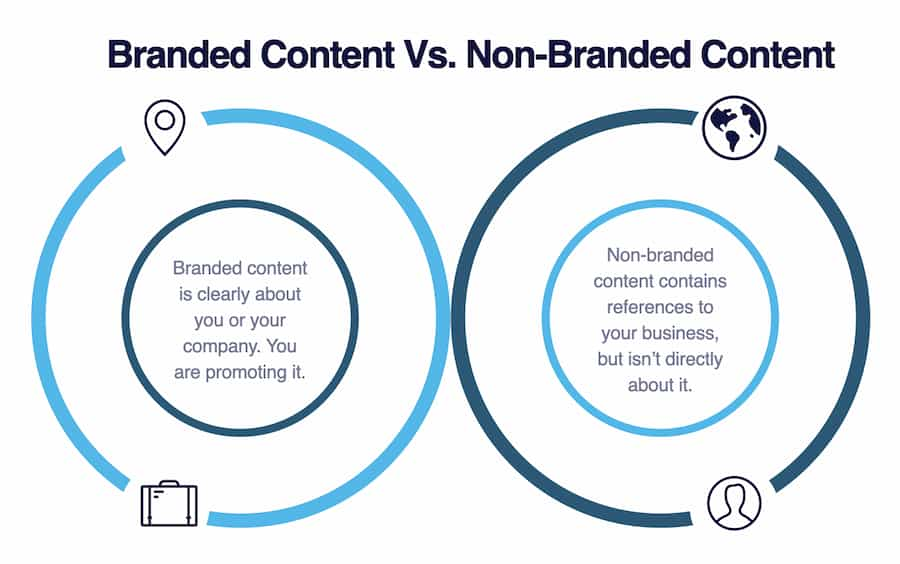
Branded online content refers to digital content created and published by a company or brand (or a representative of the brand) to promote the brand’s products or services.
Branded content is often explicitly connected to a brand or product through branding elements or the content’s subject matter, which may be related to the brand’s core values or products. When used in online reputation management, branded content might include the brand name in the headline or lead paragraph or be substantially about the brand.
The search performance difference is significant. According to MetricsWatch (2025), branded search queries convert at rates typically two to three times higher than non-branded queries. This makes sense — someone searching for your brand name already has intent and familiarity, so content that captures those queries is among your highest-value digital assets.
What Is Non-Branded Content?
Non-branded content is not created with the primary goal of promoting a particular brand or product. If a brand is mentioned, it is often in a secondary or tertiary manner. This type of content may be informational, educational, or entertaining, and individuals, social media creators, media companies, or other entities may create it.
Non-branded content may build brand awareness and engagement indirectly, but it is not directly linked to a specific brand or product. It is considered “support” content and is often used to drive clicks toward more brand-related content. Non-branded content tends to rank further back in search results than branded content.
The scale of opportunity in non-branded search is enormous. According to BrightEdge (2025), organic search drives 53.3% of all website traffic — and the vast majority of those queries are non-branded. On platforms like Pinterest, 96% of top searches are unbranded (Pinterest, 2025), signaling that most discovery-stage traffic comes from people who haven’t settled on a brand yet. Capturing even a fraction of that volume through well-crafted non-branded content can dramatically expand your reach.
How Does Branded Content Improve SEO and Reputation?
Branded Content Targets Brand Search Queries
Branded content is clearly about the brand. It appears to either represent the brand or portray it (or the product) as the subject of the content. It has your brand “written all over it,” even if you didn’t create the content. Your company, brand, or a representative may be the author, or someone else is clearly creating content about your brand — but it’s clear who the content is about and usually who commissioned it.
It might be an outright commercial, a demonstration of a service or product, or an ad that shows the how, what, or why of your brand.
Get a Free Reputation Assessment
Find out what people see when they search for you online. No obligation — results in 24 hours.
From an SEO perspective, branded content typically features the primary search phrase of the brand in the page title and H1 tag, plus relevant secondary phrases throughout. A push-down strategy for controlling search results often depends on having strong branded content occupying as many page-one positions as possible.
Examples of branded content include: full articles, blog posts, reviews, videos, podcasts, lists, infographics, X posts, and Facebook updates.
With branded content, there’s no attempt to hide the source or objective of the content. If readers don’t understand that it’s about you after the first sentence or two, the content may not be doing its intended job.
Big-name companies increasingly view branded content as an integral marketing campaign component. Companies like Molson Coors Beverage Company are blurring the line between traditional marketing and reputation marketing with coordinated branded content campaigns.
Branded Content Drives Social Sharing

Branded content is also designed to engage social sharing about the brand. Actor and entrepreneur Dwayne Johnson used branded content to build his tequila brand Teremana into a global phenomenon, leveraging blog posts, social media, and fan engagement to drive awareness. While the content clearly promotes Teremana, Johnson and his team crafted fun, shareable posts — from cocktail recipes to behind-the-scenes distillery content — and encouraged followers to add their own voices to the conversation. This approach generated a wave of shared branded content while straightforwardly promoting his business. The company’s SEO strategy allows its content to rank for multiple keywords — cocktail recipes, tequila, and specific Teremana queries — dominating the search results across all three.
Branded content is designed to achieve prominent search rankings when someone searches for the brand. Ideally, well-executed branded content should rank on the first search results page for a given keyword. The prominence of your target keyword and its variations encourages higher visibility.
As more companies discover the value of placing high-quality, unmistakably advertorial content on high-visibility web pages, and as social shareability gains ground alongside search placement, branded content campaigns will only grow more common.

How Does Non-Branded Content Support Your Brand?
Non-Branded Content Builds Authority and Backlinks
Non-branded content is much more subtle than branded content.
While non-branded content might reference you, your company, or what you do, those references are typically oblique and are not the focus of the piece. In practice, this means no brand-specific mentions in the title or header, and only sparing use throughout — if at all. Non-branded content is not about the brand but still supports the industry or other areas of interest relative to the brand.
Put another way, non-branded content is intended to support branded content as part of the branded information matrix. Think of it as earned media — content that gains traction because of its inherent value rather than its promotional intent.
Non-branded content published on high-authority websites — your own domains, well-trafficked blogs, and other web properties — is great for building links to your branded material. When done well, it attracts inbound links from high-authority domains, boosting its attractiveness to search engines and creating brand authority around your web presence. This is a core principle behind effective online reputation management strategies — a strong content ecosystem where each piece reinforces the others.
Non-Branded Content Reaches a Wider Audience
Non-branded content is generally distributed more widely than branded content. Since it doesn’t directly concern you and your company, non-branded content usually finds a wider audience — or is better suited to find that audience in terms of page views and shares — than branded material.
For example, a piece of branded content titled “Company XYZ Is at the Forefront of ABC Industry” could highlight your leadership in the space. A follow-up non-branded piece, “5 Trends Driving ABC Industry,” could then address the broader trends affecting your industry. Since the non-branded piece appeals to anyone interested in that industry, it is likely to gain wider traction and shares. Audiences are often more open to reading and sharing content that does not feel like a direct brand promotion.

A strong example of non-branded content is the Adobe Creative Types personality quiz. It invites visitors to take a quiz to learn more about their creative personalities. Over seven million people have taken the quiz since its launch (Behance, 2020), and the project won a 2020 Webby Award in the Advertising, Media & PR category. Adobe has continued evolving the experience, releasing an updated version in 2025 with eight new creative types — its fourth major iteration.
While it doesn’t directly advertise Adobe’s products or services, it gets participants thinking about their creativity, encourages sharing, and makes them more likely to use Adobe. This taps into the power of social proof — when millions of people share their results, it reinforces Adobe’s identity as the home of creative work. The quiz supports the company’s branded content, builds a positive reputation through a fun activity, and drives brand recognition without straightforward promotion.
Need Help Building a Content Strategy?
Our team can help you develop both branded and non-branded content that works together to strengthen your online reputation and dominate your search results.
Don’t overlook the positive and suggestive power of non-branded content. It acts as a supporting player to branded content.
With an online publishing platform like social media, a blog, or a video channel, anyone can quickly create and distribute positive content to enhance an online image and boost competitive advantage. Look at your industry and the interests of your current and potential customers. Always be authentic in your content creation.
Today’s online world is saturated with content, which makes it essential to create the right content and distribute it the right way. Understanding how SEO reputation management works alongside your content mix — including knowing when to conduct a search result audit — is essential to cutting through the noise.
How Branded and Non-Branded Content Work Together for ORM
Building a Content Strategy That Uses Both
This can seem counterintuitive since non-branded content is often shared or viewed more widely than individual pieces of branded content. But it’s true — non-branded content works for your branded content, not against it.
Think of your non-branded content as a cast of character actors supporting your branded content — the star of your reputation management strategy. To understand how PR and online reputation management differ, consider that PR focuses on individual placements while ORM builds a sustained content ecosystem where each piece reinforces the others.
The data supports this layered approach. According to RAIN Sales Training (2025), the average sale requires eight touchpoints to close. In B2B environments, the numbers climb much higher — HockeyStack’s 2024 analysis of 150 SaaS companies found that the average deal required 266 touchpoints and 2,879 impressions. For enterprise deals over $100K in annual contract value, those figures rose to 417 touchpoints and 5,500 impressions. According to Forrester, 82% of buyers review five or more content pieces from the winning vendor before making a purchase decision. These touchpoints span both branded and non-branded content, which means a strategy that relies on only one type is leaving potential buyers without the information they need at critical stages.
Web reputation management services typically involve both branded and non-branded content. Both types incorporate key search terms that leverage natural language processing (NLP) and semantic search principles, and are designed to appear in your Search Engine Results Pages (SERPs).
Branded content will usually rank higher for brand-related search terms, often appearing on the first page. Non-branded content doesn’t perform as well in branded searches, but it supports branded content through links and social media shares. This dynamic is a key reason why a thorough online reputation audit should evaluate both content types across your web presence.
Both are typically positive in nature, working in unison to grow a stronger online reputation. The important step is to continually generate new content — whether branded or non-branded. For a deeper look at how content fits into the bigger picture, see our guide on online reputation management.
How to Measure Branded vs Non-Branded Content Performance
Knowing the difference between branded and non-branded content is only useful if you can measure how each type performs. Here’s how to track it.
Google Search Console is the most direct way to separate branded from non-branded performance. In the Performance report, use the query filter to include or exclude your brand name and its common variations (abbreviations, misspellings). This gives you distinct click, impression, CTR, and position data for each content category.
Google Analytics 4 lets you create audience segments based on landing page or traffic source. Build one segment for users arriving through branded organic queries and another for non-branded. Compare engagement metrics like session duration, conversion rate, and pages per session to understand how each audience behaves differently.
Third-party SEO platforms like SEMrush and Ahrefs offer built-in branded vs. non-branded keyword filtering in their organic research tools. These platforms are particularly useful for tracking how your non-branded keyword rankings change over time and identifying new non-branded opportunities your competitors are capturing.
The key benchmark to watch: branded queries typically convert at two to three times the rate of non-branded queries (MetricsWatch, 2025). If your branded conversion rate is significantly lower, your branded content may need work. If your non-branded traffic is high but conversions are flat, focus on improving the internal linking paths from non-branded pages to branded conversion pages.
Examples of Branded vs Non-Branded Content Strategies
Real-world campaigns illustrate the distinct roles branded and non-branded content play in a content strategy.
Branded example: Calvin Klein × Jeremy Allen White (2024). Calvin Klein’s Spring 2024 campaign featuring actor Jeremy Allen White became one of the year’s most visible branded content executions. The campaign generated an estimated $74 million in social impressions value, with $12 million in media exposure accruing within the first 48 hours of launch alone. Calvin Klein repeated the partnership in August 2024, leveraging the momentum from the initial wave. The campaign succeeded because it was unmistakably branded — Calvin Klein’s name and visual identity were central — while the creative execution made it inherently shareable. It demonstrates how branded content, when designed for social distribution, can generate outsized reach without relying on paid amplification alone.
Non-branded example: Hotjar’s user-centric content strategy (2019–2022). Hotjar, the behavior analytics platform, invested heavily in non-branded informational content targeting user-experience and product-management topics — queries where no brand name appears. Over a three-year period, this strategy grew their non-branded organic search traffic by 734%. More importantly, that non-branded traffic converted into paying customers: Hotjar reported 1,398% growth in new paying customers over the same period, with annual non-branded new visitor volume reaching into the multi-millions. The Hotjar case shows how non-branded content isn’t just a traffic play — when aligned with the right audience and internal linking strategy, it becomes a direct revenue driver.
What both examples share is intentionality. Calvin Klein knew its branded content needed to be social-first. Hotjar knew its non-branded content needed to address real user questions at scale. The most effective content strategies deploy both types with clear roles and measurable goals.
Branded content is obviously about your brand. Non-branded content supports branded content. Non-branded content is about your industry or other supporting information about your brand. Both kinds of content work together to build a positive online reputation.
Frequently Asked Questions
Does branded content have to be created by the brand itself to count as branded?
No. Branded content is defined by its subject matter and framing, not its author. A third-party review, a news article about your company, or an influencer post that clearly features your brand all qualify as branded content. What matters is that the audience immediately understands the content is about your brand.
Can non-branded content still help a brand even if it never mentions the brand by name?
Absolutely. Non-branded content helps by building topical authority in your industry, attracting backlinks from high-authority domains, and driving organic traffic that can be funneled toward branded pages through internal linking. Even without a single brand mention, a well-ranked non-branded article strengthens your entire site’s SEO profile.
Why does non-branded content tend to get more shares and reach than branded content?
Audiences are generally more willing to share content that provides value without an obvious sales pitch. A how-to guide, industry analysis, or interactive tool feels like a resource worth passing along, while branded content — no matter how well-produced — carries an implicit promotional intent that limits its organic shareability.
How should branded and non-branded content be structured together in an SEO strategy?
Use branded content to dominate page one for your brand name and variations. Use non-branded content to capture informational and commercial queries in your industry. Link non-branded pieces to branded landing pages so that organic traffic flowing in through educational content has a clear path to your core brand pages. Measure both separately in Google Search Console and analytics to understand how each type contributes to the funnel.
Frequently Asked Questions








Protect Your Online Reputation
Every day you wait, negative content gets stronger. Talk to our experts about a custom strategy for your situation.
Get Your Free Analysis