
How to Run a Content Audit on Your Competitors Site
Discover exactly what your top competitors are doing right with content, and build a smarter SEO strategy by learning from their playbook.

- Check if competitors blog on their main domain, a subdomain, or a separate site and note their publishing frequency.
- Identify whether competitors have credible, named authors with bio pages and external bylines to signal E-E-A-T strength.
- Use Google's Schema Validator to see what structured data competitors implement across their content.
- Review Core Web Vitals using Google's Lighthouse tool, including the INP metric that replaced FID in March 2024.
- Map out all content formats competitors produce — videos, whitepapers, case studies — and assess which earn the most backlinks.
A competitor content audit helps you uncover tactics you can apply to your own SEO and content strategy. By examining your competitors' blogs, authorship credibility, schema markup, and content formats, you gain a clear picture of what is working in your niche. This process will not reverse-engineer Google's algorithm, but it will surface actionable insights that can improve your rankings and content output.
How to Run a Content Audit on Your Competitors Site
-
1
Audit their blog presence and publishing habits
Find out if your competitor has a blog and note whether it lives on their main domain, a subdomain, or a separate site. Review how often they publish, whether articles are typically 600 words or longer, and whether they update old content. Use BuzzSumo to surface their most popular content and Visualping to receive alerts when they publish something new.
-
2
Identify who creates their content
Determine whether your competitor relies on in-house employees, industry experts, or freelance ghostwriters. Check whether their authors have dedicated bio pages, external bylines, or social profiles that reinforce their expertise, since Google's E-E-A-T framework treats demonstrated author credibility as a meaningful ranking signal. Understanding their authorship model helps you identify gaps in your own author credibility strategy.
-
3
Check their schema markup and page performance
Research which structured data types your competitor uses, such as Article, Recipe, or Review schema, using Google's Schema Validator. Be aware that FAQ and HowTo rich results have limited value following Google's August 2023 update. While reviewing their technical setup, use Google's Lighthouse tool to evaluate their Core Web Vitals, including the Interaction to Next Paint metric.
-
4
Map out every content format they produce
Look beyond blog posts to identify whether your competitor publishes videos, infographics, webinars, eBooks, whitepapers, or case studies. Assess how well each format performs in terms of social sharing, search visibility, and backlinks. This helps you prioritize which content types are worth investing in for your own audience.
-
5
Discover if they contribute to outside publications
Run a backlink check to find out whether your competitor contributes articles to niche directories, industry blogs, or trade publications. Guest blogging can build links and referral traffic, but Google's spam policies warn that links in guest posts intended primarily for link building may be treated as link spam. Any guest content you produce should provide genuine value to the host site's audience.
-
6
Uncover the keywords they are targeting
If your competitor has done any on-site optimization, they have likely left a trail of target keywords in their title tags, meta descriptions, and sometimes even their footer. Use WebCEO's content audit tool to enter a competing URL and identify the keywords targeted on that page. Text Optimizer can then show you how well their articles are optimized semantically so you can compare that against your own content.
-
7
Analyze how they write title tags and meta descriptions
Review the title tags and meta descriptions on your competitor's homepage and key internal pages using the Chrome extension Open SEO Tools. Pay attention to the language they use to attract clicks from search results. Keep in mind that Google rewrites meta descriptions roughly 60 to 70 percent of the time, and growing AI Overview prevalence makes snippet visibility increasingly variable, though a well-crafted description still influences click-through rates when it does appear.
Reverse engineering Google’s search results is next to impossible — there are too many signals in play, and not all of them are known. But a competitors’ content audit is a valuable exercise that helps you discover tactics you can apply to your own content strategy and improve your SEO. In many cases, a good content audit will help you optimize your content and achieve higher rankings.
Here are the key questions that, once answered, will give you a complete view of your competitor’s content marketing strategy.
1. Do Your Competitors Have a Blog?
Maintaining a company blog is one of the best content strategies any business can use. Find out if your competitor has a blog and note whether it lives on their main domain (domain.com/blog), a subdomain (blog.domain.com), or a separate site altogether.
Next, review their blogging practices. How often do they publish — daily, weekly, or monthly? Are articles typically 600 words or longer? Do they update their old content? Note their production frequency, content quality, and the topics they cover.
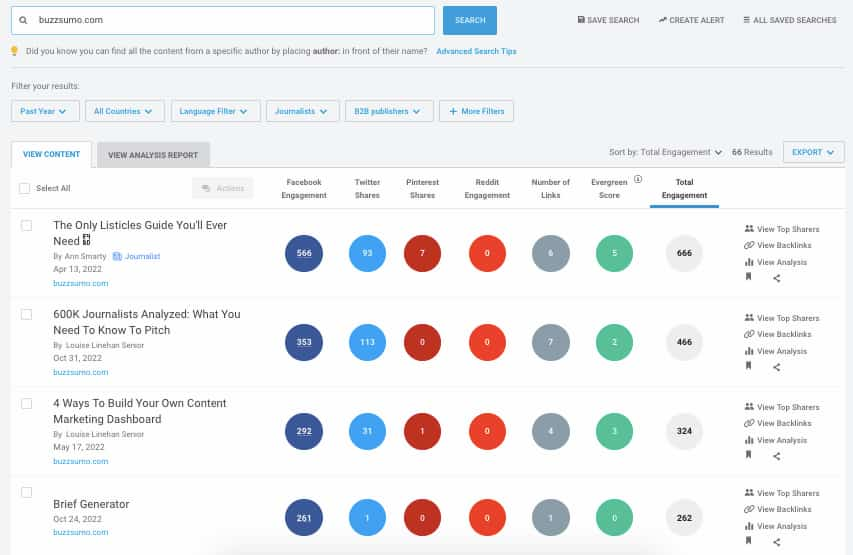
BuzzSumo allows a deeper look at a competitor’s blog. Type in their domain and BuzzSumo will surface that site’s most popular content. Keep in mind that BuzzSumo no longer offers a meaningful free plan — most competitor content analysis features require a paid subscription, so factor that into your toolset decisions.
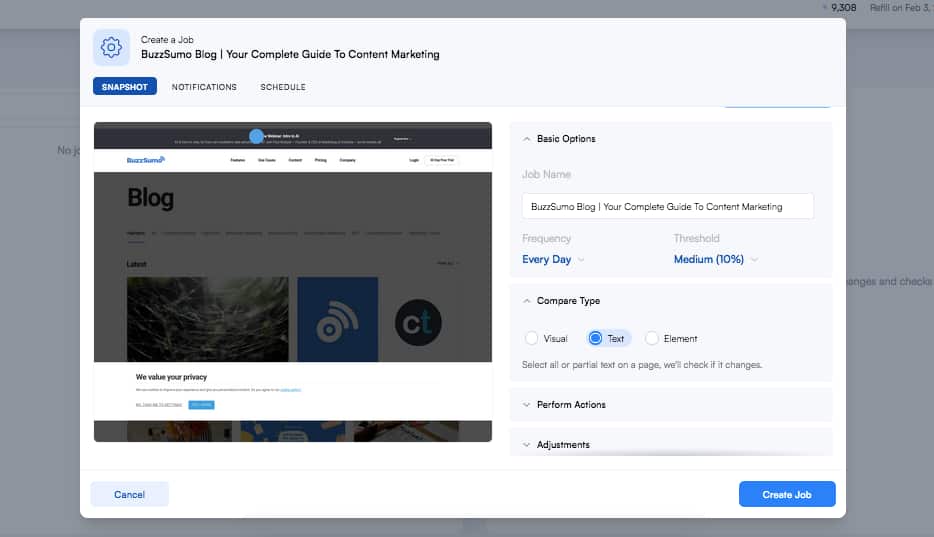
You can also use Visualping to monitor competitors’ blogs. You will be notified as soon as they publish new content.
2. Who Writes for Their Blog?
Does your competitor use in-house employees, industry experts, or freelance ghostwriters? The latter can be difficult to identify, since some companies hire freelancers and publish the content under an internal author’s name.
More importantly, is there a recognized in-house expert behind their blog? Under Google’s E-E-A-T framework — which evaluates Experience, Expertise, Authoritativeness, and Trustworthiness — demonstrated author credibility is a meaningful ranking signal. Well-established authorship matters more than ever.
Get a Free Reputation Assessment
Find out what people see when they search for you online. No obligation — results in 24 hours.
Understanding how your competitor creates great content for their blog will give you a clear model for improving your own.
3. What Schema Markup Do Your Competitors Use?
There are several Schema types commonly used within content:
- Article Schema
- FAQ Page Schema — as of August 2023, Google no longer displays FAQ rich results broadly in Search; they are now limited to authoritative government and health websites, so their value for most sites is minimal
- HowTo Schema — also affected by Google’s August 2023 update, HowTo rich results no longer appear in desktop search, though the schema retains some utility for voice search and mobile
- Recipe and Review Schema (for applicable content types)
Most businesses still ignore schema markup, so it is worth researching how competitors use structured data. Google’s Schema Validator makes this easy. While you’re at it, check their page performance — Google’s Lighthouse tool is the quickest way to evaluate Core Web Vitals, including Interaction to Next Paint (INP), which replaced First Input Delay (FID) as an official metric in March 2024.
4. Content Types, Keywords, and Title Tags
Do They Produce Other Kinds of Content?
Beyond blog posts, what other content does your competitor publish? Look for videos, infographics, webinars, eBooks, reports, whitepapers, tutorials, and case studies. Check how well each format performs in terms of social sharing, search visibility, and backlinks. This helps you determine which content types are worth investing in for your own audience.
Do Your Competitors Write for Other Websites?
You may not discover this until you run a backlink check, but look for whether your competitor contributes articles to niche directories, industry blogs, or trade publications. Guest blogging can build links and traffic — but proceed carefully. Google’s spam policies explicitly state that links in guest posts intended primarily for link building may be treated as link spam. Any guest content you produce should provide genuine value to the host site’s audience.
What Keywords Do They Target?
If your competitor has done any on-site optimization, they have likely left a trail of target keywords in their title tags and meta descriptions. On older sites, you may even find keywords stuffed in the footer.
WebCEO’s content audit tool makes this step straightforward — enter a competing URL and it will identify the keywords targeted on that page.
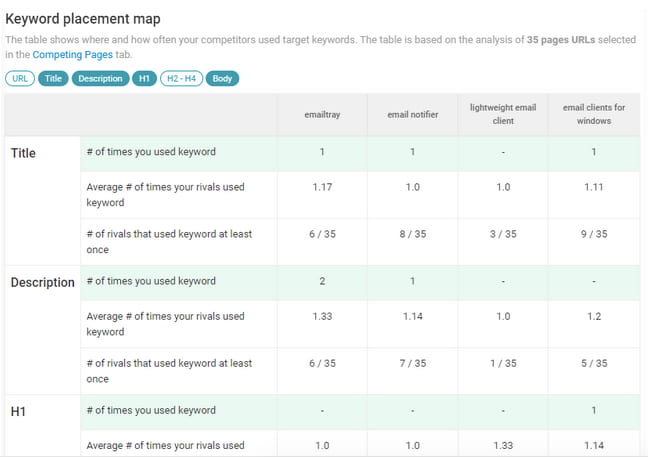
Text Optimizer shows how well any article is optimized for its target keywords semantically. Compare that score against your own content to identify gaps in your semantic optimization.

How Do They Write Their Title Tags?
Look at the title tags and meta descriptions for your competitor’s homepage and key internal pages. The Chrome extension Open SEO Tools makes it easy to view meta tags on any page you visit.

Here you are looking at the language they use to attract clicks from search results. Keep in mind that Google rewrites meta descriptions in a significant percentage of cases — some studies suggest 60–70% of the time. With the growing prevalence of AI Overviews in search results, traditional snippet visibility is increasingly variable. That said, a well-crafted meta description still influences click-through rates when it does appear.
Want to Know How Your Own Content Stacks Up?
A thorough SEO reputation audit can reveal exactly where your content strategy is falling short — and what to do about it.
5. Site Size and Backlink Analysis
How Many Pages Do They Have?
Knowing your competitor’s site size gives you a clearer sense of how much content they have indexed. You can enter site:domain.com in Google Search for a rough estimate, but this operator has become increasingly unreliable as a precise count. Tools like Ahrefs Site Explorer or Semrush provide significantly more accurate data.
Also note that a competitor with their blog on the main domain will typically have more indexed pages than one using a subdomain or separate site.
Where Are Your Competitors Getting Their Backlinks?
Review a sample of your competitor’s backlinks to understand their overall link strategy. Common link sources include:
- Guest blog posts
- Blogroll links
- Blog comments
- Forum posts
- Directories
- Article networks — now classified as link spam under Google’s updated spam policies; a high-risk tactic to avoid replicating
- Link exchanges — Google’s spam policies explicitly flag excessive link exchanges as link spam; treat any competitor use of this tactic as a warning sign, not a model to follow
For comprehensive backlink analysis, Ahrefs Site Explorer or Semrush Backlink Analytics offer far more complete link indexes than BuzzSumo. From there, you can dig into the actual sources behind your competitor’s most-linked content. You can learn more about building a sustainable link profile in our guide to link building for SEO reputation campaigns.

Do Their Links Look Paid or Natural?
Paid links can be difficult to spot, but patterns reveal them. If a competitor’s links consistently appear alongside unrelated companies across multiple sites, that is a signal they may be purchasing placements. Links in blogrolls, footers, or guest posts with anchor text unrelated to the surrounding content are common paid link indicators.
Ahrefs makes this analysis more systematic. Its Link Intersect tool, Anchors report, and link type filters within Site Explorer provide structured ways to distinguish paid from natural link acquisition.
What Anchor Text Do Your Competitors Use?
If the same keywords appear repeatedly in your competitor’s anchor text, those are likely their primary target phrases. Avoid mirroring an over-optimized anchor text profile — building many links to only a few specific keyword phrases is a risk. Mix in branded anchor text and natural variations. For a deeper look at diversifying your own approach, see our guide on anchor text diversity guidelines.
6. Social Media Strategy Audit
What Social Networks Do Your Competitors Focus On?
Start by checking your competitor’s website or blog for links to their social profiles — typically X (formerly Twitter), Facebook, Instagram, LinkedIn, Pinterest, TikTok, and YouTube. Then search their name on Google to surface any additional active accounts. From there, review each profile to identify tactics worth researching further.
How Do They Brand Their Social Profiles?
Look beyond the company name. Do they use a logo, a recognizable executive, or a product as their main profile image? Do they communicate as a brand or through individual employee accounts? What do their X and YouTube profile headers look like?
Is their main profile link pointing to the homepage or a specific internal page? These details reveal whether they lean on a personal or corporate reputation strategy — and how your audience may respond to each approach.
How Often and What Do They Post?
Different networks require different posting cadences. You may find a competitor posts far more frequently on X than on Facebook, or publishes short-form video less often than static images on Pinterest.
A successful social media strategy typically includes a mix of plain status updates, links, long-form video, short-form video (Reels, Shorts, TikToks), and photos. Gauge how well each format performs by looking at comments, likes, shares, saves, and other reactions. Short-form video has become a dominant content format across platforms since 2022, so pay close attention to how — and how often — competitors use it.
This is a foundational checklist. Once you start digging into your competitors’ content creation and distribution tactics, the analysis tends to go deeper quickly. Think of it as detective work — and use what you find to build a stronger, more informed content strategy of your own.
Frequently Asked Questions








Protect Your Online Reputation
Every day you wait, negative content gets stronger. Talk to our experts about a custom strategy for your situation.
Get Your Free Analysis