
Guide: Media Coverage for Wikipedia References
Everything you need to know about building credible Wikipedia citations through strategic, reference-worthy media coverage.

- Preferred Wikipedia sources include reputable news outlets, academic journals, and government publications.
- Press releases, company websites, and social media posts are not acceptable Wikipedia references.
- Coverage must be substantial — a passing mention is not enough to qualify as a usable reference.
- The subject should ideally appear in the headline or early in the article to signal relevance.
- Targeting peer-reviewed journals and mainstream media is the most reliable path to citable coverage.
This guide explains how Wikipedia references work and what makes a source credible enough to support article content. It covers where references appear, what types of sources Wikipedia prefers or discourages, and why substantial media coverage matters. PR and marketing professionals can use this to build smarter strategies for earning Wikipedia-worthy press coverage.
Introduction
When our clients ask about Wikipedia references and citations, this is the page we send them to. This guide will walk you through the intricacies of Wikipedia references, using a fictional crypto company, “CryptoInnovate,” as our example. We’ll explore what constitutes a good Wikipedia reference and how to identify appropriate sources and strategies for obtaining reference-worthy media coverage.
What is a Wikipedia Reference?
Wikipedia references are the backbone of the encyclopedia’s content statements. They are publicly visible evidence designed to support the statements made in articles, allowing Wikipedia readers and editors to verify the information and explore topics in greater depth.
Locating References in Wikipedia Articles
References can typically be found in several places within a Wikipedia article:
Does Your Company Qualify for a Wikipedia Page?
Run a free notability check. Our analysis engine reviews real press coverage against Wikipedia's actual notability standards and emails you a detailed report — no sales call required.
Your notability check is running
We're analyzing coverage of right now — it usually takes 10–15 minutes. Your report link will arrive from noreply@reputationx.com; check spam if you don't see it. Keep reading — nothing else to do here.
- Inline citations: Small superscript numbers or letters that link to the full reference at the bottom of the page.
- References section: A dedicated area at the end (bottom) of the article listing all sources cited.
- Further reading or External links sections: Additional resources that may not be directly cited in the article but provide valuable related information.
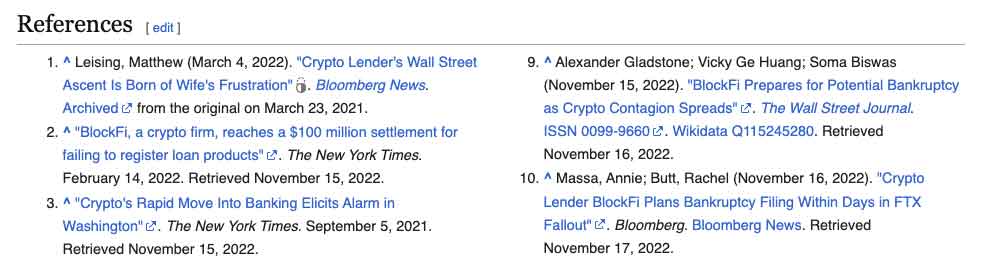
Below is a screenshot of what Wikipedia references look like at the bottom of an article.
Qualities of a Good Wikipedia Reference
There are good Wikipedia sources and bad ones. This is how to tell the difference.
Preferred vs. Non-Preferred Sources
Wikipedia has clear guidelines on what constitutes a reliable source. Generally, preferred sources include:
- Reputable news organizations
- Peer-reviewed academic journals
- Books published by respected publishing houses
- Government publications and reports
Non-preferred or discouraged sources often include:
- Press releases
- Company websites
- Personal blogs or social media posts
- Forums or discussion boards
- Self-published materials
An example of a source that is currently deemed unreliable
Anti-Defamation League: One might think the ADL would be considered reliable, but, according to Wikipedia “There is consensus that the ADL is a generally unreliable source for the Israel/Palestine conflict, due to significant evidence that the ADL acts as a pro-Israeli advocacy group and has repeatedly published false and misleading statements as fact, un-retracted, regarding the Israel/Palestine conflict.“

The Importance of Substantial Coverage
A major aspect of a good Wikipedia reference is that it provides substantial coverage of the subject. This means:
- The article should be mainly about the subject (in our case, CryptoInnovate), not just mentioning it in passing.
- The subject’s name should ideally appear in the headline or early in the article, indicating its significance to the content.
- The coverage should provide meaningful information about the subject, not just a brief mention or listing.
Types of Content Suitable for Wikipedia References
Wikipedia accepts a wide range of content types as references, provided they meet the criteria for reliability and relevance. Understanding these content types can help PR and marketing professionals target the right sources for their Wikipedia strategy. Below are some examples using our sample company as an example:
Scientific and Academic Sources
- Peer-reviewed journals: These are considered among the most reliable sources, especially for technical or scientific claims. For CryptoInnovate, this might include articles in blockchain technology journals or cryptography publications.
- Academic books: Books published by university presses or respected academic publishers can provide in-depth, reliable information.
- Conference proceedings: Presentations or papers from reputable academic or industry conferences can be valuable sources, especially for cutting-edge topics in the crypto world.
Mainstream Media and Publications
- Newspaper articles: Articles from respected national or international newspapers (e.g., The New York Times, The Wall Street Journal) are generally considered reliable.
- Magazine features: In-depth articles from reputable magazines, especially those focusing on technology or finance, can be excellent sources.
- Online news sites: Established online news outlets with editorial oversight are often acceptable. For CryptoInnovate, technology sections on sites like CNBC or Reuters could be relevant.
Industry-Specific Publications
- Trade journals: Publications specific to the industry can provide specialized, in-depth coverage but are often biased.
- Professional magazines: These can offer insights into industry trends and company profiles.
Books and E-books
- Non-fiction books: Books published by reputable publishing houses, especially those covering the history or analysis of the industry, can be valuable references.
- Technical manuals: For specific technical claims about technology, technical documentation from respected sources might be appropriate.
Government and Institutional Sources
- Government reports: Official reports or documents from government agencies (Think: SEC filings, congressional testimonies) can be highly reliable sources.
- Think tank publications: Reports from respected, non-partisan think tanks or research institutions can provide valuable analysis and data.
Multimedia Sources
- Video content: While less common, video content from reputable sources (e.g., interviews on major news networks, TED Talks) can sometimes be used as references.
- Podcasts: Transcripts or audio from established journalistic podcasts might be acceptable, especially for quotes or first-hand accounts.
Digital Archives and Databases
- Digital libraries: Resources from established digital libraries or archives can be valuable, especially for historical context.
- Specialized databases: For financial or technical data about CryptoInnovate, information from respected industry databases might be appropriate.
When selecting sources for Wikipedia references, consider not just the type of content but also its reliability, neutrality, and relevance to the subject. For CryptoInnovate, a mix of technical sources (for details about the technology), financial publications (for market impact and company performance), and mainstream media (for general company information and industry trends) would likely create a well-rounded set of references.
Remember, Wikipedia generally prefers secondary sources over primary sources. This means that an article analyzing CryptoInnovate’s impact on the crypto market would typically be preferred over a direct statement from the company (a primary source). Always aim for sources that provide comprehensive, objective coverage rather than those that might be perceived as promotional or biased.
Promotional content in Wikipedia pages is one of the fastest ways to get the page harshly edited, or even deleted.
High-Quality vs. Low-Quality References
Understanding the distinction between high-quality and low-quality references is very important for maintaining the integrity of a Wikipedia article, and also for maintaining the viability of the article itself.
Examples of High-Quality References
- A feature article about CryptoInnovate in a respected financial publication like Forbes or Bloomberg.
- An in-depth analysis of CryptoInnovate’s technology in a peer-reviewed blockchain publication. Note: Crypto industry publications are often not considered reliable enough to use as important references. This is often due to Wikipedia editor bias.
- A government report mentions CryptoInnovate’s impact on the cryptocurrency market. Government reports are generally considered relaible.
Examples of Low-Quality References
- A press release on CryptoInnovate’s website announcing a new product.
- A blog post written by CryptoInnovate’s CEO on the company blog.
- A forum discussion where users speculate about CryptoInnovate’s future projects.
What Constitutes a Reliable Source for Wikipedia?
A reliable source for Wikipedia is one that has editorial oversight, fact-checking processes, and a reputation for accuracy. These sources are typically well-established publications or institutions known for their credibility in the relevant field.
Consequences of Using Low-Quality References
Using subpar references can have several negative impacts on a Wikipedia article:
Frequently Asked Questions









Protect Your Online Reputation
Every day you wait, negative content gets stronger. Talk to our experts about a custom strategy for your situation.
Get Your Free Analysis