
Basics of Reputation Management Theory
Understanding how reputations are built, contested, and leveraged is the first step toward turning yours into a true competitive advantage.

Reputation is a powerful, fragile asset that shapes how competitors, customers, and the public perceive and interact with your brand. It is formed through an accumulation of information, word-of-mouth, reviews, and inferences that others compile over time. Understanding the theory behind how reputations are built — including game theory dynamics — helps businesses strategically establish and protect their standing in the market.
The asset that most directly affects the decision-making of your competitors, customers, friends, family, coworkers, and everyone else who comes in contact with you or your brand is your reputation. A reputation is a form of power. It’s also fragile. So how is a reputation formed, what does it consist of, and what’s the basic theory around how to build or fix it?
Game theory: Competing reputations
Game theory is simply the approach to competition and the strategies that can be used for the best of possible outcomes. It can be applied to sports, war, biology and, for our purposes, the world of business.
In game theory, a reputation can altogether change the underlying assumptions of interaction between businesses. For instance, if a company has a strong reputation of being ‘reliable’, other companies in the field have the incentive to focus on other attributes instead of competing over ‘reliability’. This is simply because competing over having the strongest reputation for an attribute requires a huge outlay of resources. It’s the classic concept of conquering weaker areas. Maybe a competitor isn’t as strong in customer service, so this is an area where your company could dominate because of the opening this creates.
So by working hard to maintain a reputation for a specific attribute, a company often opens its own ‘territory’ in a market; an area of expertise where competitors might operate at a loss if they tried to enter. That means that establishing a strong reputation often cuts out a slice of the market pie just for you. An area of your field where you hold absolute dominion… and all because of something intangible that exists in the eyes of everyone else. Sounds nice, right?
Get a Free Reputation Assessment
Find out what people see when they search for you online. No obligation — results in 24 hours.
So how’s reputation made?
It all starts under the assumption that the public doesn’t know anything about you. For the sake of this discussion, let’s say you have a business named Happy Doggie Grooming and you handle services for man’s best friend.
When someone first comes into contact with you or your company, it’s usually through some nugget of information. If it were a headline, it might read “Happy Doggie Grooming gains national gold medal for dog washing,” and it instantly opens a new folder in the reader’s brain titled “Happy Doggie: good or bad quality?”
Next, new bits of information are added to that folder in their brain. They might come from word-of-mouth such as reviews, social media or even chatting in real life. The information might not even specifically be about Happy Dog Grooming, but if it’s similar, it’s usually filed away somewhere as part of that growing folder.
That person’s brain is on a mission. It’s working to compile enough data on Happy Doggie Grooming to make a judgment about the company. And once it does, it will share the data it collected and the inferences it made with the rest of the world through word-of-mouth, blog posts, social media, Yelp reviews, and other channels.
And Happy Doggie’s reputation? It’s the culmination of all the data and inferences that were compiled in that person’s brain as well as everyone else who has commented and shared their impressions about the company. While much of the data will be true, a portion of the information might have been mistaken or even falsified, and some of the inferences might have been a mile from the truth, but, nonetheless, the result affects the business in a big way. This is how a company’s reputation is formed.
If Happy Doggie Grooming wants to keep giving super deluxe puppy baths to high-paying customers every Tuesday, they’d better hope that in addition to the news of their gold medal, the other information swirling around in searches and reviews supports their positive reputation.
Image, identity, and personality
According to HB Schultz and A. Werner’s book Reputation Management, reputation consists of different parts:
- Image – What stakeholders think of the company
- Identity – What the company says it is
- Personality – What the company is all about
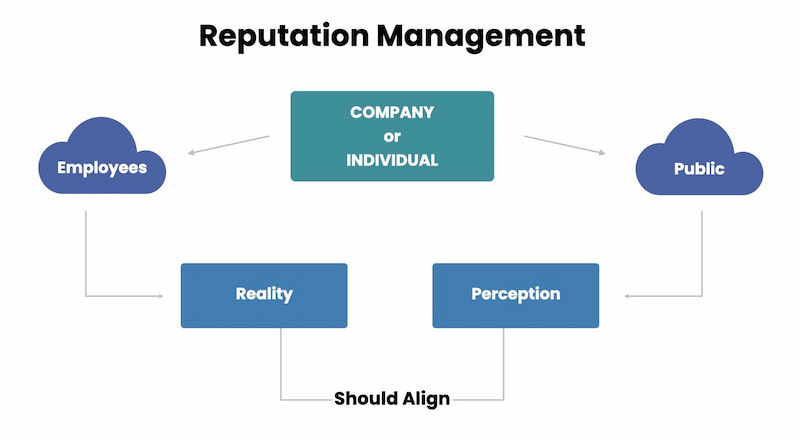
“The alignment of these factors is vital if we want to build, sustain and protect an organization’s reputation,” they explain. Everyone involved with the company plays a role in the development of that company’s reputation, not just customers. How employees or representatives speak, act or present themselves to the community outside of the operations of the company impact that brand’s reputation.
Schultz and Werner also state that “The objective of reputation management is to foster this harmonious relationship between identity and image.”
That is, it’s important not only that what the company says about itself is true but what the community thinks about itself is true as well. In a situation of good reputation, these things should align where perception directly reflects reality. If they don’t, then the company needs to take a look at how it represents itself and why its online reputation doesn’t reflect the public perception.
How does one manage a reputation?
A large part of what we do as an online reputation management company is help improve your image by increasing publicity and searchability of the positive things that are associated with you and your business. We also work to remove or bury the things that could be damaging your reputation.
A few common reputation management tactics include:
- Keywords and descriptions: The key to successful social media is the ability to communicate the value of your business and brand to your customers. This is often accomplished through attention-grabbing content that showcases your unique value proposition and brand message. Also, by using well-researched keywords and descriptions, your information rises to the top of searches. We often help clients with creative writing by balancing the key points of their business with real insight into their brand personality.
- Reviews and ratings: Maintain a pulse on online reviews by carefully monitoring what people are saying about your brand online. It is important to focus on both positive and negative reviews. Build on the positives and respond to the negatives. Always reply politely and professionally, offering concrete solutions to root problems as quickly and efficiently as possible.
- Search engine results: The first page of search engine results is critical in forming first impressions of your brand. Anything negative on this page can cause people to lose trust in your brand. By creating positive and well-written content, your brand will be driven to the top of search results. This will also push down any negative content to later result pages where it will most likely not be viewed.
Ethics and Reputation Management
A common concern is related to the ethics of the field of reputation management. These ethics are a part of every project we consider and we pride ourselves on being an ethical company. If you’re interested in our thoughts about ethics in reputation management, check out our page on the subject.
Reputation management operates by aligning the perception in the community with the identity of the individual or company. For an online reputation management company like Reputation X, this includes search engine optimization (SEO) and other tactics that deal with online resources.
SEO is a large part of what we do. We push down bad search results and defend positive search results that relate to your company. We also pursue the removal of content that negatively impacts how consumers perceive your brand or you as an individual. Using these and other tools, we work to raise your company’s positive reputation.
Skim through our comprehensive list of reputation management services for more details. If you want to know more about online reputation management, read our blog or contact us directly today.
Frequently Asked Questions







Protect Your Online Reputation
Every day you wait, negative content gets stronger. Talk to our experts about a custom strategy for your situation.
Get Your Free Analysis