
All the Types of Wikipedia Article Protection Explained
Wikipedia links appear on the first page of 81 to 84% of desktop search results across Google, Bing and DuckDuckGo for common queries, making your article a valuable asset worth defending with the right level of protection.

A 2021 Northwestern University study found Wikipedia links on the first page of 81 to 84% of desktop search results across Google, Bing and DuckDuckGo for common queries, making it a critical reputation management asset. Because anyone can edit unprotected Wikipedia articles, they are vulnerable to vandalism and deliberate misinformation. Wikipedia offers 11 distinct types of article protection, each designed for different threat levels, and understanding them helps individuals and organizations safeguard their online presence.
A 2021 Northwestern University study found Wikipedia links on the first page of 81 to 84% of desktop search results across Google, Bing and DuckDuckGo for common queries and 67 to 72% for trending topics. Some pages are more vulnerable to vandalism though. In that case, consider requesting some form of protection for the article. If you cannot watch the article yourself, a Wikipedia monitoring service will check the article on a regular schedule and report changes promptly.
Highlights:
- Some Wikipedia articles are prone to deliberate attacks of false information.
- To prevent fraudulent edits and vandalism, Wikipedia has various levels of article protection.
There are 11 types of Wikipedia article protection, created to protect different types of articles in specific ways.
Why is Wikipedia article protection important?
Not every Wikipedia article needs protection. But for the ones that do, it’s not just essential to have protection; it’s crucial to have the right type. Why is it so important, you ask? Well, having a Wikipedia article can boost your SEO efforts and is a critical part of your reputation management strategy. This is because Google recognizes Wikipedia as a source of valuable and relevant information and is very likely to put Wikipedia links atop its search engine results article (SERP) rankings.
In fact, a 2021 Northwestern University study found Wikipedia links on the first page of 81 to 84% of desktop search results across Google, Bing and DuckDuckGo for common queries and 67 to 72% for trending topics. Such a valuable digital asset deserves protection.
And that protection is particularly needed in the Wild, Wild West that is Wikipedia collaboration. After all, a 2012 survey of 1,284 PR professionals found that 60% believed their company’s or a recent client’s Wikipedia article contained factual errors that may be damaging to corporate reputation — a narrower finding than “over half of all Wikipedia articles.” Worse, sometimes the errors are deliberate attacks on public figures or companies amid controversy or with skeletons in the closet. Wikipedia refers to this as vandalism.
Because anyone can edit Wikipedia articles that don’t have some level of protection, they have become popular forums for calling out individuals and corporations for their misdeeds and mistakes. An example is the star of The Bachelor Season 17, Arie Luyendyk, Jr., a race car driver turned reality star who made an unpopular pivot on the show’s season finale. Fans of the show barraged Luyendyk’s unprotected Wikipedia with an onslaught of criticisms before it received semi-protection, exhibiting that if you’re a notable figure in the middle of controversy, the internet trolls will find you.
In certain circumstances such as this, it is necessary to protect a Wikipedia article from being edited or modified by certain people. Typically, Wikipedia article protection coincides with a specific event that damages the subject matter of an article, and that cannot be mitigated or prevented through other avenues, such as a block.
Because Wikipedia is built on the principle of anyone being able to edit its articles, you must be proactive and request article protection if you want your article to be completely safe from vandalism.Wikipedia established its protection policy to screen those seeking article protection.
Does Your Company Qualify for a Wikipedia Page?
Run a free notability check. Our analysis engine reviews real press coverage against Wikipedia's actual notability standards and emails you a detailed report — no sales call required.
Your notability check is running
We're analyzing coverage of right now — it usually takes 10–15 minutes. Your report link will arrive by email from Reputation X; check spam if you don't see it. Keep reading — nothing else to do here.
Wikipedia’s goal is to have as many of its articles as possible open for public editing, so you must advocate for your article’s protection if you believe you meet the criteria for one of the site’s 11 types of protection (discussed below).
If you or your business are notable enough to warrant a Wikipedia article, part of your reputation management game plan should include, first, figuring out what type of protection is warranted and then, requesting such protection from Wikipedia.
Let’s take a look at the different types of Wikipedia article protection so you can make an informed decision.
What types of Wikipedia article protection are there?
If a Wikipedia article is unprotected, anyone can edit it. But article protection affects tens of thousands of articles in English Wikipedia alone. This renders some of Wikipedia’s most visited articles uneditable by most of its users. However, the degree of protection varies. Here are the different tiers of Wikipedia article protection:
Fully-protected
 A fully-protected Wikipedia article can only be edited or moved by the article’s administrators. You can set this protection for a specified amount of time or it can be indefinite. Sometimes administrators will modify fully-protected articles if a change is proposed on the article’s talk article, and there is a consensus that implementing the change would be uncontroversial.
Wikipedia’s “Most vandalized articles” article is an example of a fully-protected article.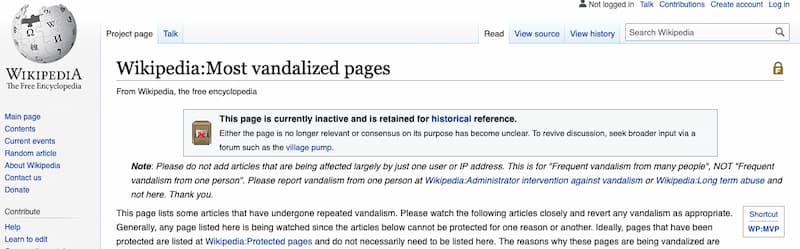
Interface protected
 Not all fully-protected articles can be changed or removed by ordinary Wikipedia administrators. An example of this is an Interface protected article. An article with this type of protection is restricted to editing by interface administrators only and involves access to editing Wikipedia’s system-wide CSS and JavaScript articles.
Interface protection is a type of “Permanent Protection” for Wikipedia articles that are either very visible (like Wikipedia’s main article) or that should not be edited for legal reasons, such as the general disclaimer. These hard-coded protections are usually fully protected for an indefinite period.
Template-protected

There are a few limited instances where high-risk articles outside of the template space receive Template protection but, for the most part, Template protection can be viewed as full protection for Wikipedia’s templates and modules.
Semi-protected

Besides administrator access, semi-protected articles also can be modified by autoconfirmed, confirmed, or extended confirmed users.
A Wikipedia user’s account becomes auto-confirmed when it is at least four days old and has made at least 10 edits on Wikipedia.
Because certain individuals with negative views toward a particular subject might try to open a Wikipedia account and quickly tarnish an article about the subject they disagree with, the online Encyclopedia likes to get to know users and their habits a bit before allowing them to edit semi-protected articles such as the article for “Islam.”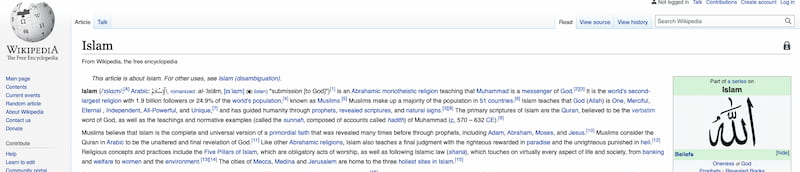
Create protected

Creation protection is pretty self-explanatory. Wikipedia administrators have the ability to prevent the creation of articles. This is particularly useful for popular “bad articles” that previously have been deleted but repeatedly get recreated.
The online Encyclopedia uses a title blacklist to help identify new article titles that should be blocked. Articles that are creation protected are also referred to as “salted” articles. If a contributor wants to create an article with appropriate content about a “salted” title, they can contact the protecting administrator.
Move protected

- An article is persistently the subject of article-move vandalism
- An article has an article-name dispute
- An article is so highly visible that it has no reason to be moved
All fully-protected articles are move protected.
Upload protected

Pending changes protected

In these cases, all users are still allowed to continue to submit edits. However, edits made by unregistered users or new editors are hidden from public view until those changes are reviewed and approved by a pending changes reviewer.Auto-confirmed, confirmed and extended confirmed editors will continue to see all changes immediately, whether accepted or not.
Extended confirmed protected

As stated before, Wikipedia’s goal is to have as many of its users as possible able to edit its articles. However, the online Encyclopedia does like to reward those who use its site regularly and abide by its policies consistently.
Wikipedia’s VIP users are referred to as “Extended Confirmed.” Extended confirmed protection is also known as 30/500 protection because users must be registered for at least 30 days and have a minimum of 500 edits to their name to be granted extended confirmed status.
Sometimes an article doesn’t warrant full protection but semi-protection is not enough. This is a good example of when extended confirmed protection comes into play. This ensures that only Wikipedia’s most reliable users can edit some controversial articles, such as the Wikipedia article for former President of the United States Donald Trump.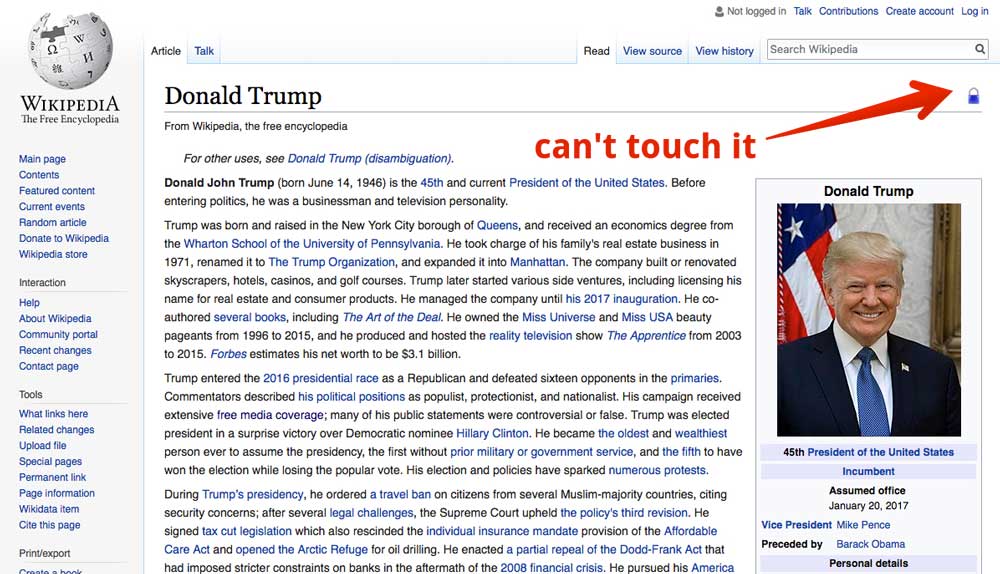
Protected by Office

Cascade protected
Cascade protection is very technical but also very important. It is to protect transcluded items that are considered “ultra-high-use” and are crucial to the Wikipedia interface. Cascade protection is similar to interface protection, except it encompasses the protection of more elements of an article, such as templates, images, and other media hosted on the article.
Some of these types of protections are more common and applicable than others. But here is a table that summarizes the tiers of Wikipedia article protection and the specs of what each protection entails.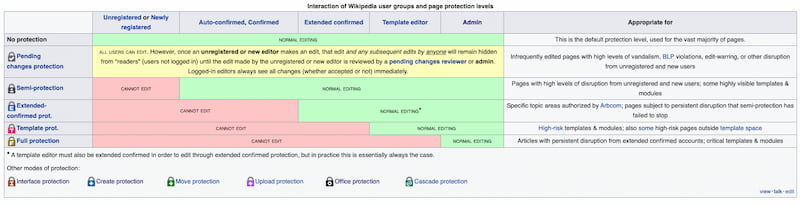
Who should edit protected Wikipedia articles?
Just because you may be able to edit your own Wikipedia article once it’s protected doesn’t mean that you should. Even if your goal is to limit the number of people who can edit your company’s Wikipedia article to as few people as possible, you should allow some more objective voices other than you or your stakeholders to modify your Wikipedia article. This helps prevent conflicts of interest.
Wikipedia in search
Wikipedia reaches the first page of most searches
A Wikipedia link showed up on the first page of results for roughly four in five common queries and about two in three trending topics.
Frequently Asked Questions





Protect Your Online Reputation
Every day you wait, negative content gets stronger. Talk to our experts about a custom strategy for your situation.
Get Your Free Analysis