
DMCA Takedowns for Reputation: A Practical Guide
How DMCA takedowns work, what they can and can't fix for your reputation, and how to file a notice the right way.

A DMCA takedown is a formal notice under Section 512 of the U.S. Digital Millennium Copyright Act asking an online service provider to remove material that infringes your copyright. It helps your reputation only when your own copyrighted content is reused without permission. Section 512 covers copyright infringement, not negative reviews, news, or opinions.
What is a DMCA takedown?
A DMCA takedown is a request, authorized under Section 512 of the Digital Millennium Copyright Act, asking an online service provider to remove or disable access to material that infringes your copyright. Congress passed the Digital Millennium Copyright Act in 1998 to update U.S. copyright law for the internet. Section 512 lets copyright owners remove infringing online content without going to court.
Responding is voluntary for the provider. Providers that do respond gain the law’s “safe harbors” — limits on their liability for copyright infringement. Section 512 sets out four safe harbors, covering providers that transmit or route traffic, cache content, store material at users’ direction, or link to material through tools like directories, according to the Congressional Research Service.
That voluntary-but-incentivized structure drives the whole system. A provider has a strong reason to act on a valid notice, because acting is how it keeps its legal protection. For the mechanics of the right being enforced, see our explainer on copyright infringement and Google removal.
When does a DMCA takedown actually help your reputation?
A DMCA notice can remove content you hold the copyright to. It cannot remove content that is merely unflattering. The tool manages your intellectual-property rights; it does not repair your reputation except in the rare case where copyright infringement and defamation overlap, as Reputation.ca notes. Per the National Security Law Firm, you should not use it for defamation, privacy, or harassment unless the content also infringes your copyright.
In our removal work at Reputation X, we regularly meet clients who expect a DMCA notice to pull a bad review or a critical article. We redirect that expectation: DMCA covers copyright infringement, not content that is simply unflattering or contested. The table below maps where the tool applies. — Reputation X editorial team
Get a Free Reputation Assessment
Find out what people see when they search for you online. No obligation — results in 24 hours.
| DMCA can help remove | DMCA cannot remove |
|---|---|
| Your original photos reposted without permission | A negative review of you or your business |
| Your written text or bio copied to another site | A news article you dislike but that infringes nothing |
| Your video or audio reused without a license | An opinion, blog post, or forum comment about you |
| Your copyrighted images embedded in a hostile post | Harassment that contains no copyrighted material of yours |
The test is simple. Ask whether the content reproduces something you actually own the copyright to. If yes, DMCA may fit. If the content is just true, critical, or embarrassing, it is the wrong tool — and reaching for it anyway invites the misrepresentation risk covered below. When copyright infringement isn’t the issue, a broader negative content removal strategy is usually the more appropriate starting point.
Who can file a DMCA takedown notice?
Only the copyright owner or their authorized agent can file a DMCA takedown notice, per the National Security Law Firm. That rule hides the most common reputation snag we see: being in the content is not the same as owning it.
Consider a frequent scenario. Someone is the subject of a photo or short video now being misused online, but a photographer or third party took it. The subject does not own the copyright, so they generally cannot file a notice themselves. Appearing in an image gives you no copyright in it. For situations where you want an unwanted image removed but lack copyright standing, see our guide on removing images from Google, which covers alternative routes including Google’s personal-content removal policies.
There is a lawful workaround, offered here as an option rather than a guarantee. You can contact the original copyright holder — for example, the photographer — and ask them to assign you the rights or authorize you to act as their DMCA agent. With a signed statement of that authorization, you can then issue takedown notices on their behalf, according to the same source. This route is slower and depends entirely on the rights holder’s cooperation, but it is the legitimate path when you are depicted but do not own the work.
How do you file a DMCA takedown notice?
A valid notice must contain the six elements set out in 17 U.S.C. § 512(c)(3). Omitting one can void the notice or let a provider lawfully ignore it, so treat the list as a checklist, not a suggestion. The elements are a signature, identification of the copyrighted work, identification of the infringing material with enough detail to locate it, your contact information, a good-faith statement, and an accuracy-and-authority statement — as the U.S. Copyright Office and the statute confirm.
The step-by-step checklist accompanies this guide as a structured module. Two practitioner notes are worth flagging. Identify the infringing material by its exact URL rather than a general description, because “somewhere on this site” rarely satisfies the locate-it requirement. And write the good-faith statement honestly, since after Lenz v. Universal Music you are expected to have considered fair use before you sign it.
How do you find the provider’s designated agent?
Send the notice to the provider’s designated DMCA agent, not a general contact form. Providers must designate an agent to receive notices, publish that agent’s contact information, and register the agent through the U.S. Copyright Office’s DMCA Designated Agent Directory. Searching that directory is the fastest way to find the correct recipient. Sending to the wrong address is a common reason a valid notice stalls.
What happens after you file a DMCA notice?
Once a provider has a valid notice, it has a legal duty to act expeditiously to remove or disable the infringing material, because that response preserves its safe-harbor protection. The duty is triggered when the provider gains actual or constructive knowledge of infringement, according to the Congressional Research Service.
After removing the material, the provider must take “reasonable steps” to notify the user who uploaded it, the same source explains. That notification gives the uploader the chance to file a counter-notice, the process covered below.
Be careful what you promise yourself on timing. The statute requires “expeditious” action but sets no fixed deadline. Some practitioners interpret expeditious removal as occurring within roughly a day or two for hosting services, but that is an interpretation, not a statutory requirement. Real-world response times vary widely by provider and by how clean your notice is.
Does a DMCA remove content from Google or from the website?
A Google DMCA request removes specific URLs from Google Search results. It does not delete the content from the website that hosts it. This distinction trips up more reputation efforts than almost anything else, so state it plainly: de-indexing reduces discoverability, while host removal eliminates the material at the source. They are different actions with different reach, which is why, in practice, the two are often pursued together — de-indexing limits what searchers find while a separate notice to the host targets the content itself. Our ranked guide to removing Google search results covers how DMCA de-indexing compares to other removal methods and when each is fastest.
| Aspect | Google Search de-indexing | Host removal |
|---|---|---|
| Who you ask | Google (via its copyright removal tool) | The website’s host or platform’s designated agent |
| What is removed | The URL from Google Search results | The content itself, from the source site |
| What remains | The content still lives on the host, reachable by direct link, other search engines, and shares | If granted, the material is gone at the source |
| Public disclosure | Request details may be sent to the Lumen database (personal contact info usually redacted) | Varies by host; many forward the notice to the uploader |
Google may send a copy of your request to Lumen, a public database that tracks content-removal efforts, though personal contact information is usually removed before publication. That transparency is a feature, not a bug, but it means your notice can become public record — one more reason to file accurately.
Processing windows shift over time and are not fixed by Google. Treat any specific number as approximate and verify against the provider’s current help pages before relying on it.
What is a DMCA counter-notice?
If your content was removed and you believe it was a mistake or misidentification, a counter-notice can restore it within 10 to 14 business days — unless the sender sues. Under the framework summarized by the Congressional Research Service and confirmed by the U.S. Copyright Office, the provider may repost the material not less than 10 nor more than 14 business days after a valid counter-notice, unless the original sender first notifies the provider that it has filed a copyright infringement action in federal court.
A counter-notice has its own required elements: your physical or electronic signature; your full name, address, and telephone number; a statement under penalty of perjury that you have a good-faith belief the material was removed by mistake or misidentification; and your consent to the jurisdiction of the federal district court where you live. Confirm the exact statutory wording against copyright.gov/512 or 17 U.S.C. § 512(g) before you file. The consent-to-jurisdiction element means a counter-notice is not a step to take casually — it can pull you into federal litigation if the sender escalates.
Fair use, false notices, and § 512(f) liability
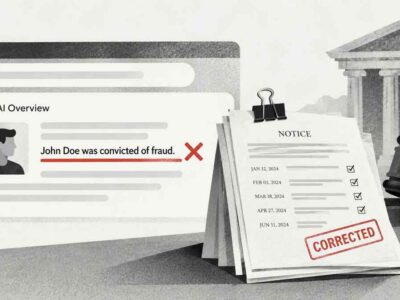
The law expects good faith before you file, and it penalizes those who lack it. In Lenz v. Universal Music (9th Cir. 2015), the court held that a copyright holder must consider fair use before sending a takedown notice, a point summarized in commentary on the decision. This is not a formality. If the material you target is plausibly fair use — commentary, criticism, parody, or news reporting — filing anyway is exactly the conduct the next provision punishes.
Section 512(f) creates liability for any person who knowingly materially misrepresents that material is infringing, per 17 U.S.C. § 512. Combined with the penalty-of-perjury statement in every notice, this is the legal teeth behind the system. Bad-faith filings can expose you to damages. If you are on the receiving end of what appears to be a retaliatory or bogus notice, our overview of the DMCA’s broader framework explains the safe-harbor system that governs both senders and providers.
You do not always need federal court to pursue a misrepresentation claim. The Copyright Claims Board is a voluntary, lower-cost alternative to litigation, and eligible claims include misrepresentations in notices or counter-notices under Section 512. For anyone hit by an abusive takedown, that lowers the barrier to pushing back.
How is the DMCA abused in reputation management?
This section is a warning, not a playbook. A segment of the so-called “reputation management” industry has used DMCA notices to intimidate sites into removing inconvenient material, as documented by WalledCulture. The favored trick is to back-date a copy of the target article, then claim the legitimate original is the infringement — a fraud dressed up as a copyright complaint.
The scale is not trivial. A Lumen researcher found nearly 34,000 takedown notices that appear to misuse the notice-and-takedown process, per the same reporting; that figure is from Lumen/Berkman Klein research dating to roughly 2022 and may have changed since. The honest takeaway: this is fraud, it carries § 512(f) liability and perjury exposure, and it tends to surface publicly through Lumen. The same bad actors often accompany these tactics with broader reputation attacks — understanding how those campaigns are built helps you recognize when a DMCA notice is being weaponized against you.
There is also a quieter, practical cost. Erroneous or abusive takedowns can damage your credibility with service providers, who may scrutinize or ignore your future notices if you build a track record of questionable claims, the National Security Law Firm warns. Abusing the system burns the very tool you may genuinely need later.
Disclaimer
This guide is educational and is not legal advice. DMCA matters turn on specific facts, and copyright law and platform procedures change over time. We do not promise any particular outcome — whether content is removed, de-indexed, or restored depends on the provider, the facts, and the law. Before filing a notice or counter-notice, consult a qualified attorney licensed in your jurisdiction.



















Protect Your Online Reputation
Every day you wait, negative content gets stronger. Talk to our experts about a custom strategy for your situation.
Get Your Free Analysis