
What Makes a Good Wikipedia Reference
Not all sources are created equal — here is exactly what Wikipedia editors look for before accepting a citation as credible and reliable.

- Cite sources readers can independently verify — broken evidence chains get edits flagged or reverted.
- Wikipedia favors academic journals, major news outlets, and government agencies over blogs or press releases.
- Avoid sources with political agendas or advocacy leanings, even if the underlying facts are accurate.
- Always link to the original source, not a secondary report about it.
- Outdated sources can mislead just as much as unreliable ones — prioritize current references.
A good Wikipedia reference must be verifiable, published by a reputable source, neutral in perspective, and relevant to the claim it supports. This article breaks down each of these criteria, explains which source types Wikipedia favors or rejects, and offers practical tips for evaluating whether a source will hold up to editorial scrutiny.
What makes a good Wikipedia reference? Should you cite that news story from five years ago? How about the blog authored by a supposed expert? Perhaps a glowing press release?
Whenever someone reads an article on Wikipedia, they’re implicitly trusting the evidence behind claims made. While Wikipedia doesn’t expect perfection, a quality reference must meet core criteria: be verifiable, reliable, unbiased, and relevant. There’s more subjectivity in there than it seems.
This article explains what defines a strong reference for Wikipedia. It covers the kinds of sources Wikipedia holds in high regard, common pitfalls to avoid, and practical ways to quickly gauge whether a source makes the cut.
Key Takeaways
- Verifiability is top priority. Every significant fact needs to be traceable to a reputable publisher. Provide breadcrumbs that any reader can follow to confirm the information presented.
- Not every source carries equal weight. Wikipedia prioritizes academic journals, authoritative news outlets, and recognized institutions due to their rigorous fact-checking. Personal blogs, social media posts, and promotional content usually don’t qualify.
- Neutrality matters—a lot. Wikipedia avoids sources with built-in biases, political agendas, or advocacy leanings. A quality reference informs readers without steering them toward a particular viewpoint.
- Keep sources timely and relevant. Outdated studies or reports can misinform as much as unreliable ones. Use current sources to ensure articles reflect the latest understanding.
- Avoid misrepresenting what a source says. Many editors pull quotes and information out of context. This can lead to the reference being removed by other editors as non-neutral.
- Check the list of acceptable source types below for examples of what does or does not make the cut.
Attributes of a Reliable Wikipedia Reference
Verifiability
Verifiability means ensuring anyone can confirm claims by checking clearly cited, accessible sources. For example, when adding information about a new medical treatment, link to peer-reviewed articles in respected journals like The Lancet or JAMA, where readers can see the original study, methods, and findings.
Does Your Company Qualify for a Wikipedia Page?
Run a free notability check. Our analysis engine reviews real press coverage against Wikipedia's actual notability standards and emails you a detailed report — no sales call required.
Your notability check is running
We're analyzing coverage of right now — it usually takes 10–15 minutes. Your report link will arrive from noreply@reputationx.com; check spam if you don't see it. Keep reading — nothing else to do here.
If a reader can’t easily trace a claim back to its origin, the article loses credibility. If you don’t provide clear paths, another editor may add a citations-needed template, which is difficult to remove.

Reliable Publishers
The publisher behind a source matters. Wikipedia strongly favors established, reputable outlets because of their editorial oversight and fact-checking. Think respected news institutions like The New York Times, government agencies, recognized academic institutions, or international bodies like the United Nations.
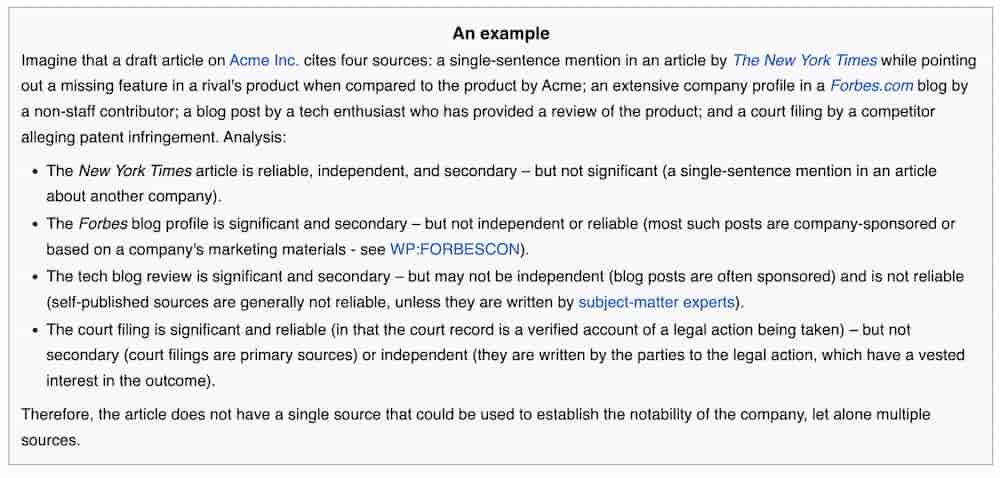
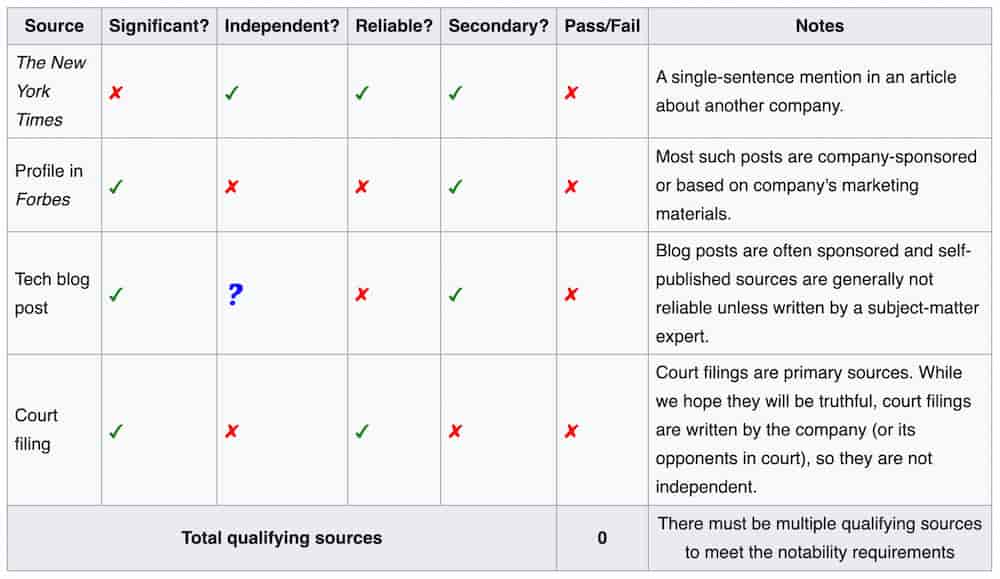
Personal blogs or opinion websites rarely pass muster unless authored by well-known experts. A self-published paper from a Nobel Laureate might earn inclusion based on the author’s recognized expertise. A random blogger without demonstrable credentials likely won’t qualify. Sourcing from trusted, widely known publishers helps preserve reader confidence and keeps articles authoritative.
Consistency with Wikipedia’s Neutral Point of View (NPOV)
Neutrality is essential—sources should resist steering readers toward specific political ideologies or special interests. When writing about tax policy, citing neutral government statistics like IRS data or Census Bureau reports reinforces impartiality. Quoting heavily from politically aligned think tanks risks introducing bias.
Even factual content sourced from advocacy groups can subtly skew context. Always assess whether a source promotes objectivity and reflects balanced perspectives.
Date and Relevance
Consider the timeliness and relevance of your references. Information in fields like technology, medicine, and environmental science changes quickly. Sources from 2010 likely won’t reflect today’s best practices in cybersecurity—the methods, threats, and tools have evolved significantly.
Choose recent sources whenever possible to accurately represent the current state of knowledge. Ensure sources also clearly address your article’s specific topic to maintain coherence and value for readers.
Taken together, these factors—verifiability, proven publishers, neutrality as defined by Wikipedia’s conflict of interest rules, and timeliness—shape trustworthy references that readers and Wikipedia editors can depend upon. They also make your edits easier to defend if they are ever challenged.
Need Help With Wikipedia References?
Getting Wikipedia citations right is harder than it looks. Our team knows exactly what Wikipedia editors look for — and how to build a page that sticks.
Examples of Wikipedia Sources
Here’s a clear breakdown of common source types used by Wikipedia editors, categorized by their typical acceptability. If you’re building a Wikipedia presence for a brand or executive, understanding these distinctions is essential. See our guide on earning media coverage that qualifies as Wikipedia references for a deeper look.
Usually Acceptable
- Peer-reviewed academic journals
- Books from reputable publishers
- Newspapers with editorial oversight (e.g., The New York Times, The Guardian, Washington Post)
- Magazines with strong editorial standards (e.g., The Economist, National Geographic)
- Official government reports and documents
- Official websites of recognized institutions and organizations (for factual claims about themselves)
Sometimes Acceptable
- Industry-specific publications and trade journals (Depending on editorial oversight and reputation)
- News agency reports (e.g., Reuters, AP) (Usually reliable, but preliminary reports may occasionally be updated or corrected)
- Local newspapers (Depending on reputation and subject matter; smaller papers with less rigorous editorial standards may face closer scrutiny)
- Documentaries and broadcast media (Reputable documentaries or news reports are generally reliable, but opinion-based programs usually aren’t)
- Blog posts or articles written by recognized experts (Acceptable if the author is a clearly acknowledged expert, but less credible than peer-reviewed or journalistic sources)
Rarely Acceptable
- Press releases (Typically self-serving and lacking neutrality; occasionally acceptable for basic facts but generally discouraged)
- Self-published books or ebooks (Usually unreliable unless the author is a well-known expert in the specific subject area)
- Social media posts (X/formerly Twitter, Facebook, Reddit, Instagram) (Almost never reliable as primary sources; may occasionally be cited to illustrate public response in limited circumstances)
- Crowdsourced content (forums, wikis, Quora, Stack Exchange) (Generally unacceptable due to lack of reliable editorial oversight and verifiability)
- Opinion editorials (Op-eds) (Rarely acceptable for factual claims, though sometimes usable to illustrate notable perspectives clearly attributed to their authors)
Understanding the source hierarchy is also important if you’re thinking about creating a Wikipedia article that won’t be deleted—strong references are one of the most important factors editors evaluate. If your page is already live, weak citations are a common reason pages end up flagged for deletion or vandalism.
Frequently Asked Questions








Protect Your Online Reputation
Every day you wait, negative content gets stronger. Talk to our experts about a custom strategy for your situation.
Get Your Free Analysis