
Review Management Strategies and Tactics
Learn which review management strategies actually move the needle—and which ones can get your business banned from the platforms that matter most.

Online review management is critical because most consumers read reviews before choosing a local business. A strong strategy combines proactive customer outreach, timely responses, and removal of policy-violating reviews. Businesses that ask every customer for feedback and fix problems quickly earn better ratings over time.
When a brand wants to improve its online reviews and ratings, the right strategy will make all the difference. Some strategies are slow, others faster. Some work, others get you banned.
Online reviews are an excellent resource for consumers and businesses as they go about their buying decisions. Word of mouth has always been a key player in whether people opt for one product over another, and the wealth of online reviews and rating systems available today are simply the digital versions of this phenomenon.
of consumers say they always read reviews when choosing a local business
BrightLocal 2024 Local Consumer Review Survey
Yet despite this, online review management remains a significant challenge for many businesses. A large share of companies still lack a formal strategy for monitoring and improving their ratings. Research consistently shows that a substantial majority of consumers will avoid a business after reading negative reviews.
This article serves as a primer to online review management strategy so that you can start taking control of your online reviews today.

Online Review Management Strategies
Because online reviewing is so prevalent, it is normal to be concerned about what people might be saying about your business. Not all review sites are created equal. Most consumers put more stock in a review from a trusted site like Yelp than from an obscure or unverified source.
Many who seek strategies for online review management do so because they hope to delete or mitigate negative reviews. A comprehensive strategy will include at least some of the following:
- Encouraging positive reviews on popular sites like Google Business Profile, Yelp, Angi, Google Reviews, Facebook, and Trustpilot through focused customer outreach, but without bribery.
- Removing negative reviews when possible. Reviews that violate terms of service or promote demonstrable falsehoods are the most common acceptable grounds for removal. If reviews are negative and truthful, your strategy will need to be more proactive.
- Displaying Yelp and other review site badges and signage on websites, storefronts, advertising, or email newsletters to encourage satisfied customers to share their experiences online.
- Establishing a protocol for monitoring and responding to online reviews across all relevant platforms.
Even with a solid strategy in place, some reviews will be difficult to address. Vague or irrational complaints can drag down ratings for no apparent reason, which is why a proactive approach matters.
Online reviews
Most consumers read reviews, and most act on them.
Nearly every consumer reads reviews for local businesses, and large majorities say reviews and owner responses change which business they choose. Only the last bar falls below a majority.
To counter bad reviews from customers and competitors, business owners must stay proactive. Here are two core tactics that a company like Reputation X can help you develop and implement.
Take Control of Your Online Reviews
Review management is part of our reputation marketing campaigns, which help businesses improve ratings, respond to feedback, and protect their reputation across every major platform.
Intercepting the Customer
Businesses that intervene during and just after the sales cycle to request feedback tend to earn better star ratings. They give customers a direct channel to share whether their experience was positive or negative, alongside the public review link.
Asking for feedback can be automated using review management tools. Send the same request to every customer, not just the ones you expect to be happy, so the reviews you earn reflect your real customer base. When a customer tells you something went wrong, reach out and fix it right away. A problem solved quickly is the best way to keep a frustrated customer from becoming a public complaint.
How to Ask for Reviews
The best review requests are simple and well timed:
- Ask directly after a successful transaction or a positive interaction.
- Empower front-line representatives to make the request. Account managers, field technicians, and sales reps who maintain daily customer contact are the most natural candidates to request feedback. Instruct them to ask every client systematically, rather than selectively approaching accounts they assume are happy.
- Send a follow-up email a few days after purchase that thanks the customer and includes a direct link to your review page.
- Make the link easy to find on your website, in staff email signatures, and on your social profiles.
- Use signage, cards, or QR codes at the point of sale so customers can reach your review page in one step.
Keep your email communications brief, human, and direct. Draft conversational subject lines like “How was your experience?” or “What did you think of [Product]?”, address recipients by first name, and explicitly reference the specific service or item they bought. Request an authentic, honest evaluation—never specify a positive or high rating. Use this baseline framework:
Subject: How is your new [product] working out?
Hi [name],
Thank you for choosing [product]! Could you spare sixty seconds to share your experience? Your authentic feedback helps other buyers make informed choices and allows our team to keep improving.
[Direct Link to Review Profile]
Thank you,
[Your team]
Some platforms, Yelp in particular, discourage businesses from asking for reviews at all, so check each site’s guidelines before you send a request.
Choosing Which Platform to Focus On
You can change your review link whenever your priorities change. Usually the platform that needs the most attention is the one that ranks high in your brand’s search results and could use a better star rating. Google reviews, for example, often appear more prominently in search results than Yelp. If Google is on page one with a 3-star average while Yelp sits on page three, focus on Google first, then shift as your search results change.
Regardless of which platforms you prioritize, claim your business listings on each directory and fill out every profile section completely. While user feedback is out of your direct control, you control the brand photos, business descriptions, operating hours, and contact channels showcased alongside those ratings. Beyond optimizing your Google Business Profile and Yelp page, ensure you secure listings on Bing Places, Facebook, the Better Business Bureau, and Trustpilot. For specialized B2B software ecosystems, look to G2 and TrustRadius; for employer-specific branding, manage Glassdoor. Maintain a steady cadence of requests year-round. Prospects consistently favor recent feedback over legacy entries, making a consistent monthly flow far more effective than an occasional blitz.
Responding to Reviews
How you respond to reviews is visible to every future customer who reads them. Responding consistently also appears to help ratings. A 2018 study published in Harvard Business Review, based on TripAdvisor hotel reviews, found that ratings rose by an average of 0.12 stars after businesses began responding.
- Stay calm and empathetic. Acknowledge the customer’s frustration, never argue, and focus on a solution.
- Personalize every reply. Address the specific issue the reviewer raised. Canned responses read as indifference.
- Respond promptly. A reply within a day or two shows that you take feedback seriously.
- Own your mistakes. If something went wrong, say so, and explain what you have changed.
- Take specifics offline. Offer a phone call or email to resolve the issue privately. Once the problem is fixed and the customer is satisfied, you can ask whether they would consider updating their review. Never pressure them to do it.
- Thank positive reviewers too. You don’t need to answer every five-star review, but short, genuine thank-yous show readers that real people are listening.
Yelp also publishes its own guidance on responding to reviews that is worth reading before you reply on that platform.
Leverage Positive Customer Testimonials
High ratings do more than boost your aggregate scores. Feature authentic reviews and client testimonials across your corporate website and social media feeds to break up promotional updates with real customer voices. Quote users verbatim without modifying the underlying intent of their text, and always secure explicit user permission before prominently featuring an individual’s full name or likeness.
Removing Reviews That Violate TOS
When reviewers violate a site’s Terms of Service, the content can often be removed. Yelp will remove reviews that fall into the following categories:
- Irrelevant
- Inappropriate
- Conflicts of interest
- Violations of privacy
- Promotional
- Intellectual property issues
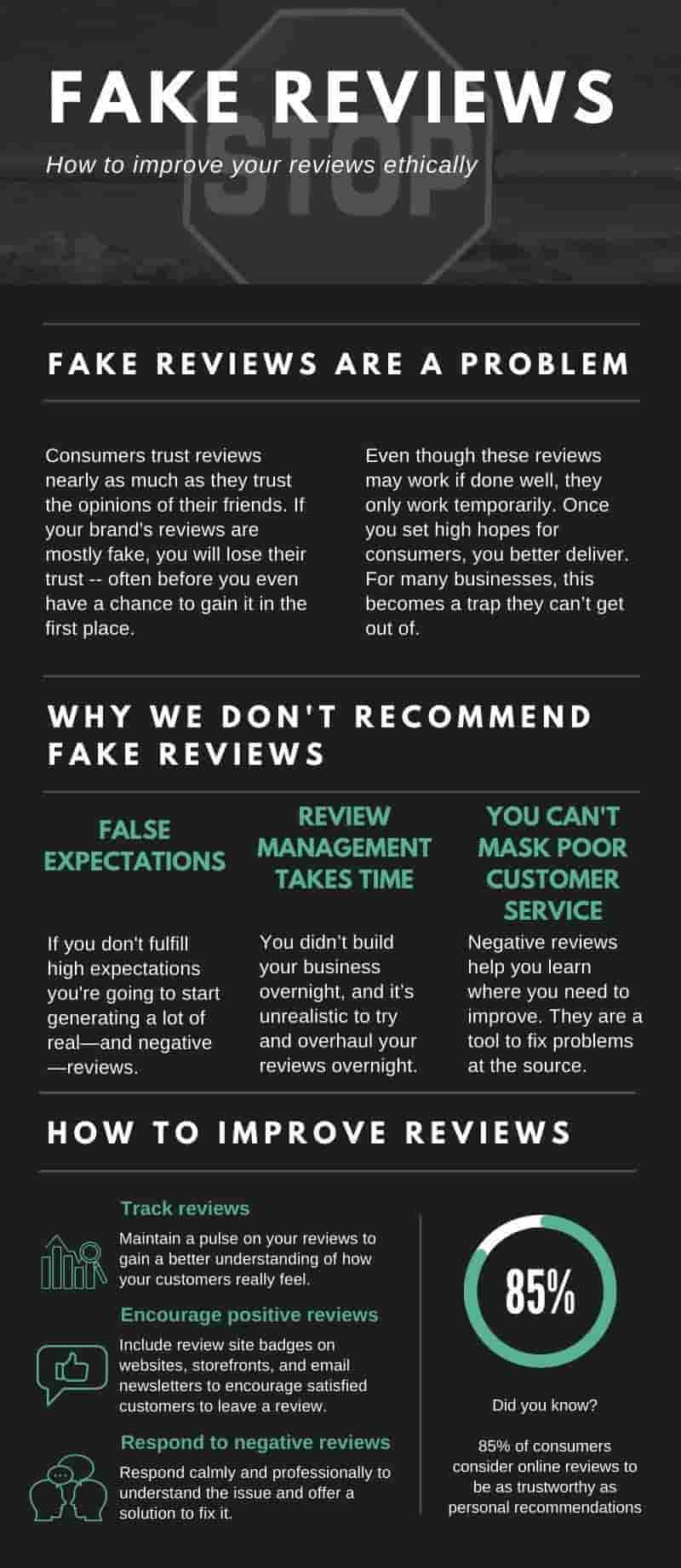
Fake reviews usually come from a short list of sources: competitors trying to drag down your rating, former employees retaliating, customers angling for a refund or freebie, and review mills hired to post in volume. If you suspect one, flag it through the platform’s reporting tool and cite the specific guideline it breaks. Respond calmly in public while you wait, because readers will see your reply even if the review is never removed. Meanwhile, keep earning legitimate reviews so that a single bad-faith post carries less weight.
Should You Pay for Fake Reviews?
No. Here’s why.
Paying people to post positive reviews may seem like a shortcut, but online review fraud can severely damage your reputation. The regulatory stakes have never been higher. In 2024, the FTC updated its rules on fake reviews and testimonials, introducing civil penalties of up to $51,744 per violation — a cap the FTC adjusts annually for inflation, now $53,088 per violation as of 2025.
Paying for reviews is not the only practice that can get a listing penalized. Avoid these as well:
- Writing reviews of your own business, or of competitors.
- Offering discounts, freebies, or payment in exchange for reviews.
- Pressuring, paying, or threatening customers to change or remove critical reviews.
There is a straightforward alternative: ask for reviews yourself. Rather than waiting for customers to post on their own, encourage them to share feedback on the platforms that matter most to your business. Understanding how to analyze online reviews and feedback can also help you identify patterns and improve the customer experience that drives positive ratings organically.
Review Management as One Piece of the Pie
If you want to build a positive business image for the long haul, you will need to do more than monitor online reviews. A strong review management strategy is important, but it is only one component of your broader digital footprint.
Understanding how positive and negative reviews affect business revenue can sharpen your focus and help you prioritize where to invest your efforts. For a broader view of what is possible, explore effective strategies to improve your online reputation or contact us today for a free consultation.
Frequently Asked Questions







Protect Your Online Reputation
Every day you wait, negative content gets stronger. Talk to our experts about a custom strategy for your situation.
Get Your Free Analysis