
Build a Great Personal Brand Online Using Content Gap Analysis
Discover how top branding professionals use content gap analysis to systematically grow personal brand visibility and turn search results into a powerful reputation asset.

- Run a reputation audit on yourself before analyzing competitors to establish a clear baseline.
- Identify content gaps by analyzing what top-ranking personal brands in your space are publishing.
- Align your content strategy to all stages of the buyer's journey, not just awareness.
- Analyze the keywords, platforms, and formats your target audience actually uses.
- Avoid 'spray and pray' content publishing — focus on gaps with the highest strategic value.
A personal brand is a financial asset that requires strategic content investment, not random posting. Content gap analysis helps you identify missed opportunities by examining what your audience wants, what competitors are doing, and where your current content falls short. Using this systematic approach ensures your content reaches the right people at every stage of the buyer's journey.
Highlights:
- Improve your personal brand online by paying attention to what Google reveals about similar people.
- Online content gaps are missed opportunities at generating awareness and interest in your personal brand.
- A successful content strategy addresses customer’s needs at all stages of the buyer’s journey.
- A quick and efficient way to spot and correct content gaps is a best-practices analysis of your competitors.
Don’t be misled by the name. A personal brand is first and foremost a financial asset that generates sales, increases revenues, opens the doors to new opportunities, and enhances online reputation.
Like all other financial assets, a personal brand is an investment—success demands research, planning, strategy, and a diverse portfolio of communications and content.
Most personal brand advice starts with something about being unique, finding your voice, etc. But once you’ve determined what your unique personal brand should say, what’s next? What “content” portfolio do you invest in to build your brand’s value and positive reputation?
What will the canvas of search results reveal about your personal brand, and how do you get Google to show the world what you want it to see?
You could start by just throwing content at the internet. At Reputation X we call this “spray and pray.” From an investment perspective, this is like throwing darts at a list of stocks.
Before you start launching content into the ether, consider this: approximately 7.5 million blog posts are published every single day—and that number keeps climbing. A more focused approach is essential.
Branding professionals start by looking carefully and systematically at the content marketplace. They look for a brand’s “content gaps,” like these:
- Audience-attracting topics
- Social listings, formats, platforms
- Any other opportunities that a brand is ignoring
There’s an old maxim in sales: it’s not about knocking at the right door, it’s about knocking at every door. The pros zero in on those opportunities using Content Gap Analysis.
What Is Content Gap Analysis?
Content Gap Analysis is the process of finding missed opportunities to build online awareness of a brand, attract an interested audience, and convert that interest into sales.
Get a Free Reputation Assessment
Find out what people see when they search for you online. No obligation — results in 24 hours.
Content Gap Analysis is customer analysis. Finding the gaps in your content strategy starts with a basic question: who are my customers and what do they want? What information do they need? What benefits are they looking for? What platforms do they use? What keywords do they search on?
Content Gap Analysis is competitor analysis. In the current content marketplace, which competitors are hitting the top search engine slots? What content are they posting? What platforms and keywords are they using?
Content Gap Analysis is an internal analysis. It involves a thorough audit of where you stand right now. If you’re already posting content, how well is it performing? Are you meeting measurable goals? Above all, is your content strategy generating leads, closings, sales, or revenues?
In the context of personal branding, when examining competitors who have the most successful personal brands, what content are they doing that you’re not?
Do You Have the Content Your Customers Want?
The crucial first step in content analysis is understanding the customer. This means understanding the buyer’s journey—the entire process people go through on their way to becoming a loyal customer.
The Buyer’s Journey
Customers begin with a budding awareness of a need or problem. They may not know exactly what the problem is, but they suspect something needs to be made right (the awareness stage).
As they get a better handle on the situation, they ferret out possible solutions (the consideration stage), gradually narrowing their way to a few best options before making a final choice (the decision stage).
The journey doesn’t end there. There is still distance between a “customer” and a “loyal customer.” Online content plays a crucial role in this final and most profitable stage—the loyalty or advocacy stage.
In each stage of the customer’s journey, people turn to online content for guidance and direction:
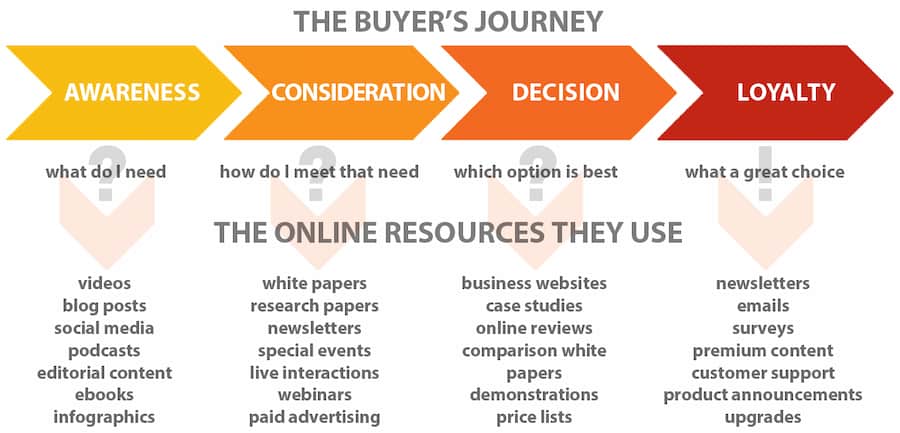
Don’t confuse format for content. At certain stages of the buyer’s journey, people gravitate to certain formats. What they’re looking for, however, is understanding.
At the earliest stages, people seek general answers and information. They ask “what is,” “how is,” and “why is” type of questions—not product demonstrations or price comparisons. If that’s what they find, they leave.
At later stages, they need specifics to help them make a decision. If they can’t find prices or reviews, they go looking elsewhere.
Close the Gap Between You and Your Competitors
Our team can identify exactly what's missing from your personal brand's online presence and build a content strategy that puts you in front of the right audience.
Where to Start Building Personal Brand Content
Most people developing a personal brand don’t have the time to master the deepest secrets of Content Gap Analysis. That’s okay. There is a generally reliable way to get started: best practices.
A best practices analysis involves systematically examining the leading online personal brands of your most successful competitors—people like you, or people like whom you want to be perceived as.
They have already done the hard work of optimizing content across the entire customer journey. Your job is to identify the gaps between your content and theirs. Imitation, as the saying goes, is the sincerest form of learning.
The Content You Need for a Personal Brand
Suppose you are a cosmetic surgeon in the San Francisco area. You could start your content gap analysis with Usha Rajagopal, M.D. or Dino Elyassnia, M.D., two of the leading personal brands in the Bay Area’s cosmetic surgery marketplace. A search on either turns up an online presence that includes:
- A core website
- A Google Knowledge Panel
- Independent editorial content
- Multiple review sites (Yelp, HealthGrades, Google, RealSelf, Zocdoc, Vitals)
- Active social media accounts (Instagram, Facebook, TikTok, and YouTube)
- Multiple online professional profiles
- Multiple organization affiliations
- Online videos
- Images
- Paid advertising
Start with this broad range of content and platforms. Go through the entire web profile piece by piece. Write down what it is, what it says, what part of the customer journey it addresses, and what search terms lead you there. Everything you find is a potential opportunity.
A deep dive into Dr. Rajagopal’s San Francisco Plastic Surgery & Laser Center or Dr. Elyassnia’s professional website reveals a complete content strategy that targets customers from the awareness to the decision stage. Each provides a wealth of introductory content explaining the basics of several plastic surgery procedures—a comprehensive encyclopedia of “what is” articles.
Each keyword-rich introductory article directs visitors to more specialized content appropriate to later stages of the customer journey: more detailed information, reviews, and pricing. At every stage, the “person” behind the brand is always present through photographs and videos. This content is always personal, no matter how general or informative.
These core websites use a classic and effective content strategy: heavy with awareness content, but even the most general articles funnel visitors toward later stages of the buyer’s journey. Bottom-of-funnel content—such as pricing, calls to action, and virtual consultations—may not star in this show, but it is the closing act.
As you work to brand yourself, don’t be discouraged when you take a deep dive into your best competitors’ content. All the content you’ll find took months or years of steady, focused work to build. A best practices content gap analysis provides a map for the long haul, not a recipe for a quick fix.
Don’t be disheartened by professional design or impressive visuals either. Your most successful competitors hire professional designers to develop a clean visual brand appropriate to their customers’ expectations. You will address this issue in good time. For now, focus on the content gaps—then get to work.
A strong personal brand also benefits from a well-structured executive biography page and a presence on key websites that amplify executive reputation—both of which are common gaps revealed during a thorough content analysis. And if your competitors are appearing in Google’s Knowledge Panel results, understanding what sources Google relies on for Knowledge Panels can help you close that visibility gap faster.
Frequently Asked Questions








Protect Your Online Reputation
Every day you wait, negative content gets stronger. Talk to our experts about a custom strategy for your situation.
Get Your Free Analysis