
Online Defamation: A Response Blueprint
From identifying false statements to taking legal action, this guide gives you a clear, actionable plan for fighting back against online defamation.


- Defamation requires a false statement of fact — not opinion — shared with a third party that causes reputational or financial harm.
- Online defamation (cyber libel) can appear on review sites, social media, blogs, and video platforms.
- To confirm you are a victim, verify the statement is false, unprivileged, and caused demonstrable damage.
- Preserve defamatory content as evidence before reporting it to the hosting platform.
- Claiming your social media profiles proactively helps prevent impersonation and limits further reputational risk.
Online defamation involves false statements published online that damage an individual's or business's reputation, most commonly taking the form of cyber libel. This article defines the legal criteria that distinguish defamation from protected speech and explains how to identify whether you are a victim. It also outlines immediate steps to take, including preserving evidence, reporting content to platforms, and seeking legal counsel.
Online defamation refers to false statements about an individual or business that harm their reputation. It spans many platforms, including social media, blogs, and online forums, making online reputation management a significant concern for many. This article explains the various types of online defamation and provides actionable responses.
Navigating online defamation means understanding its nature — predominantly libel in the online context, which concerns written or published false statements that damage reputation.
Defamation can be either libel or slander. Here is the difference between the two:
- Libel: A written or published defamatory statement.
- Slander: Defamation that is spoken.
To be considered defamation, the material must be:
- Demonstrably false
- Shared with a third party
- Harmful to the subject’s reputation or financial standing
What is Online Defamation?
Online defamation is any false statement about an individual or business that is published online and can cause harm to their reputation.
Here is a breakdown of the core concepts:
- Defamation: A false and unprivileged statement of fact that is harmful to someone’s reputation, made with fault — such as through negligence or malice.
- Online Defamation (Cyber Libel): The publication of false statements of fact about a third party online that causes reputational damage. This can include libel (written defamation) and slander (spoken defamation), manifesting across review sites, social media, and video posts.
If you can answer yes to each of the following, you may be a victim of online defamation:
- The defendant published a statement about the plaintiff to a third party.
- The statement was false and capable of being proven false.
- The statement was not privileged and was made with the requisite degree of fault.
- The statement was either inherently damaging or caused economic damage.
Online defamation can have severe consequences for all parties involved:
Get a Free Reputation Assessment
Find out what people see when they search for you online. No obligation — results in 24 hours.
- Impacts on Victims: Online defamation causes reputational, emotional, and financial harm. It can affect anyone — from celebrities to small business owners — leading to professional setbacks and personal distress.
- Legal Consequences for Perpetrators: These may include civil liability, possible criminal charges, and reputational damage. Specific legal requirements and defenses vary by jurisdiction.
- Preventive Measures and Response: Identifying the publisher, preserving defamatory content as evidence, and reporting the content to the platform are critical first steps. Claiming social media profiles can also help prevent impersonation.
Identifying Defamatory Content
Identifying defamatory content online is a critical step toward managing your reputation effectively. Understanding what constitutes reputational harm is essential before you can act on it.
Evaluate each of the following factors carefully:
- Validity of the Statement: Establish whether the statement is entirely false. A statement must convey a provably false factual assertion — such as allegations of criminal activity without any basis in truth — to be considered defamatory.
- Publication and Audience: For content to be deemed defamatory, it must have been made publicly available to someone other than the person defamed. The wider the audience, the greater the potential for reputational harm.
- Impact on Reputation: The content must negatively impact your reputation. This involves demonstrating tangible harm, such as loss of business, professional discredit, or personal distress.
- Privilege and Fair Comment: Certain statements are protected under the principle of privilege, such as fair comments about public proceedings. Determine whether the statement falls under any legal protections that might exempt it from being classified as defamatory.
- Legal and Factual Analysis: Distinguishing between fact and opinion is vital. Opinions can also be defamatory if they imply a verifiable factual assertion that harms one’s reputation. Legal advice may be necessary to navigate these complexities.
- Identifying the Responsible Party: Identifying who is responsible for the defamation is crucial, especially when pseudonyms or anonymous profiles are used. Once you determine something is fake news or authored by trolls, you can create an effective response plan.
Online Reviews as Defamatory Content
Businesses often face anonymous or fraudulent negative reviews on review sites. These can include false claims about the business, its products, or services, leading to potential defamation lawsuits if the claims are demonstrably false.
Google Business Profile is a vital tool for managing online reputation. A key part of that process is identifying and reporting fraudulent reviews that can harm your business’s image.
What Google Considers Fraudulent
Google defines fraudulent content as fake, dishonest, or misleading content.
Reviews must be based on real experiences and information. Google explicitly prohibits:
- Fake content: Reviews should reflect genuine customer experiences. Fabricated reviews, whether positive or negative, are not allowed.
- Impersonation: Assuming the identity of another person or organization to post a review is prohibited.
- Conflict of interest: Posting reviews about your own business or a competitor’s business to manipulate ratings is not acceptable.
- Off-topic content: Reviews must be relevant to the actual experience with the business. Irrelevant content, including political or social commentary, is not appropriate.
- Restricted content: Reviews should not contain or link to content that violates Google’s policies, such as illegal or sexually explicit material.
- Spam: Repeated or unwanted content that aims to manipulate a business’s ratings is prohibited.
For a full list of Google’s prohibited and restricted content, visit Google’s contribution policy.
How to Report Fraudulent Google Reviews
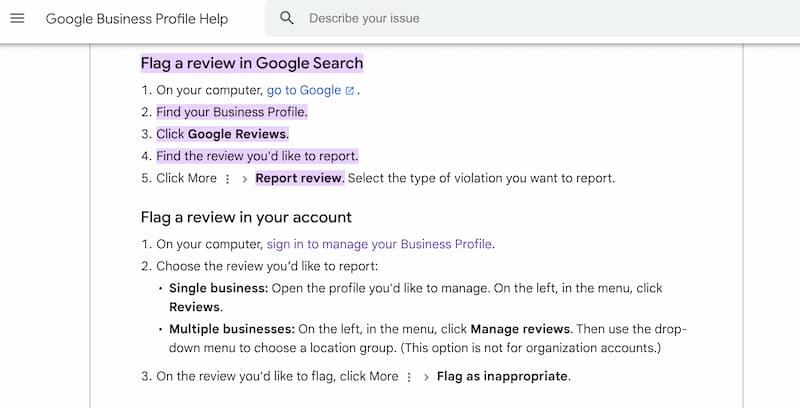
- Identify the fraudulent review: Regularly monitor your Google Business Profile to quickly spot suspicious or clearly fraudulent reviews.
- Report to Google: Once identified, report the review directly through your Google Business Profile account. Click on the review and select the “Flag as inappropriate” option.
- Provide evidence: Support your claim with evidence, such as inconsistencies in the reviewer’s account history, deviations from actual customer experiences, or signs of malicious intent.
- Follow up: Monitor the status of your report. Google may take several days to respond. If the review remains or you face a high volume of fraudulent reviews, contact Google’s support team directly.
- Engage professionally: When a review is negative but not clearly fraudulent, respond professionally and constructively. This demonstrates to potential customers that you take feedback seriously and are committed to improving your service.
Dealing With Defamatory Content Online?
Our reputation specialists can help you document, suppress, and remove harmful false content — and rebuild the positive presence you deserve.
Social Media Defamation: Risks and Responses
Social media dramatically amplifies the reach and impact of defamatory content. As of early 2025, approximately 5.24 billion people worldwide use social media, according to DataReportal. The average internet user engages with nearly 6.83 different platforms each month.
Platforms like TikTok and Facebook often do not remove content unless it violates their guidelines, leaving victims with limited recourse. Take social media impersonation as an example — the bar for removal is high, and the process can feel like shouting into the void.
Social media is ripe for defamation, from false accusations of misconduct by ex-partners to competitors making misleading statements about products or services. The vast reach of these platforms exacerbates the potential damage.
Despite the harm caused, most social media companies are shielded from liability for user-posted content under Section 230(c) of the Communications Decency Act. It is worth noting that Section 230’s scope remains subject to ongoing legal and legislative scrutiny — the Supreme Court declined to narrow its protections in Gonzalez v. Google (2023), while reform efforts continue in Congress.
On social media, defamation can occur through posts, comments, videos, and shares. Its viral nature can spread defamatory content rapidly across platforms, causing significant reputational damage.
Key Characteristics of Social Media Defamation
- Virality: Information spreads quickly and widely, often without context, leading to rapid reputational damage.
- Anonymity: People often feel emboldened to post harmful content anonymously or under pseudonyms, complicating accountability.
- Permanency: Once defamatory content is published online, it can be difficult to remove, persisting in search results and social feeds.
Managing Defamatory Social Media Content
- Monitoring and Identification: Regularly monitor social media channels for mentions of your brand or name to identify potential defamatory content quickly.
- Legal Evaluation: Consult with legal professionals to determine if the content meets the legal defamation criteria. Keep in mind that public figures often face higher thresholds for proving defamation, as they must also demonstrate actual malice or reckless disregard for the truth.
- Content Removal Requests: If the content is defamatory, request its removal from the social media platform. Most platforms have policies and procedures for reporting such content.
- Response Strategy: Develop a communication strategy to respond to defamatory content. This may involve public statements, clarifications, or outreach to affected parties.
- Documentation: Keep detailed records of the defamatory content, your communications, and actions taken. These records can be important in legal proceedings.
- Reputation Repair: Implement a reputation management strategy to mitigate the impact of defamatory content, which may include SEO tactics, positive content creation, and public relations efforts.
Real-World Example: The Case of Lisa-Michelle Kucharz
Lisa-Michelle Kucharz’s experience is a stark reminder of the damage that online defamation can cause. Kucharz was targeted by a stranger who posted false accusations against her on various social media platforms and blogs.
These unfounded claims caused emotional distress and had profound effects on her professional life and financial well-being. Her case underscores how defamatory content can severely impact an individual’s reputation and quality of life, especially when spread across multiple platforms.
Steps to Take When Faced with Online Defamation
When faced with online defamation, a strategic and measured approach is essential. Most importantly, stay calm. Then consider the following options.
Immediate Actions
These steps apply in every instance of defamation, regardless of scale.
- Stay Calm and Assess the Situation: Avoid quick, emotional reactions that may worsen the issue. Carefully evaluate the content and its potential impact on your reputation.
- Collect Evidence: Document the defamatory content using tools or methods that create authenticated copies of posts, articles, or comments. This is essential if the matter reaches a court case.
- Report the Content: Use the reporting features on the platform where the defamation occurred. Most websites and social media platforms have policies against such content and may remove it upon review.
Reputation Management
Reputation management strategies work best when tailored to your specific situation. Every plan will differ based on the type, severity, and source of defamation, as well as your existing online presence. For a broader look at how these strategies fit together, see our complete guide to online reputation management.
- Respond Publicly When Appropriate: A public response may be warranted to clarify inaccuracies and present your side of the story. Keep responses professional and fact-based.
- Engage Online Reputation Management Services: Reputation management professionals can suppress negative content through strategic SEO and content creation, mitigating the impact of defamation.
- Monitor Your Online Presence: Regularly check for defamatory content on social media, review sites, and search engine results. Early detection allows for quicker responses and limits potential damage.
Legal and Professional Steps
Legal action should be reserved as a last resort. Any legal steps you take can backfire and draw more attention to the very content you are trying to suppress. This phenomenon — where attempts to suppress content amplify it — is known as the Streisand Effect, and it is a real risk when pursuing public legal action.
- Seek Legal Advice: Consult with a defamation lawyer to understand your options. This may include drafting a cease and desist letter or pursuing litigation if necessary.
- Send a Cease and Desist Letter: A formal demand from a law firm may prompt removal of the defamatory content and signals the seriousness of your intent to protect your reputation.
- Pursue Legal Action if Necessary: If the defamation persists and causes significant harm, filing a lawsuit may be appropriate. Legal action can seek both removal of the content and compensation for damages.
Best Practices for Responding to Defamation
A strategic and comprehensive approach — combining preventive measures with responsive actions — is essential for addressing online defamation effectively.
Preventive ORM Measures
- Guidelines and Policies: Establish clear guidelines for customers wishing to leave reviews, explicitly discouraging defamatory statements or false claims. This proactive step can deter malicious content at the source.
- Automated Monitoring: Use automated tools or professional services to regularly monitor your online reputation. Early detection of potential defamation allows for a faster, more effective response.
- Content Creation: Regularly produce and publish positive content about your strengths and achievements. This enhances your online presence and helps dilute the impact of negative content.
- Encourage Genuine Reviews: Actively encourage customers to share their real experiences. A strong collection of authentic positive reviews reinforces trust and mitigates the effects of negative comments. Note that the FTC updated its endorsement and testimonial guidelines in 2023, with rules taking effect in 2024, including stricter regulations around review solicitation. Ensure your practices comply with the current FTC Endorsement Guides before launching any review campaigns.
Response Strategy
- Develop a Response Plan: Craft a clear and concise plan for dealing with defamation, ensuring that all communication is professional and effective. The plan should address both immediate and long-term actions.
- Lawsuit Considerations: Filing a lawsuit is a significant move and should be considered carefully. Weigh factors such as the prior strength of your reputation and the availability of time and financial resources. Be mindful of the Streisand Effect, where legal action can inadvertently draw more attention to the defamatory content.
How Can We Help You?
From negative content removal to suppression, correction, and ratings and review management, our experts can solve nearly any online brand issue.
What steps should be taken if someone defames you on social media?
Managing online defamation effectively is crucial in protecting your personal or professional reputation. If you find yourself defamed on social media, take these steps: document the defamation, assess the situation, attempt to resolve it directly, contact the social media platform, respond publicly if necessary, engage legal help, strengthen your online reputation, and consider reputation management services.
Can you explain what defamation entails?
Defamation involves spreading false statements about an individual that can harm their reputation. These statements are not based on truth and are disseminated with the intent to degrade someone’s respect, reputation, or standing, or to induce unfavorable opinions against them.
What constitutes slander on the internet?
Slander refers to defamation that is spoken, whereas written defamation is known as libel. With the surge in social media usage, online defamation — including slander in video and audio formats — has become more prevalent. Regardless of the form it takes, defamation on the internet involves making false statements that damage someone’s reputation.
Frequently Asked Questions









Protect Your Online Reputation
Every day you wait, negative content gets stronger. Talk to our experts about a custom strategy for your situation.
Get Your Free Analysis