
What Is Online Identity Management? Definition and Overview
Your online identity shapes hiring decisions, loan approvals, and first impressions — here's how to take control of the narrative before someone else does.

Online identity management (OIM) is a set of techniques used to create, promote, and protect how a person or brand is portrayed on the internet. It works alongside reputation management and branding efforts to improve the quality and accuracy of your online presence. Taking an active approach to OIM gives you greater control over what people find when they search for you online.
Online identity management is part of many online reputation management campaigns. It is comprised of a collection of techniques used to create, promote, and protect the way a person or company is portrayed on the internet. Online identity management (OIM) often works as part of a branding or reputation management campaign to improve the quality and accuracy of the information that comprises your online identity.
An online identity is a distinct identity established by engaging in online activities. This includes:
- Creating a website
- Blogging
- Engaging on social media
- Posting comments or reviews
Whenever you post to a social media account, create a new about page on a blog or website, comment on a review site or forum, or even play online games, you are shaping how your online identity is managed. This is closely aligned with impression management.
By focusing on your online identity management strategy, you will be more likely to create an online identity that expresses how you’d like to be portrayed online. This includes using different personas for different online activities to mask personal identity exposure. It can also create a distinguished presence of your true persona online, which can grow a following and rise in search engine results.
Get a Free Reputation Assessment
Find out what people see when they search for you online. No obligation — results in 24 hours.
This blog will cover:
- Benefits of online identity management
- Using online identity management to promote your online persona
- Protecting your online identity from search engines
- Threats to your online identity
Benefits of online identity management
When left unmonitored, our online identities can easily take a life of their own. Forces that may seem out of your control – from negative social media posts, malicious Wikipedia editors, bad reviews, negative press, or even hackers – can work to tear your online identity to shreds.
But if you take an active stance to manage your online identity, you can gain more control over the information people find online about you or your brand and improve your overall reputation in the process.
Depending on your goals, online identity management can be used to promote or protect your true identity. Here’s an overview of how this can be achieved.
Using online identity management to promote your online persona
Carefully curating your online reputation is a lot of work, but it’s worth putting in the time and effort to improve the way you or your brand is portrayed online. Since your online identity can be a deciding factor in securing a job interview, mortgage or loan applications, and even whether or not you’ll get that first date, it should be carefully managed.
How to manage your online identity
You can start to take charge of your online identity by dedicating just a couple of hours a week. Of course, if you’re facing an onslaught of negative reviews or some other crisis, you’ll have to dedicate more time. It’s always better to start working on improving your online identity while it is still in good standing.
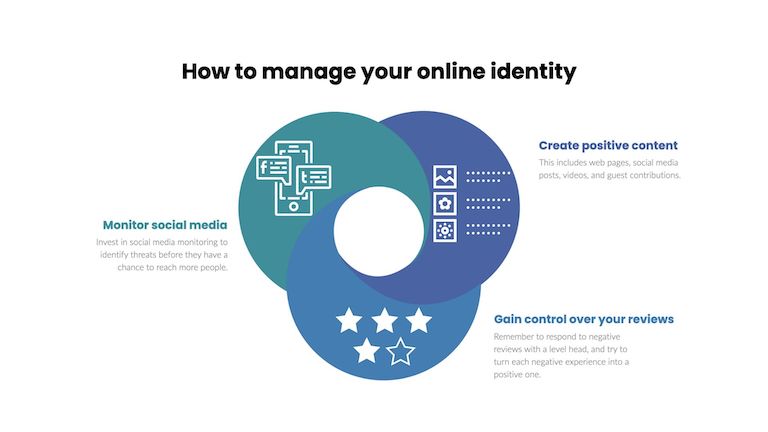
Here are some tips to manage your online identity:
- Create positive content: Since many aspects of online identity management fall outside of your control, it is a good idea to focus on what you can control. This means creating lots of positive content, whether that is blog posts, web pages, social media posts, guest contributions on other established websites in your niche, or creating videos. If you create and promote quality content about yourself, you can cause it to rise in search results and effectively push down any negative content lurking in Google’s databases.
- Gain control over your reviews: Even if you’re experiencing negative reviews, there are still steps you can take to redeem your star rating. Start by honestly assessing your service and products. Are there any gaps or room for improvement?
If so, start by improving your overall customer experience. Then, take to the review sites to remedy individual situations, such as by removing negative reviews that violate the platform’s terms of service.
Remember to respond to negative reviews with a level head and try to turn each negative experience into a positive one. Most reviewers are willing to modify their review if they feel their problem has been solved. Read some of our tips for dealing with negative reviews here. - Monitor social media: Social media moves rapidly that just one negative tweet can quickly gain traction and reach thousands of people. This is why it’s important to invest in social media monitoring to identify threats to your online identity before they have a chance to reach more people.
- Manage Wikipedia: Managing a Wikipedia page is no small feat. If your business has one, keep a watchful eye on what people are adding to it. If Wikipedia edits are needed, consider hiring a professional Wikipedia editor before taking a DIY approach. Here is a blog article in which we dive into all of the reasons why this is a good option for most. Don’t have a page? Check out these free Wikipedia alternatives.
How to prove your online identity is really yours
On the internet, it’s hard to be sure that a site or social media account really belongs to who it claims to be. Look-alike domains, fake profiles, and impersonator accounts confuse customers at best and defraud them at worst. Even without malice, a competitor can benefit when people can’t tell which channels are yours. A few steps make your real presence easy to find and confirm:
- Publish one official source of truth: Create a page on your own website that lists and links every official account. It gives customers a trusted place to check whether a profile is genuine, and it helps those profiles rank for your name. Link your major channels from your site footer too, and cross-link your accounts in each profile’s bio so they vouch for one another. This also strengthens your social media reputation.
- Verify your accounts on each platform: Most major platforms offer some form of verification, usually involving an ID check, business documents, or a paid subscription. Programs and requirements change often, so check the official pages before you apply: Facebook (Meta Verified) and Facebook business verification, Instagram, TikTok and TikTok business verification, and LinkedIn. On Pinterest, you can claim your website or apply to become a verified merchant. Businesses should also verify their Google Business Profile, which gives you ownership of the listing that appears in Google Search and Maps.
- Register key domains: Secure the domains closely tied to your name or brand before a cybersquatter does.
- Report fakes, and keep reporting: Report impersonator accounts, sites, and apps to the platform, registrar, or web host. Takedowns are not guaranteed: hosts in other countries may not cooperate, and new fakes tend to appear as old ones come down. Treat takedowns as a complement to verification, not a replacement for it.
- Remove exposed personal information: If your personal contact details have been copied onto other sites, Google offers a way to request their removal from its search results.
Protecting your online identity from search engines
All of the above tips are excellent starting points for online identity management. But what if your goal is to conceal your true identity online? There are plenty of reasons why a person would want to mask their personal identity, including when they are expressing unpopular opinions on heated topics or to appeal to various groups with competing interests.
One of the most effective ways to mask your online identity is to create different personas for various online interactions. Everyone has a right to their opinion, but if yours may be a threat to your reputation, you can create an alternate persona (or a pseudonym) for it. Pseudonyms enable us to share controversial opinions without worrying about the risk they may pose to our reputation.
Threats to your online identity
Even if you are actively managing your online identity, threats can crop up and deface your reputation. Taking an active stance in managing your online identity and being aware of its most common threats can help mitigate these risks if they arise. Here are a few of the most common threats to your online reputation:
- Honey traps: A honey trap is an investigative practice in which a person will seduce their target in order to place them in a compromised position, often with photographic or video evidence that they will then post online.
- False content: False or misleading blog posts, social media posts, and reviews can all damage your online identity.
- Social media and email manipulation: Hackers can steal your passwords and other personal information to start posting offensive or unflattering comments, pictures, or videos.
- Impersonation and look-alike accounts: Scammers and opportunists can register domains and social media profiles that mimic yours, then use them to mislead or defraud people who trust your name. Verifying your official accounts and listing them on your own site makes the fakes easier to spot.
- Unauthorized leaks: If the wrong information about you gets into the wrong hands, it can fuel fires with news publications, competitors, and anyone else who may benefit from harming your online identity.
- Sustained negative content campaigns: Any combination of these threats can impact your online identity. Antagonists can use surrogates, cloaking techniques, and fake names and identities to overwhelm sites like Yelp, RipOffReport, social media, and standalone websites to influence search results.
Whether you are a target for online identity manipulation or not, online identity management techniques can help you to put your best self forward online. In an age when a simple Google search is becoming the deciding factor in reaching your goals and objectives, your online identity must be portrayed in the manner that you’d like.
Frequently Asked Questions








Protect Your Online Reputation
Every day you wait, negative content gets stronger. Talk to our experts about a custom strategy for your situation.
Get Your Free Analysis